
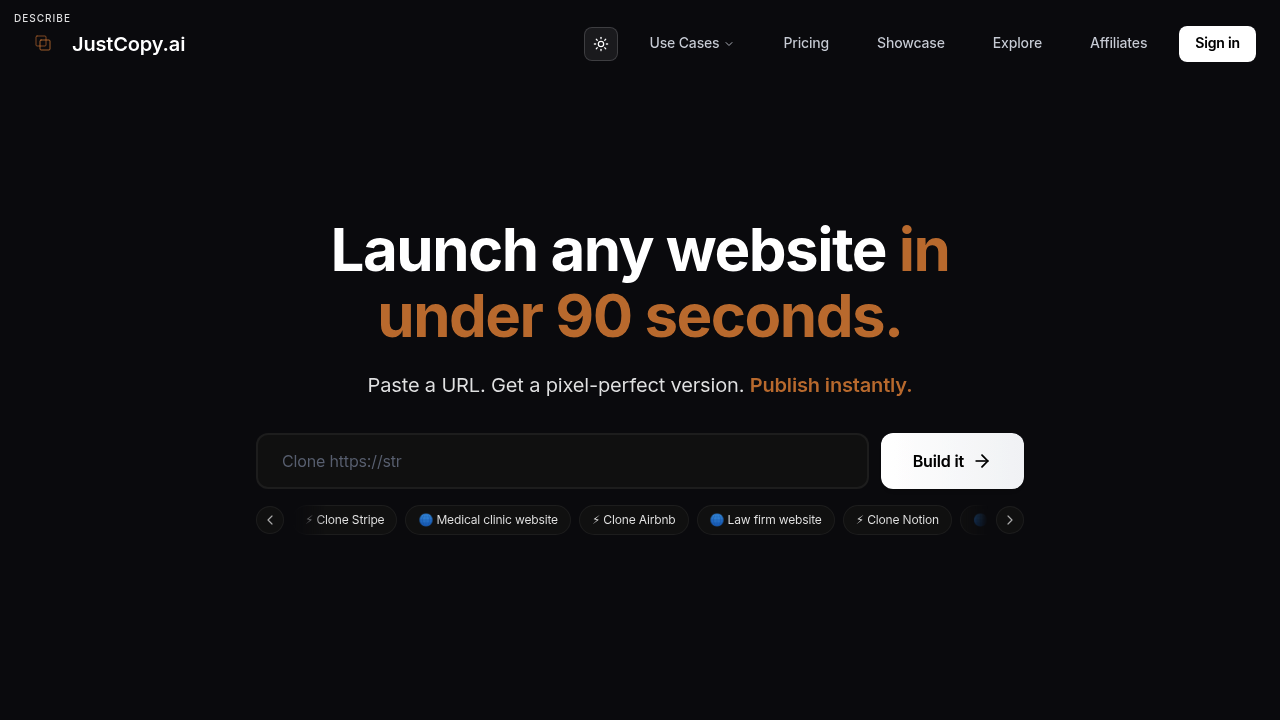
Paste any website URL and get a working clone deployed in 90 seconds. That's the premise behind JustCopy.ai, a web application that replicates websites pixel-perfectly without requiring coding knowledge or technical setup. The cloning process captures design, layout, and structure, then lets users customize the result through AI assistance before publishing to a live URL. The service handles infrastructure automatically, creating databases with appropriate schemas, setting up cloud storage for file uploads, and configuring analytics tracking without manual intervention.
The AI customization component walks users through necessary configurations step-by-step. When a cloned site needs payment processing, the system guides users through adding Stripe API keys. When storage is required, it sets up cloud file handling. This guided approach means someone without developer experience can launch functional applications that include backend services typically requiring technical expertise. Users can modify cloned sites through natural language instructions to the AI, changing colors, layouts, content, or functionality without touching code.
Beyond cloning existing sites, JustCopy.ai provides over 1,000 ready-made templates covering common use cases. These templates serve as starting points that can be customized through the same AI-powered workflow. The service positions itself as an alternative to manually coding clones of popular platforms like Stripe, Airbnb, Notion, Linear, Cal.com, Vercel, Figma, and Shopify. A community showcase lets users clone projects other users have built, creating a library of starting points beyond the official templates.
Published sites can connect to custom domains, removing the generic subdomain approach common with website builders. The export to GitHub feature means users aren't locked into the service. They can take their project code and host it elsewhere or continue development in their own environment. This addresses a common concern with no-code tools that trap users in proprietary systems.
The auto blogging feature generates and publishes blog content automatically on schedules ranging from every five minutes on the Enterprise plan to weekly on the Professional tier. This automated content creation runs in the background, potentially helping with SEO and keeping sites fresh without manual effort.
The pricing structure spans seven tiers from free to $999 monthly. The free forever plan includes 50,000 tokens monthly with an additional 50,000 bonus tokens at signup and 50,000 more per successful referral. Approximately 1,000 tokens equals 750 words of generated content or code, meaning the free tier provides roughly 37,500 words worth of AI generation monthly. Free users get unlimited projects and access to all templates but published sites display a watermark. GitHub export is available even on the free tier.
Paid plans remove watermarks and increase token allocations dramatically. The $19.99 Starter plan provides 500,000 tokens monthly with two published sites and custom domain support. The $49.99 Professional tier jumps to 1.2 million tokens, five published sites, and weekly auto blogging. Business at $99.99 offers 2.5 million tokens, 10 published sites, and hourly auto blogging. Higher tiers scale up to the $999 Enterprise plan with 40 million tokens, 100 published sites, and five-minute auto blogging intervals.
The token-based system means usage capacity depends on how much AI generation a project requires. Heavy customization burns through tokens faster than light modifications. The published site limits on paid plans create a ceiling for users managing multiple projects. Someone running 15 sites would need at least the $499 Scale plan. The free plan's watermark makes it unsuitable for professional or client work where branding matters. These constraints push serious users toward paid tiers quickly despite the generous free offering.