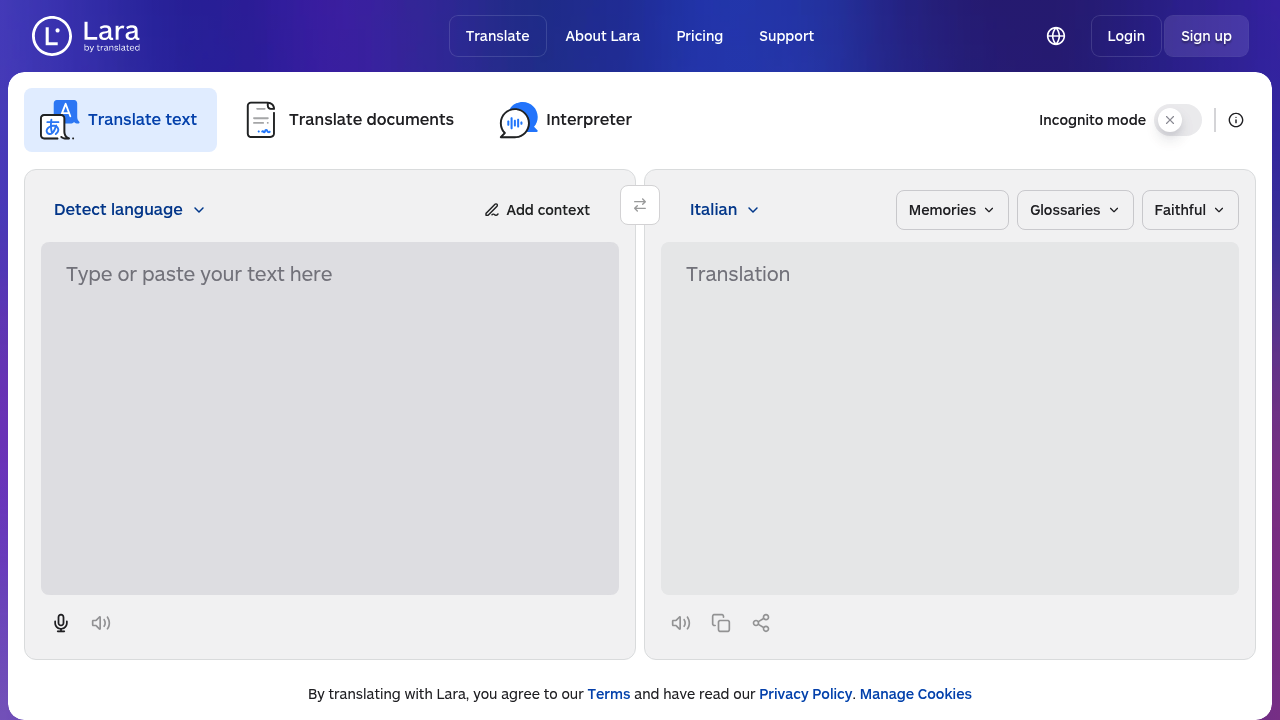
The freemium model lets you test things out before paying. That's helpful when you're unsure if Lara Translate handles your specific translation needs better than what you already use.
Lara Translate covers 200+ languages. Text translation works. Document translation works. Image translation works. There's an interpreter feature for real-time conversations. The service combines AI processing with optional human review—this addresses the usual problem where machine translation produces technically accurate but contextually awkward results. Translated backs it, drawing on infrastructure that's served over 350,000 customers.
A product manager coordinating with overseas development teams could use the Chrome extension to translate emails and documentation without switching apps. The adaptive translation API means you can build translation directly into your own software if you're developing multilingual features.
The AI-plus-human approach works well. Pure machine translation often misses nuance. Pure human translation takes forever and costs significantly more. Lara Translate sits in the middle. You choose speed or accuracy depending on what you're translating. Technical documentation might need human oversight—casual communication probably doesn't.
Image translation handles screenshots and photos with text embedded in them. That's useful for translating product interfaces or street signs in travel photos. The interpreter feature suggests real-time voice translation (though interface and accuracy matter more than the feature existing on paper).
You'll find the 200+ language count impressive until you need one of the less common ones. Quality varies wildly.