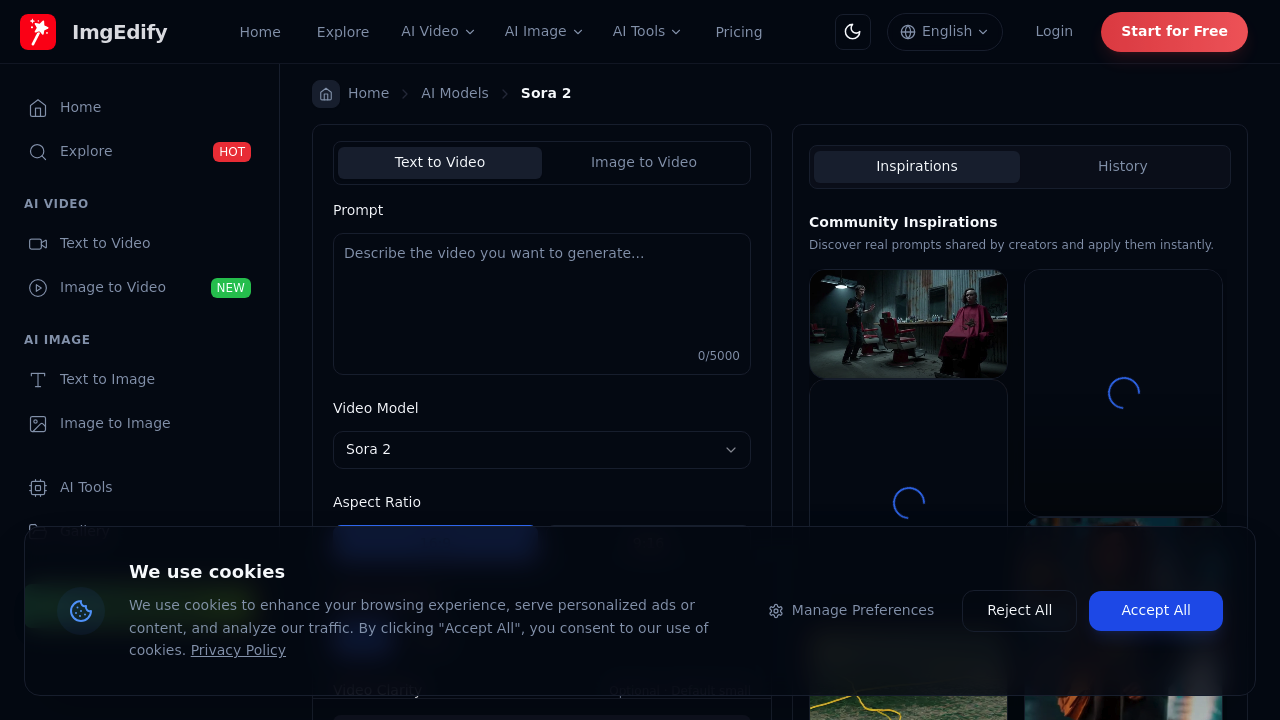
A marketing manager needs 15-second product demos for Instagram Stories but switching between three different AI video platforms burns through her morning. She writes the same prompt in Sora's interface, then VEO's dashboard, then another tool's workspace, comparing outputs manually. ImgEdify AI consolidates OpenAI Sora 2, Google VEO 3.1, and ImgEdify 2.0 into one interface where she types one prompt and generates videos across all three models side-by-side. Each video costs 20 credits from her shared pool, and she picks whichever output nails the brand aesthetic.
This tool handles text-to-video and image-to-video generation with controls most video generators skip. You set aspect ratio to 16:9 for YouTube or 9:16 for TikTok, pick duration between 10 or 15 seconds, and adjust clarity to Small or Large depending on file size needs. Prompts accept up to 5000 characters, so a brand filmmaker can specify camera movements, lighting conditions, and scene transitions in detail. Videos export as MP4 or WebM files at up to 4K resolution with cinematic lighting and motion blur baked in. The studio-grade audio, auto captions, and burned-in subtitles mean less post-production work.
A startup founder creating pitch deck videos browses the community inspirations gallery for prompt ideas, then customizes them for her product. The custom style creation feature lets her maintain visual consistency across multiple video generations. ProRes-ready assets export cleanly if she needs to hand files to an editor later.
The credit system constrains experimentation. Each video generation burns 20 credits regardless of which AI model you choose. The free plan provides 60 credits total, which translates to just 3 Sora-2 videos before you're done. That's one attempt per model if you're testing all three, with zero room for iteration. The Basic plan at $7.92 monthly supplies 700 credits for 35 Sora-2 videos. Heavy users hit limits fast. A content creator producing daily social media videos needs the Pro plan's 4000 credits for 200 videos monthly at $29.92.
Video duration caps at 15 seconds maximum. An educator building course content can't generate 30-second explainer segments or minute-long demonstrations. She'll stitch multiple 15-second clips together manually, burning more credits and losing narrative flow. The 5000 character prompt limit seems generous until you're describing complex multi-scene sequences with specific character actions and environmental details.
Free tier videos carry watermarks. That kills them for client work or professional brand content. The Lite plan at $11.92 monthly removes watermarks and provides 1500 credits for 75 Sora-2 videos, but agencies producing content at scale still outgrow this fast.
This service shines for marketers and agencies testing which AI model best fits their brand voice before committing to one ecosystem. It's built for content creators who need quick social media assets with minimal editing. Educators creating short instructional clips benefit from the auto captions and subtitle features.
It doesn't work for filmmakers needing longer-form content beyond 15 seconds. Video producers who iterate heavily on each concept will burn through credits inefficiently. Teams requiring collaboration features won't find workspace sharing or comment threads. Anyone needing API access to automate video generation at scale should look elsewhere.
The unified multi-model access solves real workflow friction. Just watch those credit limits closely.