
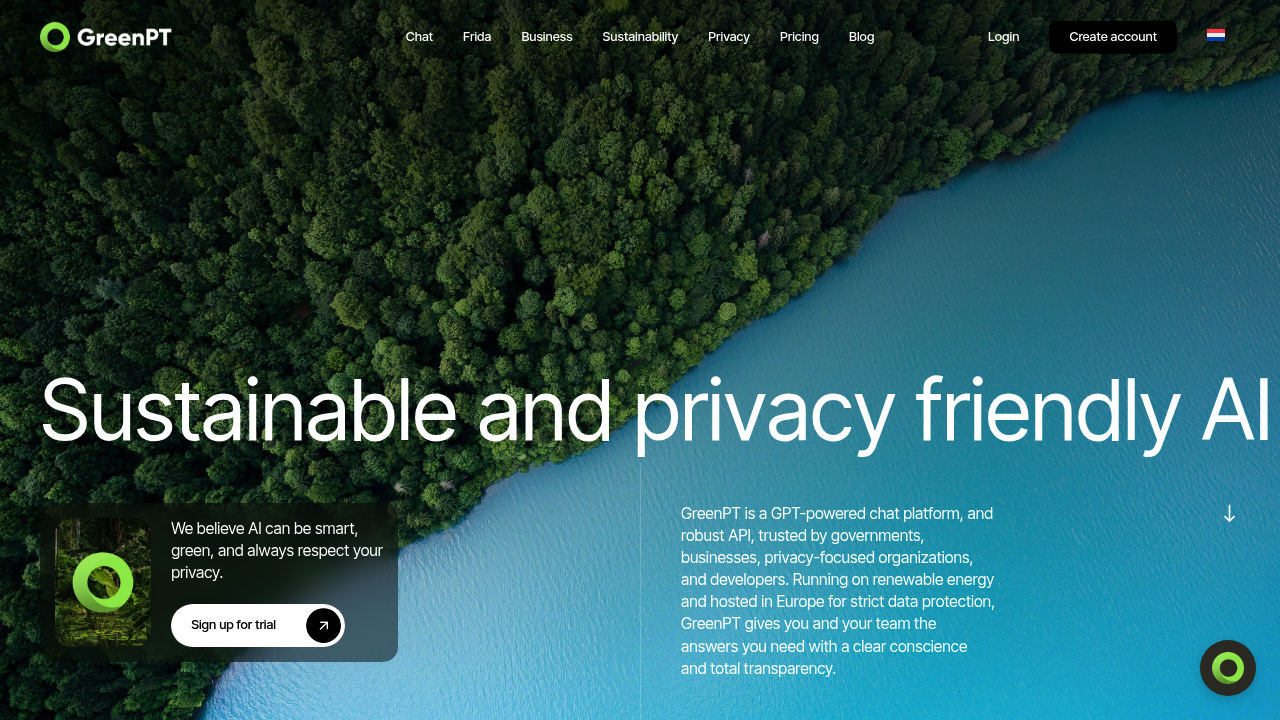
This GPT-powered service routes requests through European data centers running entirely on renewable energy sources. The infrastructure uses compression techniques and quantized model versions to cut computing power requirements by 20 to 30 percent compared to standard implementations. Real-time monitoring displays CO₂ emissions and energy consumption for each query, making the environmental cost visible at the API level.
The technical stack handles multiple input types through a unified API endpoint. Text prompts flow through reasoning engines for analysis and generation tasks. Image files get processed through vision models that extract content and context. Audio streams convert to text through speech recognition pipelines. Document uploads trigger parsing systems that extract insights and structured data. Code generation works across multiple programming languages with syntax checking built into the output validation.
GreenPT Search operates as a separate engine that crawls and indexes web content, images, news feeds, videos, scientific papers, and location data. It doesn't track user behavior or inject advertisements into results. The search infrastructure shares the same renewable energy commitment as the chat system.
The Frida chatbot system lets cultural institutions and mission-driven organizations deploy conversational interfaces without building from scratch. Organizations can reduce support workload by up to 90 percent according to internal metrics. The chatbot framework includes document analysis capabilities and connects to the same reasoning models powering the main chat interface.
Embedding and reranking functions run through the API for retrieval-augmented generation workflows. Developers can generate vector representations of text and reorder search results based on semantic similarity. These features integrate with custom knowledge bases and internal documentation systems.
The service claims 40 percent lower CO₂ emissions than hyperscaler infrastructure through its renewable energy sourcing and optimization techniques. Energy usage drops by more than 20 percent compared to unoptimized deployments. The system can handle 90 percent of typical AI tasks, though that leaves a performance gap for specialized use cases requiring maximum computational resources.
European hosting means data stays within GDPR jurisdiction throughout processing. The infrastructure doesn't route through US-based servers at any point in the pipeline.
A 14-day trial provides access to the full feature set before requiring payment commitment. Mobile apps exist for iOS and Android. Workspace features including AI agents and creative writing tools aren't available yet but are marked as coming soon. The service doesn't offer browser extensions for direct integration into web workflows.