GitHub Copilot CLI logo

GitHub Copilot CLI

It reads, writes and runs code, works directly with your issues and pull requests, and carries a task from planning to merged code.

GitHub Copilot CLI is a GitHub-native coding agent that runs in your terminal. It reads, writes and runs code, works directly with your issues and pull requests, and carries a task from planning to merged code. Slash…

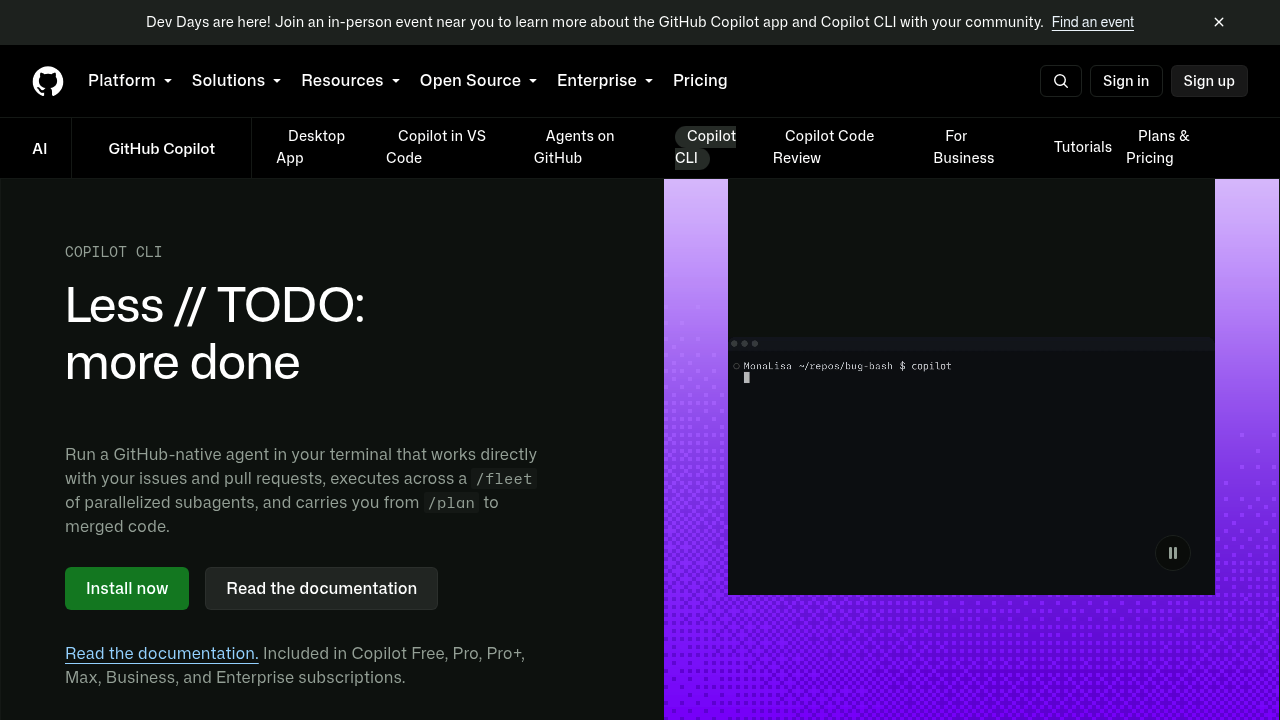
GitHub Copilot CLI screenshot

GitHub Copilot CLI is a GitHub-native coding agent that runs in your terminal. It reads, writes and runs code, works directly with your issues and pull requests, and carries a task from planning to merged code. Slash commands switch models, resume earlier sessions and run a fleet of parallel subagents. Plan mode outlines the work before changes, and autopilot mode continues without step-by-step approval. Access comes bundled with a GitHub AI coding subscription, from the free tier through Business and Enterprise, and each interaction draws on the plan's AI Credits allowance.

Developers who live in the shell will find it most natural, particularly engineers who use editors without official extensions, since the CLI operates independently and edits files any editor can display. Open source maintainers and team members can manage backlogs through native GitHub integration, while organizations get governance because it inherits existing policies. Enterprise admins must switch it on for their teams. Setup takes one npm command or an install script, and it runs on macOS, Linux and Windows.

A typical flow starts with a plan for a new feature, compares approaches across models, then executes with parallel subagents and opens the work in VS Code for refinement before shipping a pull request. Through GitHub's MCP support, the agent can search issues, analyze labels and activity, and summarize scope so you can move from backlog to implementation without hunting for context. Teams define AGENTS.md instructions and Agent Skills so behavior stays consistent across models and sessions, and connect community MCP servers from the GitHub MCP Registry for extra tools.


GitHub Copilot CLI alternatives

See all →

Frequently asked

6 questions
What can GitHub Copilot CLI do in my terminal?
It plans tasks, edits files, runs commands and works with issues and pull requests. Parallel subagents and autopilot mode let it carry larger jobs forward.
Who should use GitHub Copilot CLI?
Developers who prefer a terminal workflow or use editors that lack official extensions. It also suits teams already organized around GitHub issues and pull requests.
How does it go from an issue to a pull request?
GitHub MCP support lets it search issues and summarize scope, then you run a plan and execute across subagents. The finished work can be refined in an IDE and shipped as a pull request on GitHub.
Is it included in my GitHub subscription?
Access is part of every GitHub AI coding plan, from Free to Enterprise, with no separate fee. Interactions use the plan's AI Credits allowance.
Are there restrictions for organizations?
Business and Enterprise users can use it under their existing subscription, but an organization admin has to enable it. It inherits the organization's policies and governance settings.
How do I install it?
Install it with npm or the one-line install script, then sign in with your GitHub credentials. Homebrew and WinGet options are also documented, and it works on macOS, Linux and Windows.

Reviews (0)

Write review

No reviews yet. Be the first to share your experience.