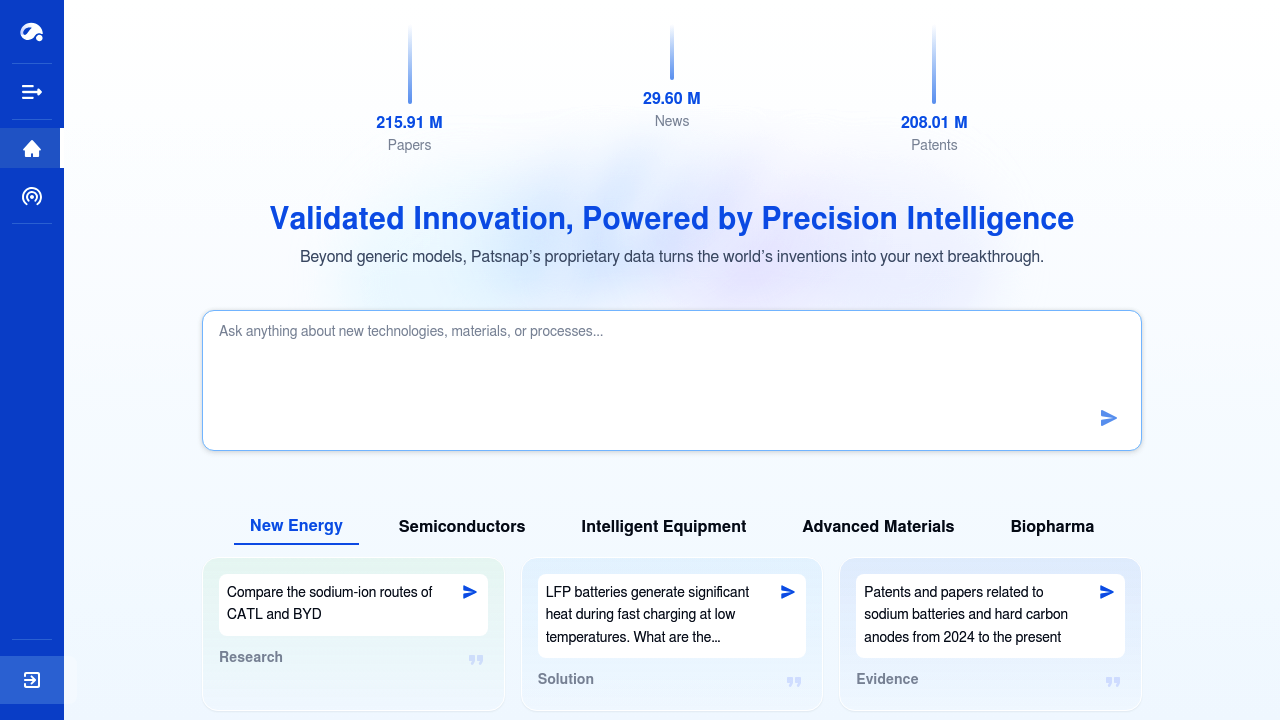
Opening Patsnap Eureka drops you into a workspace built around domain-specific AI agents rather than a general-purpose chat interface. This system organizes itself around three main domains: IP, Life Sciences, and Materials. Each domain gets its own specialized agent trained on the terminology and workflows specific to that field.
The Generate Ideas feature lets R&D teams feed in research parameters and get back concept suggestions tailored to their domain. You're not getting generic brainstorming. The output connects to actual technical knowledge in patents, scientific literature, and materials databases. The Protect Solutions capability sits on the IP side, helping teams analyze patent portfolios and identify protection opportunities for their innovations.
The workflow automation happens through these agents handling repetitive research tasks. Instead of manually searching through patent databases or literature reviews, the agents pull relevant information and synthesize it into usable insights. You can ask domain-specific questions and get answers grounded in technical data rather than surface-level summaries.
Where things get murky is the initial adjustment period for each domain agent. They're specialized, which means power users in IP will find different functionality than those in Life Sciences. The interface doesn't hold your hand much. You need to know what you're looking for.
This system clearly targets R&D professionals already working in these domains. If you're outside IP, Life Sciences, or Materials, there's not much here. The agents don't generalize well beyond their training domains. This makes Eureka narrow but deep rather than broad and shallow. Teams embedded in innovation workflows will recognize the use cases immediately. Everyone else might wonder what problem this solves.