
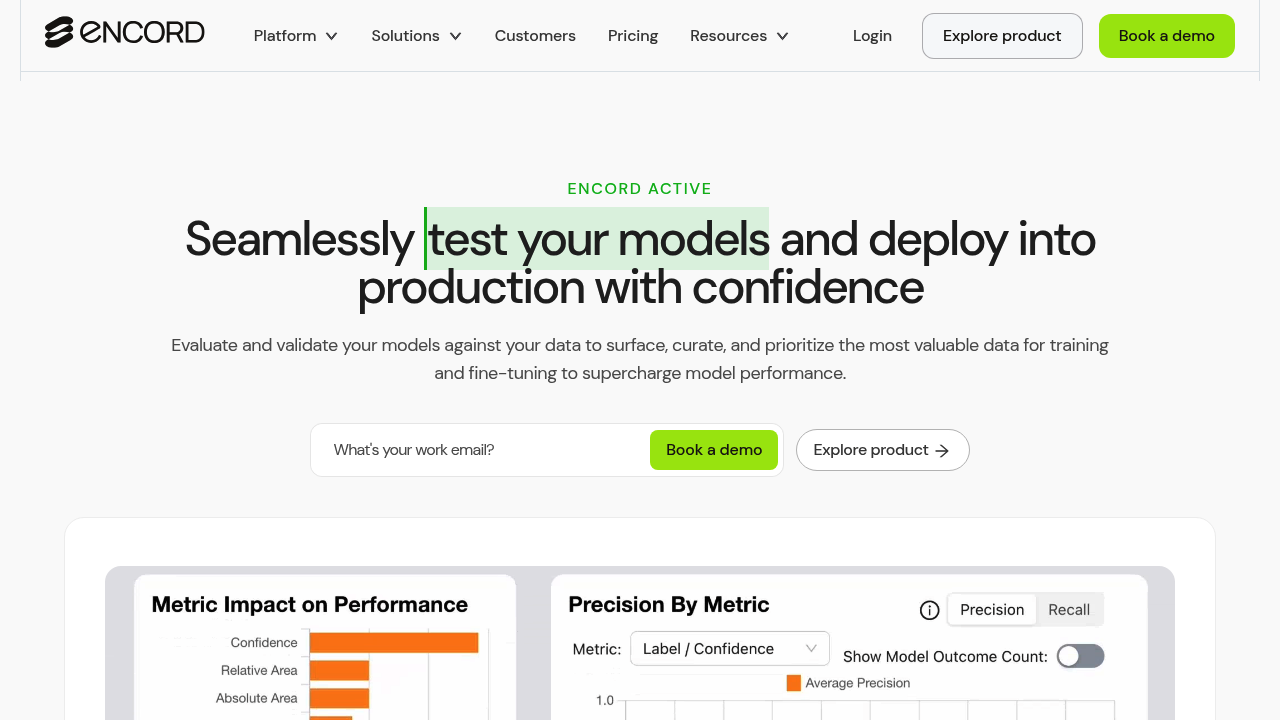
Model evaluation meets active learning in Encord, a system built to guide AI applications from initial data work through production deployment. The system handles data curation, labeling validation, and model testing in one environment, with particular strength in computer vision tasks. Teams can run reliability checks, compare model performance across iterations, and surface failure modes through explainability reports. Vector embeddings and AI-assisted quality metrics help catch label errors automatically, while humans-in-the-loop workflows keep annotation quality high. The system tracks data drift and identifies weak spots through advanced analytics, letting practitioners balance datasets and filter for edge cases before models ship.
ML engineers and data scientists building production computer vision systems make up the core user base, particularly those managing annotation pipelines at scale. Teams dealing with thousands of labeled images or video frames benefit from the label validation and quality control features. Organizations that have moved past experimentation and need systematic model monitoring find the evaluation tools useful. Practitioners who've seen models fail on edge cases or struggle with data quality issues are the typical adopters. Encord serves teams large enough to need structured workflows but still hands-on with model development and deployment decisions.
Autonomous vehicle teams use Encord to validate object detection models, catching mislabeled pedestrians or traffic signs before deployment. Robotics companies run failure mode analysis on manipulation tasks, identifying scenarios where gripper detection breaks down. Retail analytics teams building shelf monitoring systems apply the active learning features to improve performance on underrepresented product categories—one case study showed a 67% increase in edge-case class performance. Manufacturing quality control applications use the Ground Truth comparison to verify defect detection accuracy against human inspection. Medical imaging teams employ the explainability reports to understand where diagnostic models make incorrect predictions, then curate training data to address those gaps systematically.