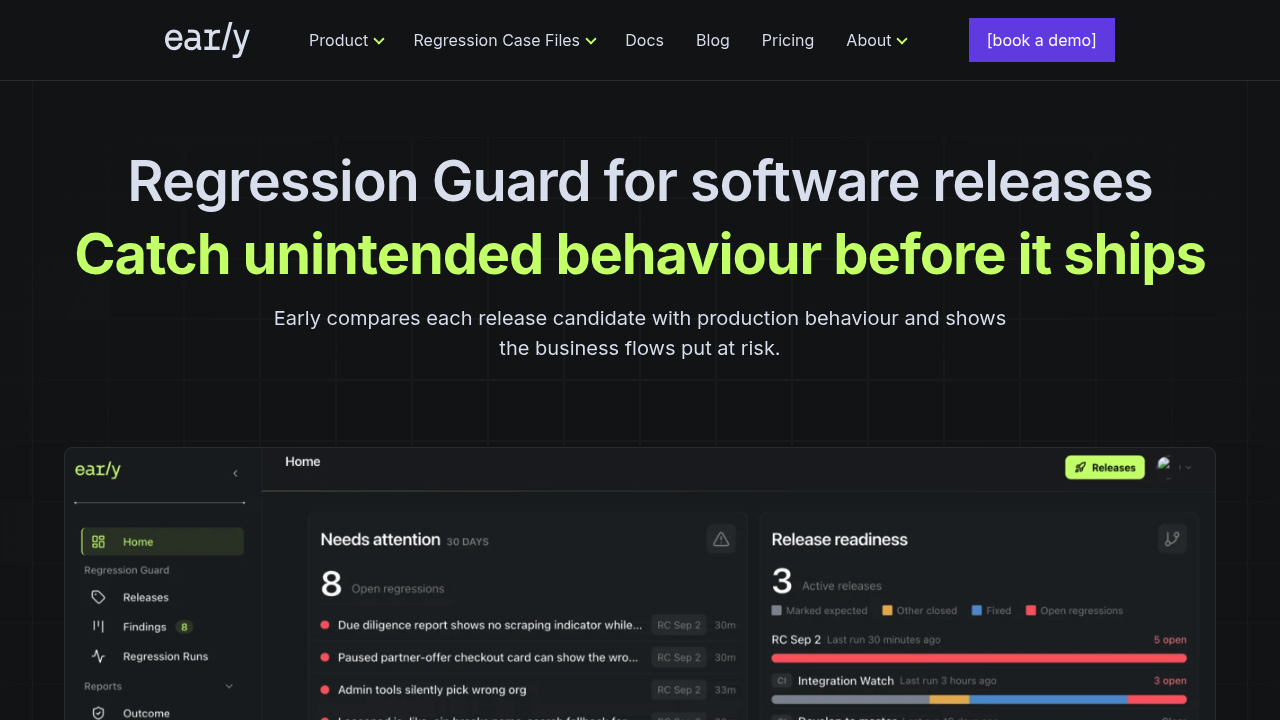
Early is a regression guard for software releases. It baselines the behavior that already works in production, analyzes each release candidate against it, and surfaces what changed, what broke and why. Results are classified as Expected or Regression and stay linked to the pull request, commit, author and run, giving reviewers reproducible evidence before a release goes out. Instead of looking only at changed files, it traces impact across configured component relationships and shows which customer and operational flows a change reaches.
The product suits engineering managers, release owners, QA leads and platform teams who need a release decision backed by data rather than a clean pull request alone. Teams shipping with AI coding agents are a particular focus, since generated code can pass review and still alter behavior elsewhere in the system. Smaller teams can use it to track readiness without building their own comparison setup, and larger organizations can use it to see regressions across components.
The company publishes Regression Case Files built from historical replays of open-source releases. Examples include a Mastra output processor regression across 3 releases that took 247 hours to fix, a Pydantic AI streaming regression spanning 14 releases and 28 days, an Rspack CommonJS export regression fixed in about 18 hours, a Conan no-op replacement regression, and a Hono form parsing regression that lasted 12 days. In day-to-day use, teams run Early on a candidate build, review which flows are flagged, trace an incident back to the change responsible, and track fixes until the release is ready. Demos are booked directly with the team.