Deepgram Voice Agent API logo

Deepgram Voice Agent API

The Deepgram Voice Agent API is one real-time API that combines speech recognition, language model orchestration and speech synthesis, so developers do not have to stitch separate services together.

Built-in barge-in detection, turn-taking prediction, function calling and mid-session control keep conversations moving without awkward pauses. Teams can bring their own LLM or text-to-speech provider while keeping…

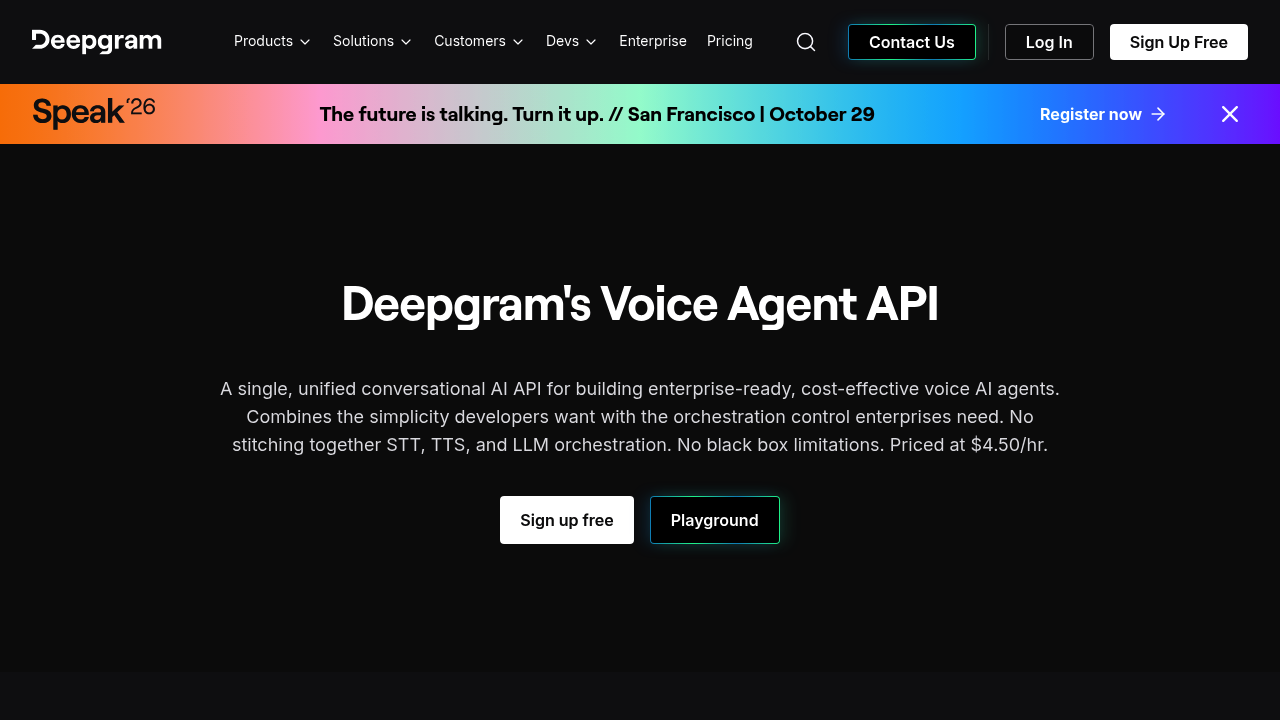
Deepgram Voice Agent API screenshot

The Deepgram Voice Agent API is one real-time API that combines speech recognition, language model orchestration and speech synthesis, so developers do not have to stitch separate services together. Built-in barge-in detection, turn-taking prediction, function calling and mid-session control keep conversations moving without awkward pauses. Teams can bring their own LLM or text-to-speech provider while keeping Deepgram's orchestration and streaming pipeline. The Voice Agent API is priced at a flat $4.50 per hour on the full Deepgram stack, with built-in rate reductions when bringing your own models.

It is aimed at software developers, AI engineers and enterprise platform teams that need production voice agents, especially in industries with strict compliance requirements. Deployment choices include fully managed, dedicated single-tenant, inside a customer VPC or self-hosted, with support for HIPAA, GDPR and regional data residency. Startups can begin on pay-as-you-go with a $200 credit, while large organizations can move to prepaid Growth credits from $4,000 a year or an Enterprise agreement.

Practical uses include phone-based customer support agents that handle interruptions and take actions, ordering and scheduling assistants, healthcare intake lines, and in-app conversational assistants. Because Deepgram runs speech-to-text, text-to-speech and orchestration itself, latency can be tuned across the whole path, which matters for natural turn-taking. Usage-based pricing means a prototype costs little, and the same pipeline carries over when a project moves toward production. A playground and demo let developers hear an agent before writing code, and teams can swap in their own models when they want to control cost or behavior at scale.


Deepgram Voice Agent API alternatives

See all →

Frequently asked

6 questions
What does the Deepgram Voice Agent API do?
It combines speech-to-text, LLM orchestration and text-to-speech in one real-time API. Developers use it to build voice agents without connecting separate vendors.
Who is the Deepgram Voice Agent API for?
Developers, AI engineers and enterprises building production voice agents. Regulated industries are served by HIPAA and GDPR support, regional data residency and isolated runtimes.
What kind of agent can I build with it?
Typical builds include phone support agents, scheduling or ordering assistants and healthcare intake lines. Agents handle interruptions, call functions and take actions mid-conversation.
How is the Deepgram Voice Agent API priced?
Voice Agent API usage is a flat $4.50 per hour on the full Deepgram stack, with reductions when you bring your own models. New accounts receive $200 in credit, and prepaid Growth plans start at $4,000 per year.
Are there limits on concurrency?
Pay-as-you-go accounts have caps on concurrent Voice Agent API connections, up to 45 on that tier compared with 60 on Growth. Enterprise plans cover larger volume and deployment needs.
Can I use my own LLM or voice provider with Deepgram?
Your own LLM or TTS provider can be connected while Deepgram handles the orchestration and streaming pipeline. A playground and free signup help you test before building.

Reviews (0)

Write review

No reviews yet. Be the first to share your experience.