DDSP-SVC logo

DDSP-SVC

DDSP-SVC is an open-source singing voice conversion project that runs on personal computers.

It is built on Differentiable Digital Signal Processing and supports both real-time voice changing and offline conversion of audio files. Training and synthesis need far less hardware than SO-VITS-SVC, and training time…

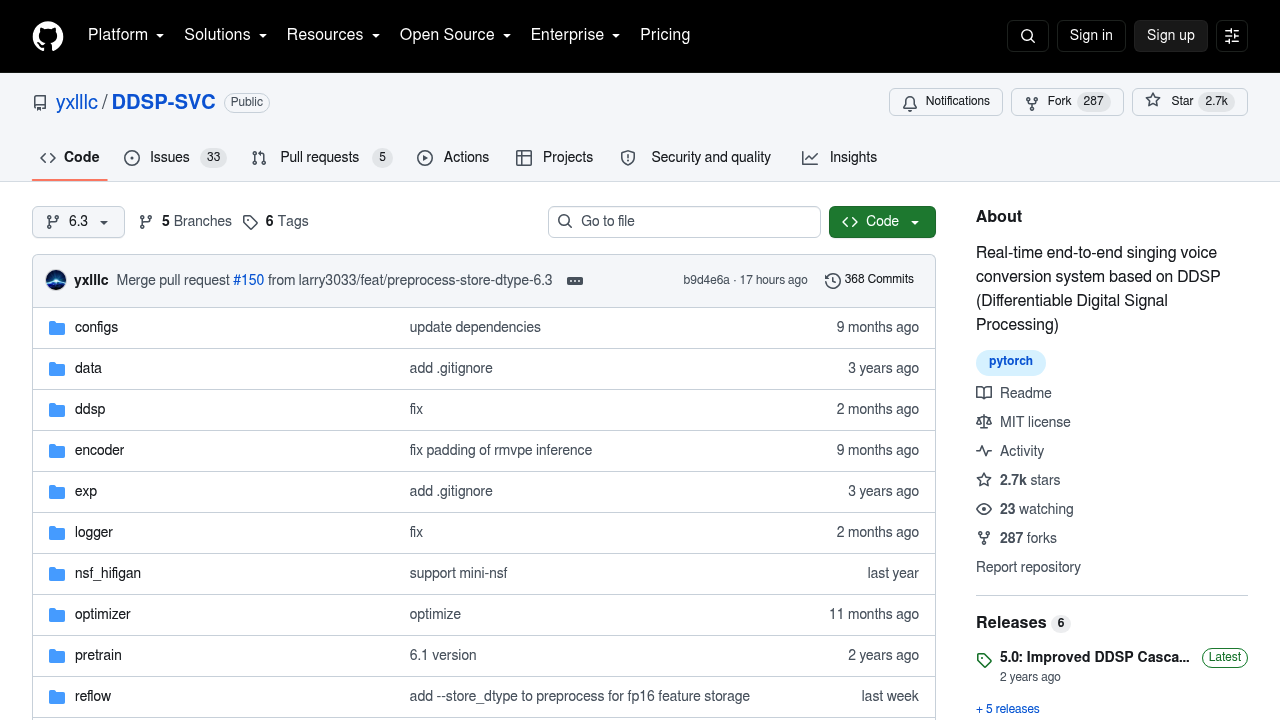
DDSP-SVC screenshot

DDSP-SVC is an open-source singing voice conversion project that runs on personal computers. It is built on Differentiable Digital Signal Processing and supports both real-time voice changing and offline conversion of audio files. Training and synthesis need far less hardware than SO-VITS-SVC, and training time is close to RVC. Raw DDSP output is modest, so the current version applies a rectified-flow model to lift quality, which on some datasets matches SO-VITS-SVC and RVC. The code is free to download from GitHub.

This project fits hobbyist developers, machine learning tinkerers and independent music producers who are comfortable with Python, a command line and a local GPU. The default configuration is tuned for a 44.1kHz model trained on an RTX-4060, so a mid-range gaming card is enough. Researchers comparing singing voice conversion approaches can use it as a lightweight baseline, and developers building their own voice apps can export models to ONNX. It is not a point-and-click app, and the author asks that models be trained only with legally authorized audio.

A typical workflow starts by installing the dependencies, placing a ContentVec or HubertSoft encoder, an NSF-HiFiGAN vocoder and an RMVPE pitch extractor in the pretrain folder, then preprocessing training and validation clips. After training, you can monitor progress through visualization, convert recorded vocals with the non-real-time script, or run the real-time GUI to change a voice live. Musicians might convert a demo vocal into another singer's timbre, streamers can experiment with live voice changing, and developers can batch-convert files or export the trained model for deployment elsewhere.


DDSP-SVC alternatives

See all →

Frequently asked

6 questions
How does DDSP-SVC convert a singing voice?
It uses a differentiable digital signal processing synthesizer driven by a content encoder and pitch extractor. A rectified-flow model in the current version improves the raw sound quality.
Who should use DDSP-SVC?
Hobbyists, developers and researchers who can work with Python and train models locally are the target. Because it is a repository rather than an app, some technical comfort is expected.
Can DDSP-SVC change a voice in real time?
Real-time voice conversion is supported, and the repository includes a GUI script for it. Its resource use during live conversion is lower than SO-VITS-SVC but probably slightly higher than the latest RVC.
Is DDSP-SVC free to use?
The project is open source and free to download from GitHub. Costs come only from your own hardware, such as a GPU suited to training.
What hardware and setup does DDSP-SVC need?
PyTorch must be installed first, and the author reports Python 3.11 with CUDA 13.0 and torch 2.9.1 working on Windows. The default configuration targets a 44.1kHz model on an RTX-4060.
What do I have to download before training a model?
A feature encoder (ContentVec or HubertSoft), the NSF-HiFiGAN vocoder and the RMVPE pitch extractor are needed in the pretrain folder. Then you place training and validation WAV clips in the data directory and run the preprocessor.

Reviews (0)

Write review

No reviews yet. Be the first to share your experience.