
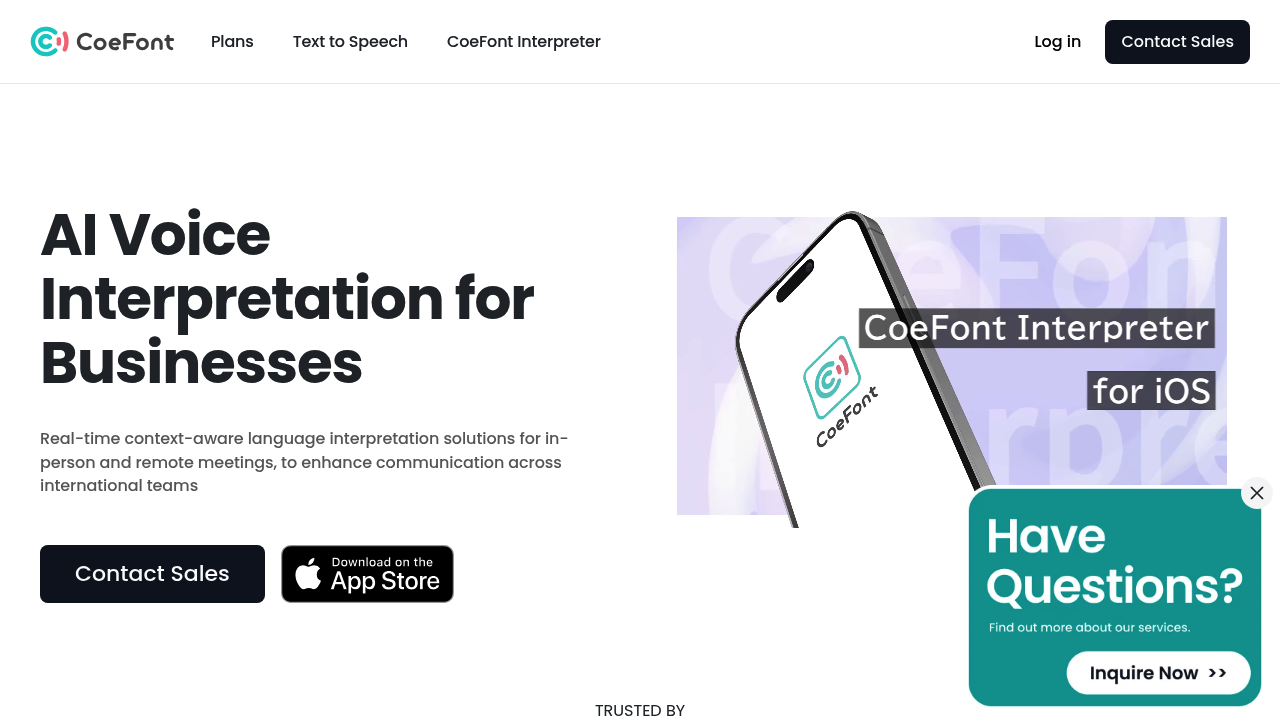
Real-time voice interpretation systems typically introduce noticeable lag between speech and translation, creating awkward pauses that disrupt natural conversation flow. CoeFont Interpreter reduces that delay to one second while simultaneously analyzing conversation context and specialized terminology to deliver more accurate interpretations than standard translation tools. The system handles 10 languages: English, Japanese, Spanish, French, Chinese, Korean, Vietnamese, Portuguese, German, and Thai.
The interpretation engine doesn't just translate words in isolation. It maintains awareness of the ongoing conversation thread and references custom terminology dictionaries that teams can populate with industry-specific jargon, company names, product terms, and proper nouns. This dual-context approach addresses one of the biggest weaknesses in automated interpretation where specialized vocabulary gets mangled because the system lacks domain knowledge. A pharmaceutical team discussing clinical trial protocols can load medical terminology. A logistics company can add shipping terms and port names. The system then prioritizes these custom entries when interpreting speech.
Two distinct deployment modes accommodate different meeting scenarios. The iOS mobile app handles in-person conversations where participants sit in the same room. The interface adjusts for either side-by-side seating arrangements or face-to-face positioning across a table. The desktop application integrates with Zoom, Microsoft Teams, Google Meet, Webex, and Discord for remote meetings where participants join from different locations. Both modes provide the same interpretation speed and accuracy.
Beyond live interpretation, the system generates automatic meeting summaries that extract main discussion points and action items. These summaries get saved alongside full transcripts that participants can review or share with team members who couldn't attend. This documentation feature turns interpreted meetings into searchable archives rather than ephemeral conversations that exist only in the moment.
One unusual capability lets teams create AI voices from recorded audio for use during interpretation sessions. This feature currently works only with Japanese language content. Teams can record a specific person's voice and have the interpretation delivered in that familiar voice rather than a generic synthetic voice, potentially making interpreted content feel more natural to listeners accustomed to hearing from that individual.
The Plus plan goes for $350 monthly and includes eight hours of interpretation time for up to five users. Teams needing more than eight hours monthly or supporting more than five users need the Enterprise tier, which removes both restrictions and adds single sign-on support, internal terminology registration capabilities, and a Microsoft Teams plugin that doesn't exist in the Plus version. Both tiers offer SOC2 Type 2 certification and exclude enterprise client data from AI model training by default.
The iOS-only restriction for the mobile app leaves Android users without an in-person meeting option. They'd need to use the desktop application even for face-to-face conversations, which creates an awkward setup where participants in the same room stare at laptop screens instead of using phones. The eight-hour monthly limit in the Plus plan breaks down to roughly two hours weekly or 30 minutes daily for a five-day work week, which constrains teams with frequent international communication needs.
Global companies managing regular cross-border meetings get the most value here. Remote teams spanning multiple language zones. Customer-facing roles serving international clients. Partnership discussions involving parties who don't share a common language. The context awareness and terminology customization matter most when conversations involve specialized vocabulary that generic translation tools consistently mishandle.