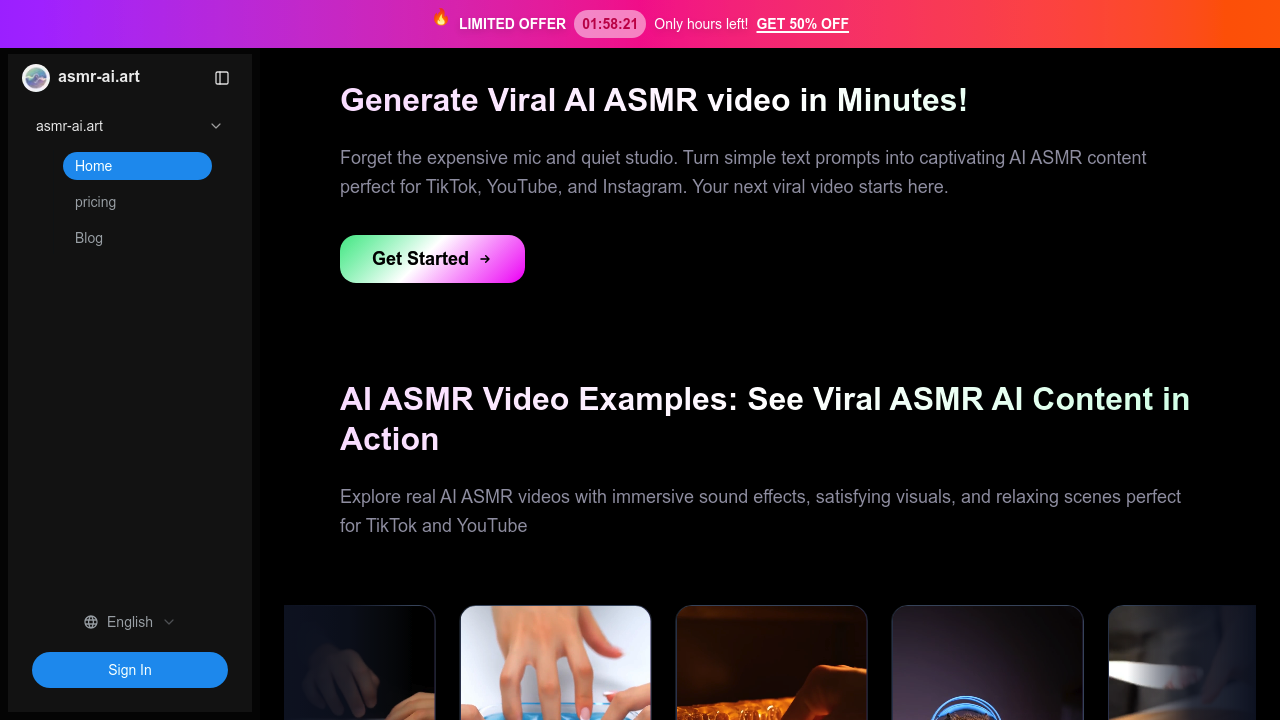
Type a description of what you want — rain on leaves, someone tapping glass, ocean waves at night — and ASMR-AI.art generates a video with matching audio. The sound effects sync with the visuals. Water drops align with ripples. Finger taps match hand movements. It's built on Google Veo 3, which handles the audio-visual coordination that makes or breaks ASMR content.
You can start from text or upload reference images to maintain consistent style across frames. This service supports multi-image uploads, lets you control individual frames, and extends videos beyond the 8-second default. You pick aspect ratio (16:9 or 9:16), resolution (720p or 1080p), and quality level. Each prompt can generate up to four variations. Videos come without watermarks, and there's lip sync support if your ASMR involves speaking.
This service includes templates for common ASMR scenarios. Generation takes 2-5 minutes. Example videos on the site show view counts ranging from 8.2K to 25.9K, suggesting people are actually using this stuff on social platforms.
Does it actually replace traditional ASMR recording? Depends on what you're making. This service claims it eliminates the need for binaural microphones (often $500 or more) and soundproof spaces. If you're churning out generic relaxation content for TikTok or Instagram, that math works. The site says it scales content output 10x compared to filming. But anyone doing detailed roleplays or personal attention videos probably needs real recording equipment. ASMR audiences notice audio quality differences.
The 8-second limit's the big constraint. That's barely enough for a single trigger loop. You can extend videos, but you're still working in short bursts. Fine for social media clips. Frustrating if you want anything approaching a full video. The credit system means each generation costs you — 20 credits for normal quality, 150 for high quality. You're calculating ROI on every prompt.
Character consistency across frames helps if you're building a recognizable presence, but this service doesn't offer API access or team features. It's a solo operation. No integrations with editing software or content management platforms. You sign in, generate, download, and handle the rest yourself.
Pricing starts at $19.90 for the Basic plan (currently 50% off from $39.90), which includes 1,000 credits that never expire. That translates to roughly 50 fast quality videos or 6 high quality ones. Pro runs $49.90 for 3,300 credits (165 fast or 22 high quality videos). Max tier is $99.90 for 7,500 credits (375 fast or 50 high quality videos), plus priority support and access to new features. These are one-time purchases, not subscriptions. Credits don't expire.
Who benefits most? Social media creators who post frequent ASMR content and don't want to invest in recording gear. You're trading production time and equipment costs for credits and 8-second segments. If your audience consumes quick trigger videos on TikTok, this works. If you're building a YouTube channel around 20-minute sleep videos, you'll hit limitations fast.
This service does what it claims — generates synced audio and video from prompts. But it's optimized for short-form platforms. Not a replacement for serious ASMR production. More like a content multiplier for people already working in bite-sized formats.