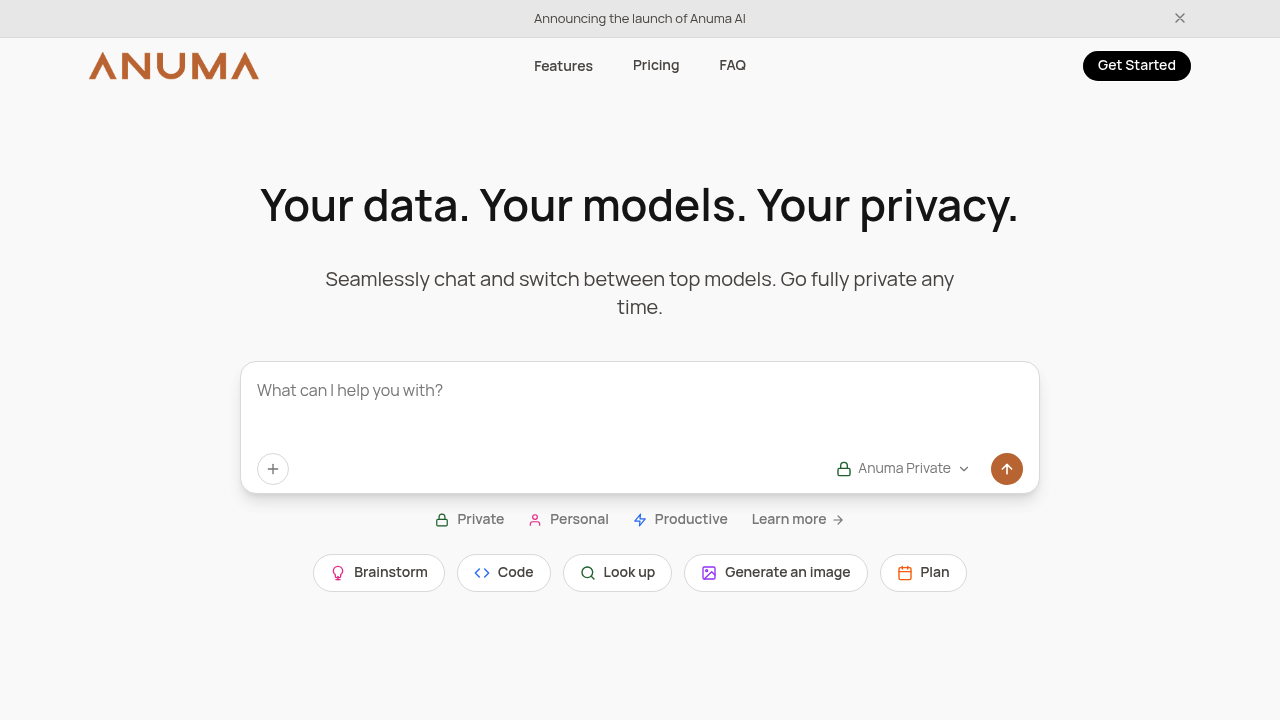
Most people who use AI assistants end up locked into one company's ecosystem, constantly re-explaining preferences and losing context when they need a different model for a specific task. Anuma takes a different approach by functioning as a private AI workspace where users can switch between multiple models while maintaining continuous memory and context across every conversation.
The service's core architecture centers on persistent memory that travels with users regardless of which AI model they're chatting with. When someone switches from one model to another mid-conversation, Anuma carries forward the entire context, including remembered preferences, communication tone, and stated goals. This eliminates the repetitive onboarding that typically happens when moving between different AI services. The memory system stays under user control rather than being owned by individual AI companies, which completely changes the privacy equation.
Privacy implementation goes beyond typical promises. Anuma uses local-first storage architecture with end-to-end encryption covering both conversations and the memory layer. The service doesn't collect user data, doesn't log interactions, and doesn't train models on what users share. When someone uses Anuma to chat with external AI models, it acts as a protective layer that borrows the model's capabilities while keeping personal memory private and separate from the AI company's systems. Users can import existing memories from other AI providers to consolidate their conversation history in one place.
The interface supports both text and image generation capabilities. Image generation integrates directly into the chat experience rather than requiring a separate tool or workflow. Chat backup functionality preserves conversation history, with media backup storage available on higher tiers for users who generate or share files through their AI interactions.
The free plan provides 200 credits monthly that work for both text and image generation, with access to all core Anuma features including private chat, memory imports from any AI provider, and the ability to generate 10 images daily. Model access gets restricted on this tier, as does chat backup capacity. The Starter plan at $5.99 monthly bumps allocation to 1,400 credits, which represents seven times the free tier amount. It provides premium models and removes the daily image generation cap. Credit pack purchases receive a 10% bonus at this level. The Pro plan costs $19.99 monthly and delivers 5,000 credits, a 25-times increase over the free tier. This tier extends conversation length limits across all models, removes chat backup restrictions, provides 50GB of media backup storage, grants access to the newest model releases as they become available, and includes early access to experimental features.
The credit-based system means users who exhaust their monthly allocation need to purchase additional credit packs to continue usage. Free tier users face the most constraints with limited model selection and backup capabilities, though core privacy features remain fully accessible.
Anuma makes most sense for people who've found themselves frustrated by single-provider limitations or who need different AI models for different tasks throughout their day. Someone might prefer one model for creative writing, another for technical analysis, and a third for image generation. Typically this means juggling multiple subscriptions and re-establishing context in each environment. Privacy-conscious users who want their conversation history and preferences stored locally rather than on corporate servers represent another natural fit, particularly those who've accumulated substantial interaction history with AI tools and want consolidated control over that data.