
A marketing coordinator applies to fifteen jobs in a week. She spent two hours last Sunday customizing a cover letter for a tech startup, weaving in details about their recent product launch and explaining how her social media campaigns align with their growth goals. By Wednesday, she's exhausted and starts submitting generic letters with just the company name swapped. Her callback rate drops. She needs the personalization without the hours.
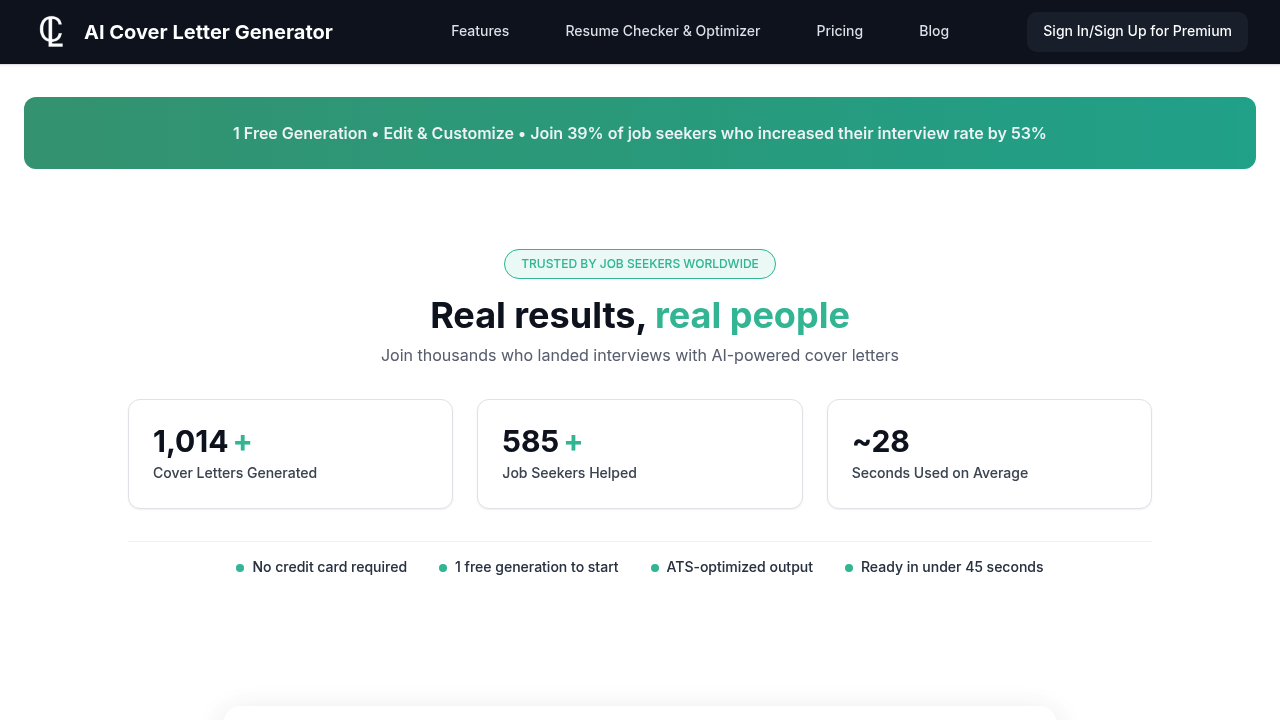
AI Cover Letter Generator takes a resume and job description, then outputs a tailored cover letter in under 45 seconds. Upload a PDF or DOCX resume up to 10MB, paste the job posting, and it analyzes both to match qualifications to requirements. It pulls job information automatically from URLs and includes company culture analysis to adjust tone. The output comes ATS-optimized, addressing common screening filters that reject applications before humans see them. Every letter downloads as a watermark-free PDF. Users can edit generated content before saving, and their cover letter history gets stored for reference.
A software engineer switching from backend to frontend development pastes a job description requiring React and TypeScript experience. His resume shows three years of Python and Node.js work but includes two side projects in React. The generator pulls those projects forward, frames his backend experience as valuable for understanding full-stack architecture, and emphasizes his learning trajectory. He gets the letter in 28 seconds average generation time. He applies to twelve frontend roles that afternoon, each with a distinct letter highlighting different transferable skills.
A retail manager transitioning to HR pastes a job description heavy on conflict resolution and team development. Her resume lists eight years managing store teams and reducing turnover by 23 percent. The generator connects her daily mediation of employee disputes to HR's conflict resolution needs and positions her turnover success as talent retention expertise. She pastes the hiring manager's name in optional fields. The letter addresses them directly.
The generator struggles when job descriptions fall below 100 characters. Vague postings like "seeking motivated individual for exciting opportunity" produce generic output because there's nothing specific to analyze. The 3000-character limit on job descriptions means lengthy academic or government postings need trimming. Additional information caps at 500 characters, so candidates with complex career pivots can't provide full context. There's no team features or API access for recruiters who'd want to generate letters at scale for clients.
The free plan includes one cover letter generation with basic AI personalization. Paid tiers run $4.99 for 25 credits, $6.99 for 50 credits, or $10.99 for 100 credits. The Pro plan breaks down to 11 cents per letter. Paid plans add auto-extract from URLs, company culture analysis, and priority support. Someone applying to five carefully selected roles per month stays free. An active job seeker sending thirty applications weekly needs Pro.
Skip this if you are applying to three dream companies and want to spend a full evening researching each one's mission statement and recent news. Skip it if you're in creative fields where cover letter format matters as much as content. The generator outputs standard business format, which won't showcase a graphic designer's layout skills. It won't help if your resume is thin and you need to compensate through storytelling that requires more than facts on a page. And it can't fix a resume that doesn't actually match the job requirements. It repositions existing qualifications. It doesn't invent them.