
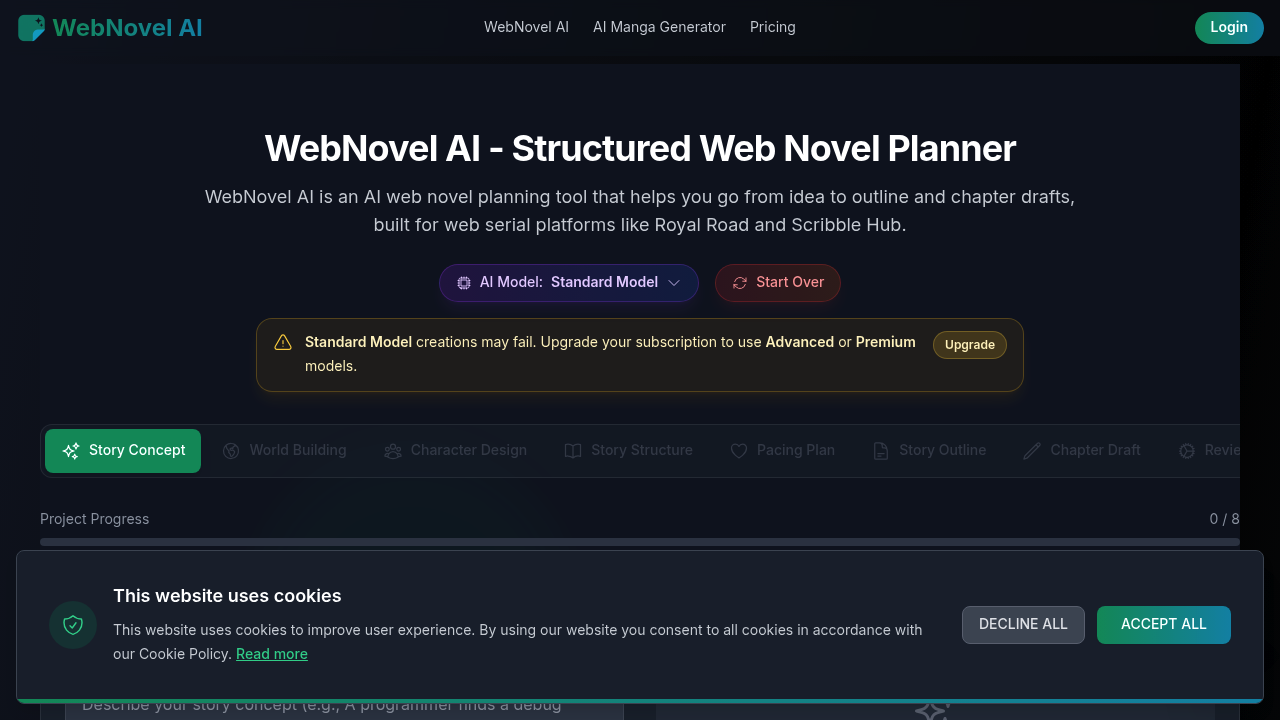
Web novelists writing serialized fiction for platforms like Royal Road and Scribble Hub get a specialized planning workflow that moves from initial concept through to chapter drafts. This system structures the creative process into eight distinct stages: Story Concept generation, World Building, Character Design, Story Structure, Pacing Plan, Story Outline, Chapter Draft, and Review & Export. This progression addresses the specific planning needs of web serial authors who publish chapters incrementally rather than completing manuscripts before release.
The genre template library targets web fiction subgenres directly. Authors find ready-made concept frameworks for LitRPG, System Apocalypse, Dungeon Core, and Portal Fantasy stories. These templates provide starting points that understand the conventions and reader expectations particular to web serial communities. Someone writing a dungeon core story gets different structural suggestions than someone planning a portal fantasy, reflecting how these subgenres operate differently in web serial contexts.
The system includes image generation capabilities alongside text planning. Authors can create visual assets for their web novels without leaving the service. Quality tiers matter here. Free users access a Standard Model that produces lower quality output and may fail during generation attempts. Paid subscribers get cleaner, more reliable results.
The credit system governs usage across all paid tiers. Basic subscribers receive 2,880 credits monthly at $12.49, along with 80 high-quality images. Professional subscribers get 7,200 credits and 200 images for $24.99 monthly. Enterprise users receive 18,000 credits and 500 images at $41.66 monthly. Annual billing cuts costs by 20 percent, dropping Basic to $149.90 yearly, Professional to $299.90, and Enterprise to $499.90.
Model access stratifies by subscription level. Free users stay locked to the Standard Model with its reliability issues. Basic subscribers gain access to the Advanced Model, which generates faster with better quality. Professional and Enterprise subscribers gain access to the Premium Model, which delivers the highest quality output available. Generation speed increases as you move up tiers.
Commercial licensing separates free from paid usage. Free tier creations come with watermarks and unclear usage rights. All paid plans remove watermarks and grant explicit commercial use licenses for generated content. This matters for authors who monetize their web novels through Patreon, Kindle Unlimited, or platform ad revenue programs.
Support escalates with price. Basic users get email technical support. Professional subscribers access priority email plus live customer support. Enterprise subscribers receive 24/7 dedicated support with SLA guarantees. Response time expectations shift dramatically between tiers.
The credit consumption model creates monthly caps on how much planning work authors can complete. Someone running multiple web serial projects simultaneously might exhaust their credit allocation before month's end. This system doesn't specify how many credits individual operations consume, which makes it difficult to predict exactly how far an allocation stretches. A Basic subscriber's 2,880 credits might generate five complete outlines or fifteen, depending on complexity and revision needs.
Authors working solo can operate on Basic plans. Professional authors managing larger projects fit the Professional tier. Teams collaborating on shared universes or writing collectives might require Enterprise allocations. This system doesn't mention team collaboration features explicitly, so multiple authors likely need separate subscriptions rather than shared workspace access.
The free tier exists primarily for evaluation. Its Standard Model limitations make it impractical for serious production work. Authors need to budget for at least Basic subscription to get reliable, commercially usable output.