Web of Science Research Assistant logo

Web of Science Research Assistant

Web of Science Research Assistant is Clarivate's conversational AI for academic research.

It starts from a single question about a topic, author or journal and turns it into a guided workflow grounded in the Web of Science Core Collection, a curated citation database. Users can search in natural language…

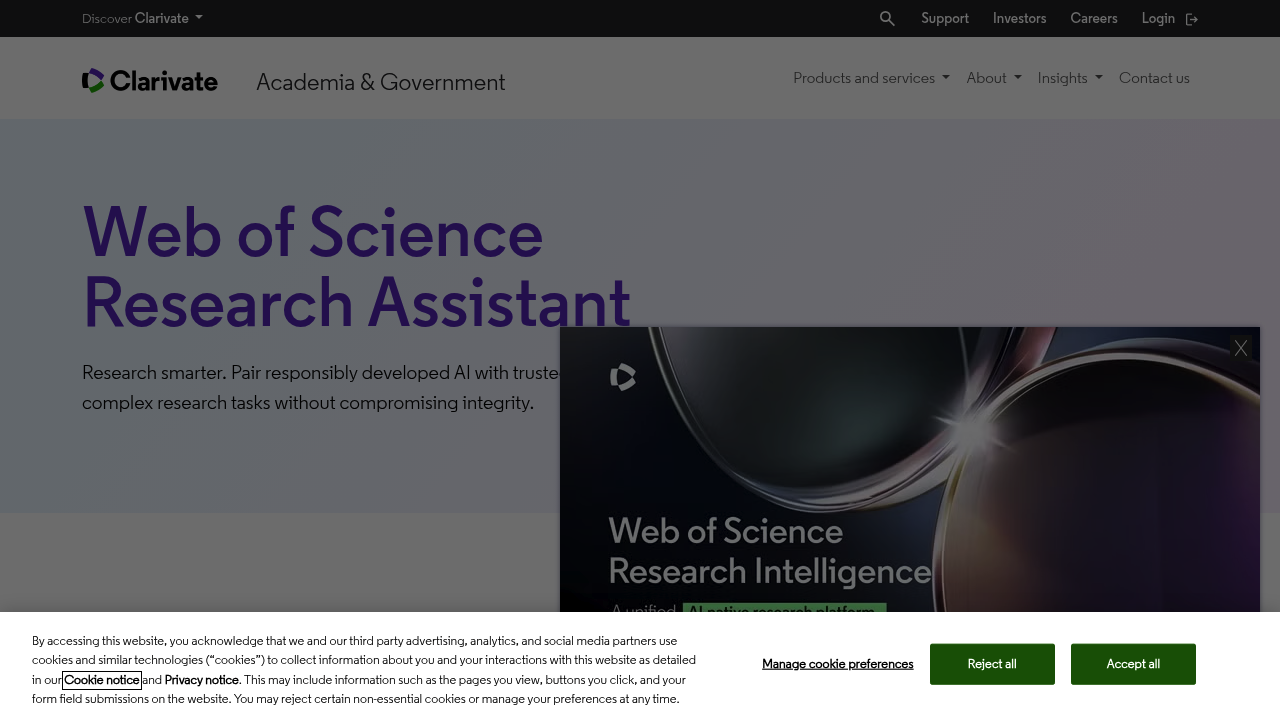
Web of Science Research Assistant screenshot

Web of Science Research Assistant is Clarivate's conversational AI for academic research. It starts from a single question about a topic, author or journal and turns it into a guided workflow grounded in the Web of Science Core Collection, a curated citation database. Users can search in natural language across several languages and receive concise overviews that draw on more than 120 years of research. Guided walkthroughs and contextual prompts appear as work progresses, and visualizations such as co-citation networks, topic maps and trend graphs support light analytics.

Academics at every career stage are the intended users, from graduate students planning a literature review to established researchers tracking an unfamiliar field. Librarians and research support staff at universities can offer it to their communities, and institutions with Web of Science Research Intelligence give researchers an extended assistant that adds guided exploration of funding opportunities and emerging topics. Clarivate says the product was developed with researchers and librarians and aligns with licensing and usage rights, which matters to institutions concerned with academic integrity.

Common tasks include exploring a new topic, building a literature review, working out an author's influence and interpreting trends and connections between papers. A researcher can ask where to go next and receive suggested steps, or identify experts to shape a collaboration strategy. Because answers rest on trusted publication and citation data and show how outputs were generated, users can interrogate responses instead of accepting them blindly. Universities such as the University of Sao Paulo, Syracuse University and National Cheng Kung University took part in its development partner program and beta testing.


Web of Science Research Assistant alternatives

See all →

Frequently asked

6 questions
What research tasks does Web of Science Research Assistant support?
Structured help covers for exploring a topic, building a literature review, understanding an author's influence and interpreting trends and connections. Guided walkthroughs and context-specific prompts appear as the work develops.
Who is it intended for?
Academics at every career stage, along with librarians and institutions that subscribe to Web of Science. Universities took part in its development partner program.
How is it different from a general chatbot?
Clarivate describes this assistant as far more than a chatbot, since it runs alongside the researcher and uses data from the Web of Science Core Collection. It also shows how outputs are generated so responses can be questioned.
Can I search in languages other than English?
Natural language searches work in several languages. Results come back as concise overviews and commentary that consider over 120 years of research.
Are there extra features for some institutions?
Institutions with Web of Science Research Intelligence can use an extended assistant. It adds guided exploration of funding opportunities and emerging topics.
How do I get access?
Access runs through a product login and institutional subscriptions, and Clarivate invites interested organizations to talk with its sales team. It is built on the Web of Science Core Collection, so a Web of Science relationship is the starting point.

Reviews (0)

Write review

No reviews yet. Be the first to share your experience.