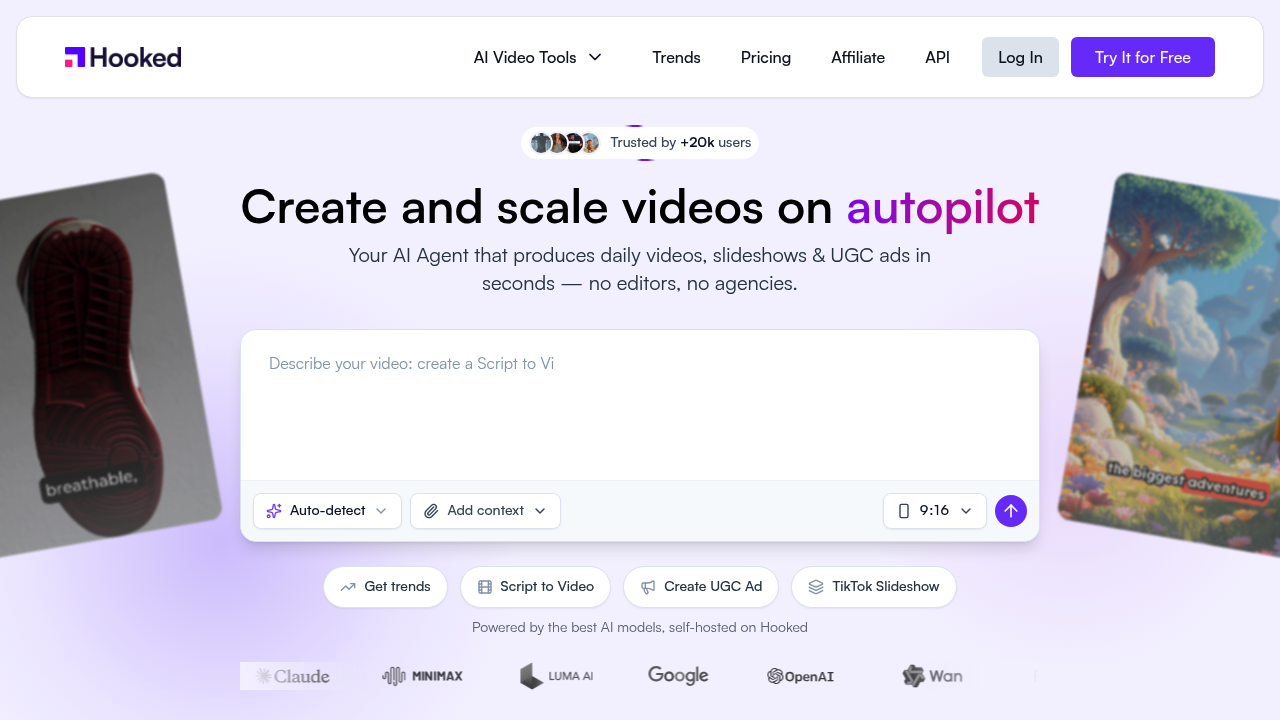
VidMe runs a self-hosted AI video generation system built on proprietary models rather than third-party APIs. This service takes text inputs, product images, or scripts and processes them through multiple AI pipelines to output finished social media videos. The technical architecture handles voice synthesis, visual generation, avatar rendering, and caption placement in a single automated workflow.
The data flow starts with content input. Users either write scripts manually, use the AI script writer with access to 500+ viral hook templates, or feed product images directly into the system. The script writer analyzes viral content patterns to generate hooks and narratives. Once the script exists, the voice generator processes it through text-to-speech models supporting 30+ languages. Voice cloning capability lets users train the system on custom voice samples for consistent audio output across videos.
Visual generation happens simultaneously. The AI builder pulls from stock footage libraries, generates custom visuals based on script context, and renders AI avatars when specified. Users can create custom avatars or select from pre-built options. The system composites these elements together, adds auto-generated captions synced to audio timing, and outputs videos in multiple aspect ratios: 9:16 for TikTok and Instagram Reels, 16:9 for YouTube, and 1:1 for Instagram feed posts.
Real-time trend tracking runs separately from video generation. VidMe monitors viral content across TikTok, Instagram, and YouTube, analyzing performance metrics and niche-specific trends. It tracks competitor content to identify what's working in specific categories. This data feeds back into the script generation system to inform content strategies.
Publishing works through direct API connections. Videos export straight to TikTok, Instagram, and YouTube without manual download-upload cycles. The scheduling system automates posting times, and the automation features let users set up recurring content pipelines. Users can configure automations to generate videos on schedules without manual intervention each time.
VidMe handles various content formats. UGC-style ads mimic user-generated content aesthetics. Faceless videos create content without human presenters. TikTok slideshows compile static images with transitions and voiceovers. Product image conversion transforms ecommerce photos into video ads with AI-generated B-roll footage. Gameplay video creation adds commentary and editing to gaming footage.
Credit-based pricing starts at $39 monthly for 150 credits, generating up to 30 videos. The Premium tier costs $89 monthly for 350 credits and 70 videos. Ultra runs $199 monthly for 750 credits and 150 videos. Yearly billing drops prices to $99 monthly for Pro and $149 for Premium with a 30% discount. Automation limits restrict Pro to 3 automations, Premium to 5, and Ultra to 10.
Technical limitations affect production capacity and quality. Monthly video caps mean heavy users hit ceilings quickly. Some language accents need refinement according to user feedback, suggesting the voice synthesis models aren't equally trained across all 30 supported languages. Complex support issues can take multiple days to resolve, indicating VidMe's technical infrastructure occasionally requires manual intervention when automated systems fail.
This service supports over 20,000 users who've created 37,000+ viral videos. 600+ creators reached 100K+ views using the system. Output quality depends heavily on input quality and template selection, but the automated pipeline removes the need for video editing software or agency contracts.