
Touchpoint logo

Touchpoint

Touchpoint generates branded email templates through a conversational AI interface that eliminates the need for design or coding experience

4 views
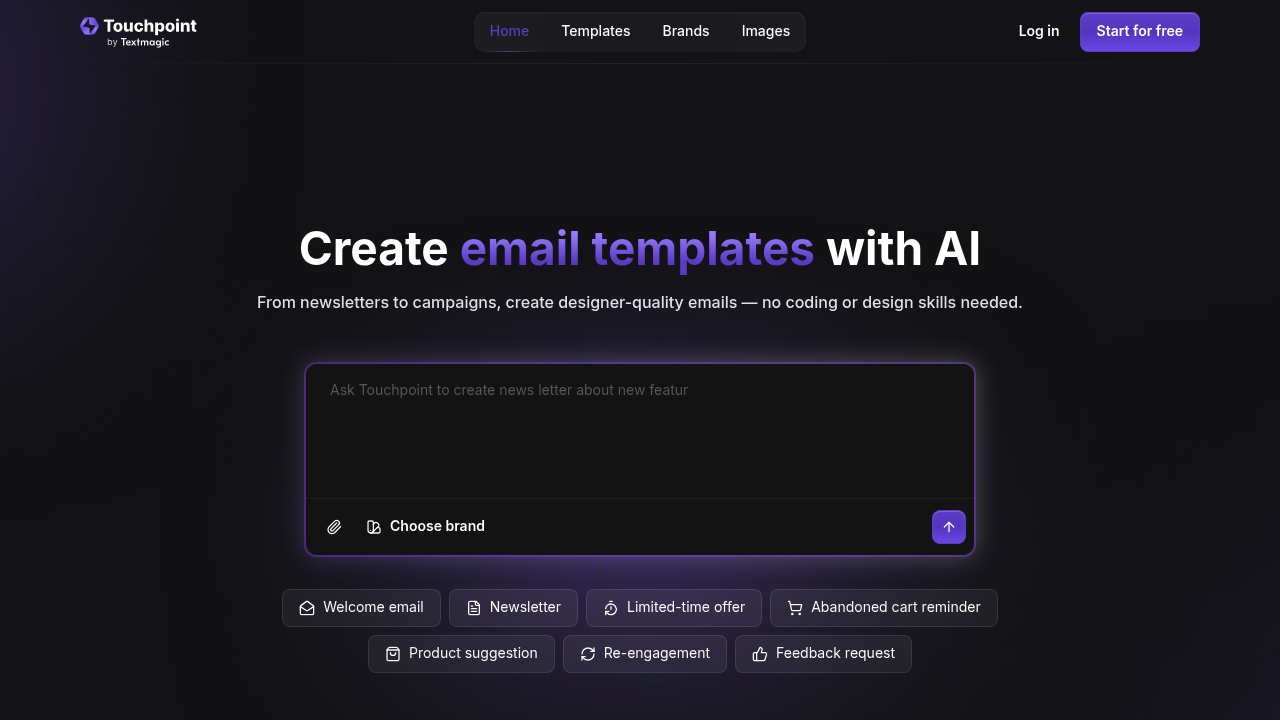
Touchpoint screenshot

Touchpoint generates branded email templates through a conversational AI interface that eliminates the need for design or coding experience. Users describe what they need in plain language, and the system produces designer-quality HTML templates ready for deployment across any email platform.

The technical workflow starts with brand asset extraction. Point it at your website, and it automatically pulls your logo, color palette, and visual identity elements. This brand information gets stored and applied consistently across every template you generate. The AI processes natural language requests through a chat interface, interpreting descriptions like "promotional email for summer sale" or "customer onboarding sequence" and translating them into structured email layouts.

The generation process uses ready-made prompt templates for common scenarios, which accelerate the creation of newsletters, promotions, transactional emails, and announcements. These templates serve as starting points that the AI adapts based on your specific requirements. The system outputs clean HTML code that meets email client rendering standards, addressing the technical challenge of cross-platform compatibility without requiring manual testing cycles.

After generation, users access a visual editor for refinement. Click-based controls let you adjust copy, swap images, and modify layout elements without touching code. For developers who want granular control, direct access to the underlying HTML allows for manual editing. This dual-interface approach handles both non-technical users and those who need to implement custom functionality or styling that visual editors cannot accommodate.

The export mechanism connects directly to Textmagic, the parent platform handling actual email transmission. One-click export moves templates into Textmagic's sending infrastructure, where you can set up campaigns and monitor delivery in real time. Your Touchpoint credentials work in Textmagic, eliminating separate authentication flows. For teams using other email platforms, standard HTML exports import into any system supporting custom templates.

The token-based pricing structure meters AI generation capacity rather than limiting template count. Starter plans include 1 million tokens monthly for twenty dollars, supporting one brand profile. Pro doubles capacity to 2 million tokens and two brands for forty dollars. Business and Growth tiers scale to 4 million and 6 million tokens with additional brand slots at seventy and one hundred dollars respectively. Enterprise pricing follows custom negotiation for large-scale deployments. Every plan includes 100,000 test tokens. Tokens do not carry over between billing cycles, requiring accurate capacity planning.

Technical limitations center on the token allocation model. Heavy users who generate numerous complex templates might exhaust monthly allowances before the reset. Brand slots restrict how many distinct visual identities you can manage simultaneously. Starter's single-brand limitation means agencies or companies managing multiple properties need higher tiers. The system doesn't specify token consumption rates per template, making it difficult to predict exactly how many emails you'll generate within your plan limit.

This platform serves Textmagic's existing customer base of over 30,000 users, many migrating from manual HTML coding or expensive design agencies. New users receive 10,000 free email sends through the connected platform. The technical architecture assumes you're either using Textmagic for delivery or have your own email infrastructure capable of importing HTML templates. There's no mobile app or browser extension. Access happens through the web interface exclusively.

The HTML output quality depends on the AI's interpretation of your prompts and the complexity of your brand assets. Simpler designs with standard layouts generate more reliably than highly customized requests.


Frequently asked

7 questions
How does Touchpoint generate email templates from text descriptions?
Under the hood, Touchpoint processes natural language through a conversational AI interface that interprets descriptions like 'summer sale promotion' and converts them into structured HTML email layouts. The system first extracts your brand assets by scanning your website for logos, color palettes, and visual elements, then stores these to apply consistently across all generated templates. Ready-made prompt templates for common scenarios like newsletters or transactional emails serve as structural starting points that the AI adapts based on your specific request. The output is cross-platform compatible HTML that meets email client rendering standards, eliminating the manual testing cycles typically required when coding templates from scratch.
Does Touchpoint have a free plan or trial?
Touchpoint doesn't offer a traditional free trial, but every paid plan includes 100,000 free test tokens to evaluate the platform before committing to monthly generation. The Starter plan begins at twenty dollars monthly with 1 million tokens and support for one brand profile. New users also receive 10,000 free email sends through the connected Textmagic platform once they're ready to deploy their templates. Token allocations don't roll over between billing cycles, so you'll need to estimate your monthly template generation needs when selecting a tier.
Can I use Touchpoint templates with Gmail or Mailchimp?
Touchpoint exports standard HTML code that imports into any email platform supporting custom templates, including Gmail, Mailchimp, or your own sending infrastructure. The one-click export to Textmagic streamlines deployment if you're using that platform, since your Touchpoint credentials work there without separate authentication. For other systems, you'll download the HTML file and upload it through your platform's template import process. The generated code meets email client rendering standards, though you'll want to test in your specific platform since some services apply their own processing to imported HTML.
What counts as a token in Touchpoint's pricing?
Touchpoint meters AI generation capacity through tokens rather than limiting template count, but the documentation doesn't specify exactly how many tokens each template generation consumes. The Starter plan's 1 million monthly tokens supports one brand at twenty dollars, while Pro doubles to 2 million tokens for two brands at forty dollars. Complex templates with intricate layouts or multiple revision requests likely consume more tokens than simple designs. Tokens expire at the end of each billing cycle without rolling over, which makes capacity planning difficult without knowing your typical consumption rate per template.
How many brands can I manage in Touchpoint?
Brand slots increase with each pricing tier, starting with one brand in the twenty-dollar Starter plan and scaling to five brands in the hundred-dollar Growth plan. Each brand profile stores extracted assets like logos, color palettes, and visual identity elements that the AI applies automatically to generated templates. Agencies or companies managing multiple client identities need Pro or higher tiers, since the single-brand limitation in Starter prevents switching between different visual systems. Enterprise plans support custom brand allocations for large organizations with numerous properties or subsidiaries.
Can I edit the HTML code directly in Touchpoint?
Touchpoint provides dual editing interfaces: a visual click-based editor for non-technical users and direct HTML access for developers needing granular control. The visual editor handles common adjustments like copy changes, image swaps, and layout modifications without touching code. Developers can access the underlying HTML to implement custom functionality or styling that visual editors can't accommodate, like conditional logic or advanced responsive breakpoints. This architecture addresses both marketers who need quick template variations and technical teams requiring precise control over the final output.
Who is Touchpoint built for?
Touchpoint targets the existing Textmagic customer base of over 30,000 users, many previously relying on manual HTML coding or design agencies for email templates. Small businesses without dedicated design resources can generate branded templates through conversational prompts instead of hiring developers. Growing companies managing multiple brands benefit from the scalable brand slot system across pricing tiers. The platform assumes you're either using Textmagic for email delivery or have your own infrastructure capable of importing HTML templates, since there's no built-in sending capability beyond the Textmagic integration.

Reviews (0)

No reviews yet. Be the first to share your experience.

Similar tools

See all →