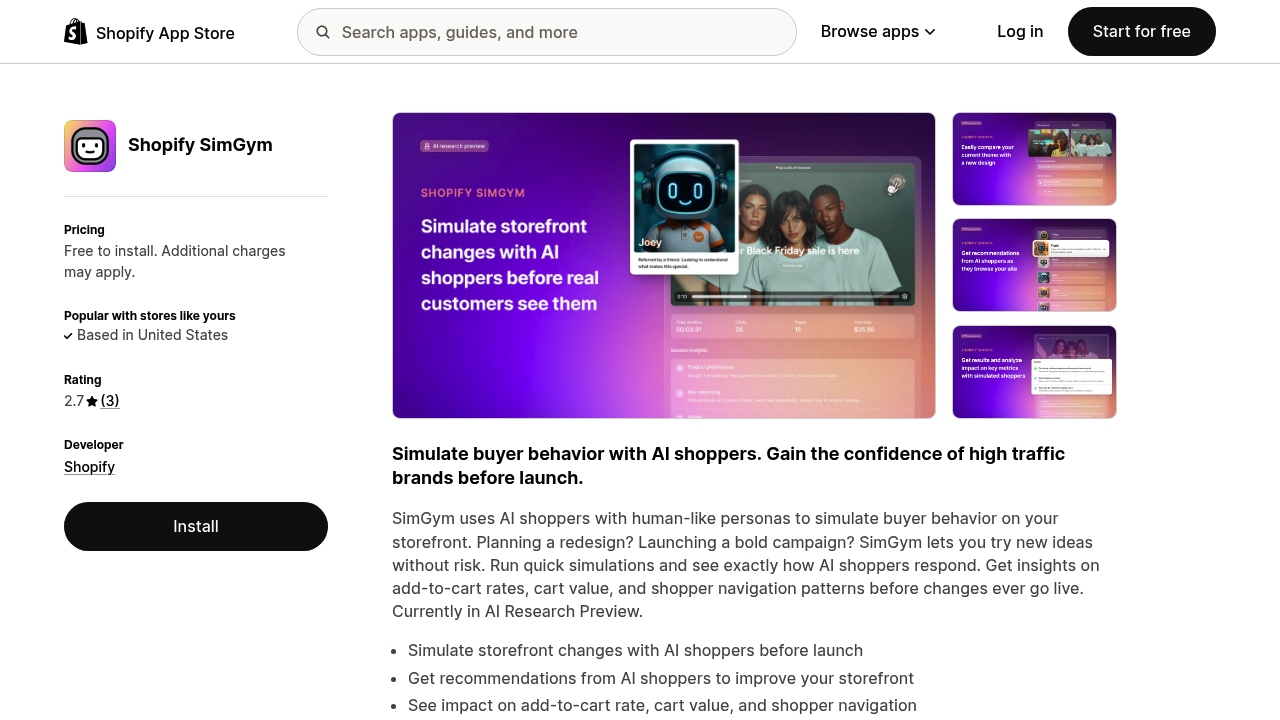
Shopify merchants get a virtual testing ground before making storefront changes go live. SimGym creates AI-powered shoppers that behave like real customers, complete with distinct personas and shopping patterns, to simulate how actual visitors might interact with proposed redesigns or new campaigns. The system runs these simulations quickly and delivers specific metrics on add-to-cart rates, average cart values, and navigation paths shoppers take through the store.
This platform targets store owners who lack the traffic volume needed for traditional AB testing. Brands with high visitor counts can split-test changes on real users and gather statistically significant data. Smaller stores can't do that reliably. SimGym aims to fill that gap by generating synthetic shopping sessions that mimic human decision-making without requiring thousands of actual visitors.
Beyond just running simulations, the AI shoppers provide recommendations for improving the storefront. They don't just report numbers. They suggest changes based on what tripped them up or what worked during their simulated shopping sessions. Store owners can test multiple variations of layouts, product placements, or promotional campaigns to see which version performs better before committing resources to implementation.
Shopify itself developed SimGym and launched it in December 2025. It carries an AI Research Preview designation, signaling experimental status. This matters because the technology remains in active development rather than being a finished product.
The app integrates directly with Shopify Admin. It charges per simulation run rather than offering subscription tiers. The exact cost per simulation appears only inside the app after installation, with all charges billed in US dollars. There's no free tier or trial period.
User feedback raises significant concerns. The app holds a 2.7 out of 5 star rating across three reviews. One merchant reported that SimGym's predictions contradicted results from actual AB tests running on their live store, suggesting accuracy problems. Another user mentioned frequent crashes. Videos within the app reportedly don't play, limiting access to tutorial content.
The Research Preview status explains some roughness but doesn't eliminate the practical risk. Merchants paying per simulation might find themselves spending money on unreliable predictions. Stores with sufficient traffic to run their own AB tests probably shouldn't bother with SimGym since real user data beats synthetic predictions. SimGym makes most sense for very low-traffic stores willing to accept experimental technology in exchange for any directional guidance on storefront changes. Anyone expecting production-ready accuracy will likely face disappointment given current performance reports and the preview designation.