Replay appears to be discontinued. Its website has been unreachable across our last three checks. See similar tools below for alternatives.
Replay logo
AI Website Builder FREEMIUM from $19/mo

Replay

Legacy application modernization typically drags on for 18 months while burning budgets and risking catastrophic regressions

Manual reverse-engineering alone consumes 12 to 18 months before developers write a single line of new code. Seventy percent of rewrite projects fail or exceed their budgets. Replay attacks this problem by converting…

Replay screenshot

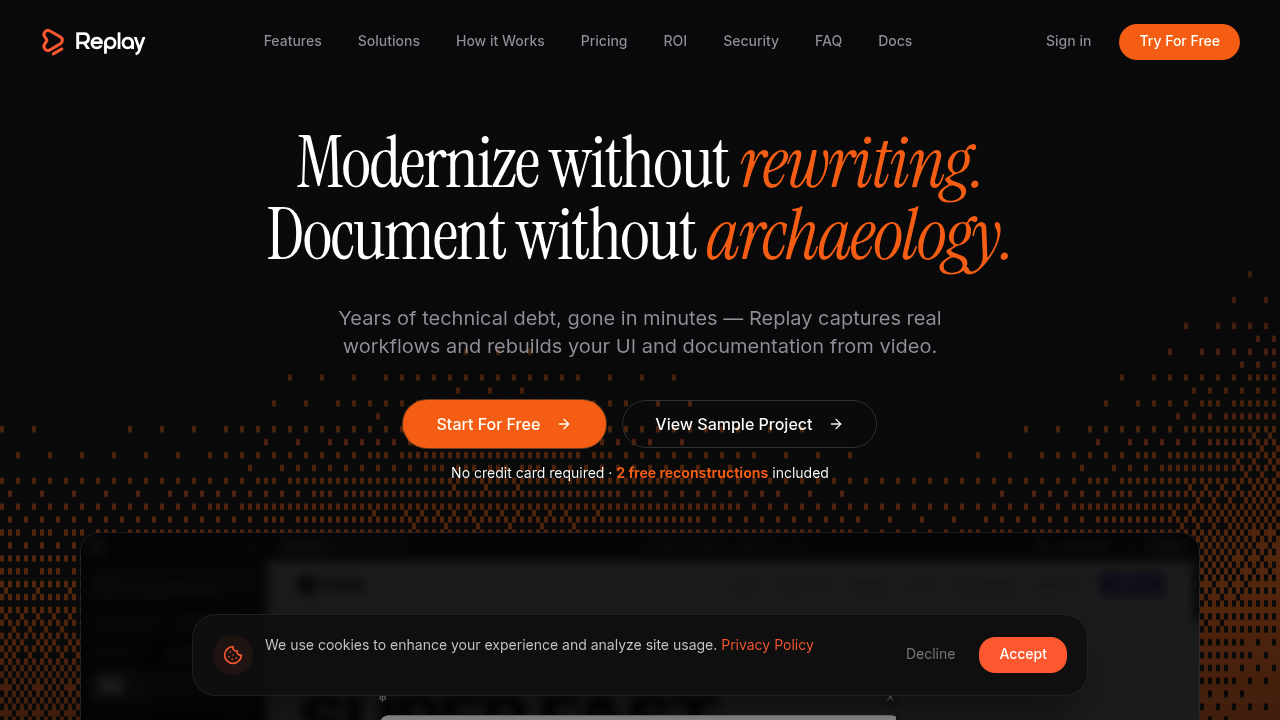
Legacy application modernization typically drags on for 18 months while burning budgets and risking catastrophic regressions. Manual reverse-engineering alone consumes 12 to 18 months before developers write a single line of new code. Seventy percent of rewrite projects fail or exceed their budgets. Replay attacks this problem by converting screen recordings of existing applications into working React code and complete documentation, shrinking the extraction phase from months to days.

This system accepts video recordings of legacy software in action. Users capture their old applications running through typical workflows, then upload the footage. Replay's analysis engine watches how the interface behaves across time, tracking state changes as users click buttons, fill forms, and move between screens. This temporal analysis reconstructs not just static layouts but dynamic behavior patterns. The Flow Map feature diagrams multi-page movement paths and detects when application state shifts, creating a visual blueprint of how the legacy system actually functions rather than how outdated documentation claims it works.

The conversion process outputs pixel-perfect React components styled with Tailwind CSS. A 19-step Reimagine pipeline takes the reconstructed UI further by applying modern design patterns while preserving functional logic. The system automatically generates a Design System by extracting reusable components from the legacy interface, cataloging buttons, forms, modals, and movement elements into a shared library. Teams get modular components they can remix rather than monolithic code blocks.

The Agentic Editor provides a search and replace workflow for refining generated components. Developers describe desired changes in natural language and the AI applies them across selected components. Each AI edit consumes roughly 10 credits while a full generation uses approximately 150 credits. Real-time multiplayer collaboration lets team members work simultaneously with live cursors and comment threads visible to everyone. This system also generates API contracts based on observed data flows and creates end-to-end tests covering the workflows captured in recordings.

The free plan provides 300 credits, enough for two generations. It includes preview access and the Flow Map but caps videos at 30 seconds and blocks code export, the editor, and library features. Users stay locked to a single project. The Pro plan costs 19 dollars monthly and supplies 1,500 credits, unlimited projects, full React and Tailwind export, Flow Map access, Design System generation, and AI visual editing. One team member works under this tier. The Agency plan runs 99 dollars monthly with 15,000 credits, seats for five team members, a shared Design System, and priority GPU processing. Enterprise pricing adapts to custom requirements and adds on-premise or private cloud deployment, SSO and SAML integration, security audits with SLA guarantees, and dedicated support channels.

Credit limits constrain how much teams can process. Free users burn through their allocation after two generations. Pro subscribers get ten generations monthly assuming standard credit consumption. Agency teams handle a hundred generations with their 15,000 credit pool. The 30-second video restriction on free accounts prevents meaningful workflow capture since most application tasks span longer sequences.

Development teams modernizing financial services platforms, healthcare record systems, telecom provisioning applications, logistics management software, government technology stacks, insurance claims processors, banking interfaces, manufacturing control panels, retail point-of-sale systems, and energy grid management applications represent the primary user base. These organizations face mission-critical systems built decades ago that can't go offline for extended rewrites but desperately need modern interfaces and maintainable code.

Frequently asked

7 questions
How long does it take to modernize a legacy application with Replay?
Replay compresses the extraction and analysis phase from 12 to 18 months down to days by automating the reverse-engineering process through video analysis. The tool converts screen recordings into working React code almost immediately, though the full modernization timeline still typically spans 18 months when accounting for testing, integration, and deployment phases. Manual approaches require teams to spend over a year just documenting and understanding the old system before writing any new code, which is where Replay delivers its most dramatic time savings. Organizations can move from recording their legacy application to reviewing generated React components within days rather than waiting months for developers to manually trace program logic.
Can I use Replay for free or does it require a paid subscription?
Replay offers a free plan with 300 credits, which covers approximately two full generations of React code from video recordings. The free tier includes preview access and the Flow Map feature for visualizing navigation flows but restricts videos to 30 seconds maximum and blocks access to code export, the visual editor, and the component library. Users stay limited to a single project under the free plan, making it suitable for evaluating the tool on a small workflow sample but insufficient for production modernization work. Teams needing to process complete applications require the 19 dollar monthly Pro plan with 1,500 credits or the 99 dollar Agency plan with 15,000 credits.
What file formats does Replay export and can I edit the generated code?
Replay exports working React components styled with Tailwind CSS, giving teams production-ready code rather than prototypes or static mockups. The Agentic Editor provides a search and replace workflow where developers describe changes in natural language and the AI applies modifications across selected components, with each edit consuming roughly 10 credits. Free plan users can't access the editor or export any code, so they only see previews and flow maps without the ability to download or modify the generated components. Pro and higher tiers unlock full export capabilities and the visual editor for refining components after the initial generation completes.
How many screen recordings can I process with each Replay pricing tier?
Credit allocation determines processing capacity, with each full generation consuming approximately 150 credits and AI edits using around 10 credits each. The free plan's 300 credits allow two generations total before exhausting the budget. Pro subscribers get 1,500 monthly credits supporting roughly ten generations, while Agency plan members receive 15,000 credits enabling about a hundred generations per month. Teams working on large legacy systems with dozens of workflows need the Agency tier or custom Enterprise pricing to avoid hitting monthly limits partway through their modernization project.
Does Replay only recreate the visual design or does it capture application logic too?
Replay performs temporal analysis on video recordings to reconstruct both interface layouts and dynamic behavior patterns, tracking how state changes as users interact with the application across time. The Flow Map feature diagrams multi-page navigation paths and detects when application state shifts, documenting actual system behavior rather than relying on outdated written specifications. The system generates API contracts based on observed data flows and creates end-to-end tests covering the workflows captured in recordings, going well beyond static visual reproduction. This temporal context analysis represents what makes Replay different from screenshot-based tools that only capture single-moment appearances without understanding how interfaces respond to user actions.
What are the main limitations of Replay's free plan?
The free tier caps videos at 30 seconds, which prevents capturing meaningful application workflows since most business processes involve longer interaction sequences spanning multiple screens and several minutes. Users get only 300 credits total, enough for two generations, with no monthly refresh of that allocation. Code export, the Agentic Editor for refining components, and the component library all remain blocked, restricting free users to viewing previews and flow maps without downloading or modifying any generated React code. The single project limit means teams can't experiment with multiple legacy applications or compare different workflow captures side by side.
Who typically uses Replay and what industries benefit most?
Development teams modernizing mission-critical legacy systems in financial services, healthcare, telecom, logistics, government technology, insurance, banking, manufacturing, retail, and energy sectors represent the primary user base. These organizations operate decades-old applications that can't go offline for extended rewrites but desperately need modern interfaces and maintainable codebases to meet current business demands. Agencies handling modernization projects for multiple clients benefit from the shared Design System and multi-seat collaboration features in the 99 dollar monthly tier. The tool targets situations where manual reverse-engineering would consume 12 to 18 months and where the 70 percent failure rate of traditional rewrite projects creates unacceptable business risk.

Traffic

Estimated monthly website visits · last 8 months

2K visits/mo
Monthly visits
2K
↓ 31.3% MoM
Global rank
#6,658,360
US #3,645,263
Category rank
#61
AI Website Builder
4.8K 3.6K 2.4K 1.2K 0 Dec 2025: 0 visits Dec 2025 Jan 2026: 3.2K visits Jan 2026 Feb 2026: 4.8K visits Feb 2026 Mar 2026: 4K visits Mar 2026 Apr 2026: 2.9K visits Apr 2026 May 2026: 2.7K visits May 2026 Jun 2026: 3K visits Jun 2026 Jul 2026: 2K visits Jul 2026

Reviews (0)

Write review

No reviews yet. Be the first to share your experience.