
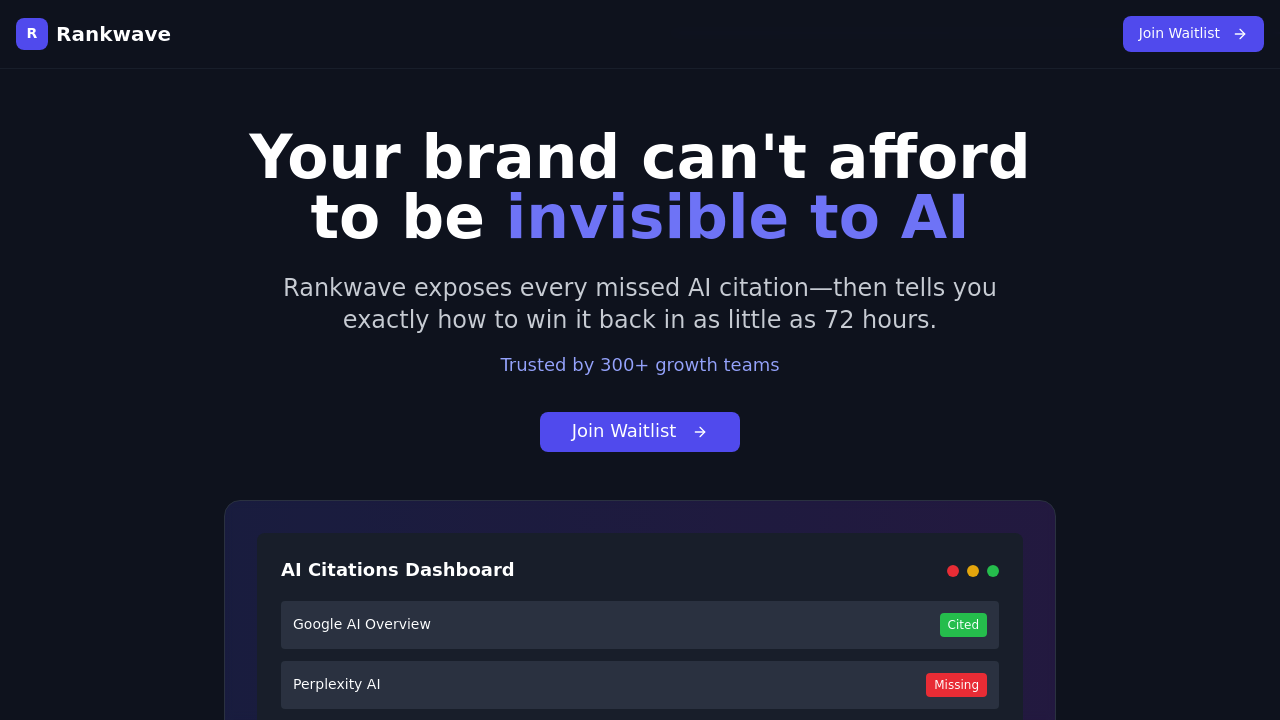
Rankwave monitors how often your brand appears in AI-generated search results and suggests specific changes to improve that visibility. This service tracks citations across Google AI Overview, Perplexity AI, and conversational search engines, showing you when competitors get mentioned instead of your company.
The technical architecture runs daily scans of your target keywords across multiple AI platforms. You input the search queries that matter to your business, and Rankwave queries each AI engine to capture the full response text. The system parses these responses to identify which domains get cited, how often, and in what context. This creates a baseline visibility map.
The multi-engine query monitor is the core tracking mechanism. It doesn't just count mentions. It captures the exact text snippets where citations appear and stores historical versions. The Snippet Explorer feature uses diff-view comparison, letting you see precisely what changed between yesterday's AI response and today's. If your brand dropped out of an answer or a competitor appeared, you'll see the exact paragraph that shifted.
Citation data feeds into a share-of-voice calculation. Rankwave benchmarks your domain against competitors for the same queries, showing relative visibility as percentages. This service generates an AI Visibility Score and offers a public badge you can display, similar to how sites show security certifications.
The optimization engine analyzes why certain domains get cited. It produces what Rankwave calls playbooks with paragraph-level rewrite suggestions for your content. These aren't generic tips. The system identifies specific sections of your pages and recommends structural changes, wording adjustments, or factual additions that align with how AI engines extract information. It also checks schema markup implementation and suggests improvements, since structured data influences how AI platforms parse content.
One technical feature checks llms.txt crawl controls. This file tells AI systems how to interact with your site, similar to robots.txt for traditional search crawlers. Rankwave verifies whether you've configured these controls correctly.
The analytics dashboard breaks down citations per query over time. You can see which keywords consistently generate brand mentions and which never do. Weekly digests arrive via Slack or email with summary metrics and notable changes.
Setup takes about 60 seconds. You connect your domain and add keyword lists. Rankwave claims results appear within 72 hours, though this depends on how quickly AI platforms refresh their training data and retrieval systems. Rankwave doesn't control when these external engines update.
The system works with 300-plus growth teams currently. This week 348 marketers signed up. The free tier includes monitoring for 50 keywords across all supported AI engines. A founding members program offers 50 percent off for 12 months with private Slack access, limited to the first 500 members. No credit card required for signup.
Technical limitations exist. Rankwave's in a waitlist or beta phase, so full feature access might be restricted. The founding members cap means availability's time-sensitive. Rankwave can only track what AI platforms publicly return. If an AI engine changes its citation logic or starts pulling from different sources, your visibility could shift independently of your optimization efforts.
This software targets marketing leaders, SEO teams, content strategists, and agency partners who need quantifiable metrics on AI search presence. It's built for people who understand that traditional search rankings don't translate to AI answer visibility and need separate tracking infrastructure.