Rails Guard logo

Rails Guard

Rails Guard watches your Rails console sessions for PII leaks and approves emergency database fixes through Slack at 2 AM

Rails Guard sits between your engineers and production Rails consoles with live AI data masking. It obfuscates sensitive data in real-time. No more worrying about developers accidentally seeing customer credit card…

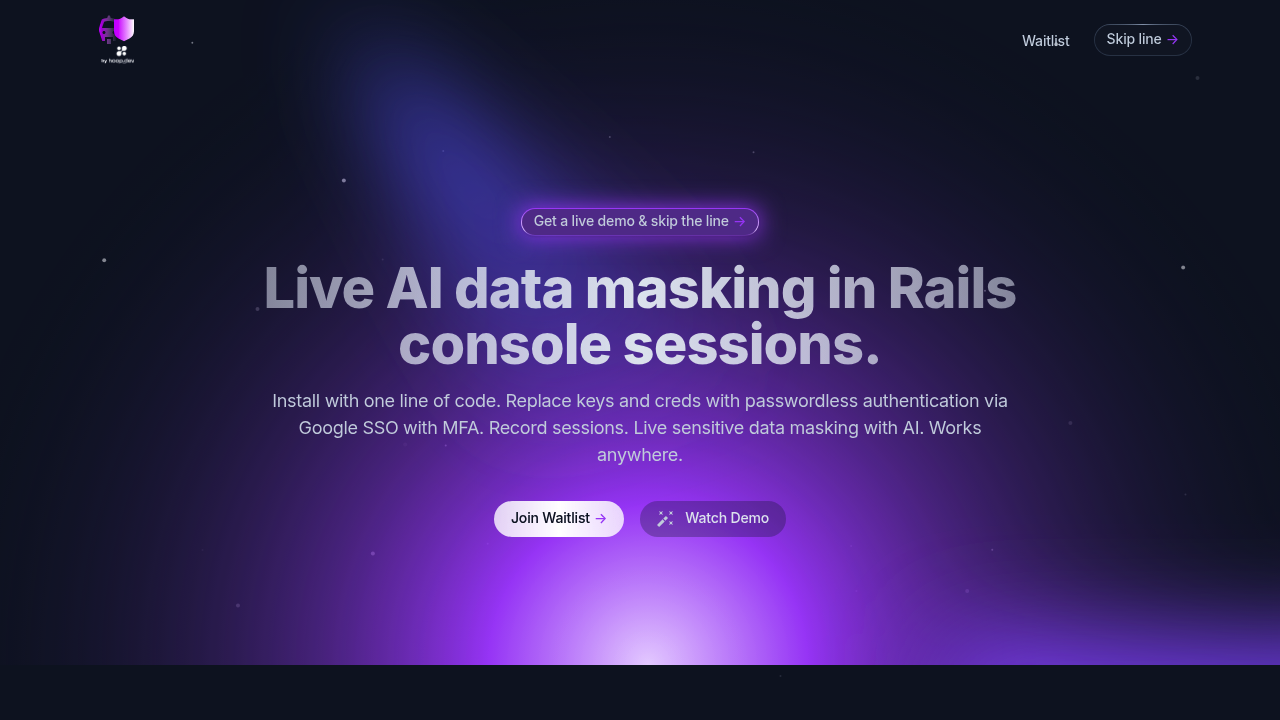
Rails Guard screenshot

Rails Guard watches your Rails console sessions for PII leaks and approves emergency database fixes through Slack at 2 AM.

Rails Guard sits between your engineers and production Rails consoles with live AI data masking. It obfuscates sensitive data in real-time. No more worrying about developers accidentally seeing customer credit card numbers or social security numbers while debugging. The AI catches PII as it appears in console output. Masks it instantly.

Setup takes 10 seconds with one-line code integration. Engineers authenticate through Google SSO with MFA instead of sharing root passwords. When someone needs emergency database access, they request it through Slack and get approval for anywhere from 10 minutes to 12 hours. Every keystroke gets recorded with full audit trails showing exactly who ran what commands when.

A DevOps engineer managing a healthcare Rails app would use this when HIPAA compliance requires tracking every database interaction. Picture this: an engineer needs to fix corrupted patient records at midnight. They request 30-minute access through Slack. Get approval from the on-call manager. Rails Guard records every SQL query while masking patient names and birthdates in real-time.

Rails Guard integrates with Kubernetes. AWS ECS. Heroku. Linux environments too. Rails Guard claims it saves teams 20 hours monthly and reduces context-switching by 6x — though those numbers feel optimistic for smaller teams. The compliance automation covers HIPAA, SOC, PCI, and GDPR requirements without additional configuration.


Rails Guard alternatives

See all →

Frequently asked

7 questions
How does Rails Guard's AI decide what counts as PII that needs masking?
Rails Guard's AI spots common PII patterns automatically -- stuff like credit card numbers, SSNs, phone numbers, and email addresses. It masks these in real-time without you having to configure anything or train it. The system looks for structured data patterns rather than trying to understand context.
Can I set custom time limits for database access requests beyond the 10 minutes to 12 hours range?
The docs show Rails Guard supports access windows from 10 minutes up to 12 hours. But they don't say if you can go outside this range. You'll probably need to stick with these preset timeframes when you're approving emergency access through Slack.
Does Rails Guard work with Rails applications that don't use ActiveRecord?
Rails Guard monitors console sessions and database stuff at the infrastructure level -- not through Rails ORM hooks. This means it should work with Rails apps using other ORMs like Sequel or raw database connections. As long as they're running in supported environments (Kubernetes or AWS ECS), you're good.
What happens if the Slack integration goes down during an emergency database access request?
The docs don't mention what happens if Slack fails. This could be a real problem during emergencies when engineers need database access ASAP but can't get approvals through the normal workflow.
How much storage space do Rails Guard's audit trails typically consume?
Rails Guard records every keystroke and SQL query with full audit trails. But the docs don't give storage estimates. For busy Rails apps with lots of console access, this could create tons of log data -- so you'll need to plan your storage capacity accordingly.
Can Rails Guard mask custom sensitive data beyond standard PII like internal employee IDs or proprietary codes?
The tool focuses on standard PII patterns like credit cards and SSNs. There's no mention of custom masking rules for company-specific sensitive data. You'd probably have to rely on the built-in AI detection rather than defining your own patterns.
Does the one-line integration require any changes to existing Rails console commands or workflows?
Rails Guard sits as a proxy between engineers and production consoles. Your actual Rails commands stay exactly the same. Engineers just authenticate through Google SSO instead of using direct database credentials. The integration happens at the infrastructure level -- no code changes needed in your Rails app.

Traffic

Estimated monthly website visits · last 0 months

Not enough historical data for a chart yet.

Reviews (0)

Write review

No reviews yet. Be the first to share your experience.