
Polaris appears to be discontinued. Its website has been unreachable across our last three checks. See similar tools below for alternatives.
Polaris logo
AI Marketing FREEMIUM from $5/mo

Polaris

An AI agent watches companies for you and emails a weekly digest of what changed

Polaris pulls from 100+ sources daily — website updates, social media posts from both the company and its employees, news mentions, and public filings. Instead of setting up Google Alerts and drowning in irrelevant…

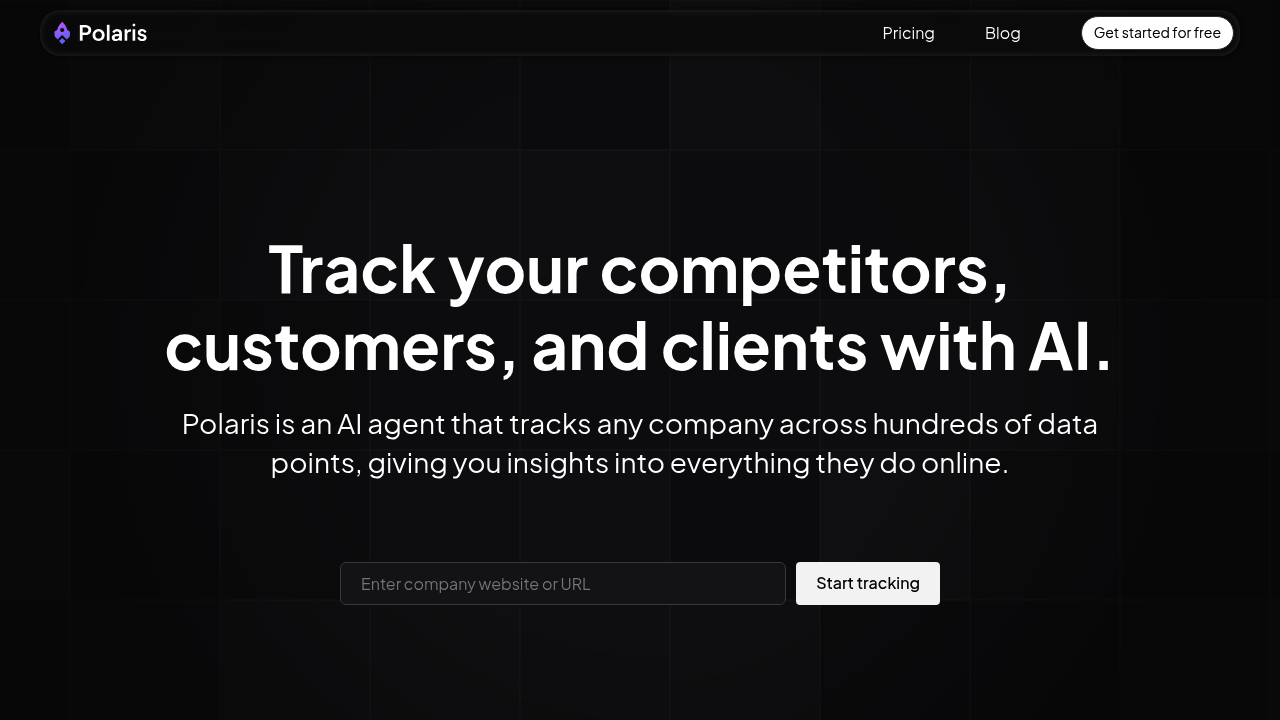
Polaris screenshot

An AI agent watches companies for you and emails a weekly digest of what changed. Polaris pulls from 100+ sources daily — website updates, social media posts from both the company and its employees, news mentions, and public filings. Instead of setting up Google Alerts and drowning in irrelevant pings, you get filtered summaries that highlight actual movement.

The filtering matters here. Polaris doesn't just scrape and forward. It analyzes hundreds of data points and decides what's worth your attention. That means fewer false alarms and more signal about competitor product launches, customer hiring sprees, or regulatory filings that actually affect your decisions. You track companies, not keywords.

Setup is straightforward. Add the companies you care about — competitors, customers, leads, portfolio companies, whatever. The AI starts monitoring. Every week you get an email with insights organized by company. The free Starter plan lets you track five companies and loop in three teammates. That's enough for small teams keeping tabs on key accounts or a handful of direct competitors.

Does it actually catch things you'd miss? The comparison to Google Alerts suggests it does. Social media monitoring includes employee posts, which often surface product updates or company culture shifts before official announcements. Website change tracking picks up pricing tweaks or new feature pages. Public filings cover the regulatory and financial moves that don't always make headlines. The breadth of sources helps, but the real test is whether the AI filters well enough that you trust the weekly email instead of feeling like you need to double-check everything yourself.

Weak spots show up in the free tier. Five companies is limiting if you're in a crowded market or managing multiple accounts. Three team members might not cover a sales or investor relations team. Real-time delivery through Slack or Microsoft Teams with enterprise only. Same with API access and integrations to Airtable, Notion, or Google Sheets. The free plan is email-only, which works for weekly check-ins but not if you need instant alerts or want to pipe data into your existing workflow tools.

The Unlimited plan charges $5 per tracked company per month. Not per user — per company. That's unusual and actually helpful for larger teams. If you're tracking 20 competitors with a 10-person team, you pay $100 monthly instead of scaling costs by headcount. For small teams watching dozens of companies, this pricing model makes sense. For solo users tracking just a few, it adds up quickly compared to the free tier.

Enterprise pricing is custom. That tier includes the dashboard view, API access, and the workflow integrations. If you need Polaris feeding into your CRM or alerting your team in real time, you're negotiating directly.

Who gets value here? Sales teams tracking prospects and customers. Investors monitoring portfolio companies or deal targets. Executives watching competitors. Anyone who needs company intelligence but doesn't have time to manually check 100+ sources. This service works best when you're tracking a specific set of companies over time, not doing one-off research. It's surveillance, not search.

The free plan is worth testing if you've got five companies that matter. Beyond that, the per-company pricing either saves you money or costs more depending on your team size and tracking needs.

Frequently asked

7 questions
Does Polaris have a free plan?
The Starter plan is free and lets you monitor up to five companies with three team members. You get AI-filtered summaries and a weekly email report, which covers the core monitoring features. The main limits are the number of companies and teammates — no real-time alerts, no API access, and no integrations with tools like Airtable or Notion. For small teams tracking a handful of competitors or key accounts, it's a solid starting point without pulling out a credit card.
How much does Polaris cost per month?
The Unlimited plan costs $5 per tracked company per month, not per user. If you're monitoring 10 companies with a five-person team, you pay $50 monthly regardless of team size. That pricing structure helps larger teams but adds up fast if you're solo and tracking dozens of companies. Enterprise pricing is custom and includes real-time delivery, API access, and integrations with Airtable, Notion, and Google Sheets.
What sources does Polaris monitor?
Polaris pulls from 100+ sources daily, including company websites, social media posts from both the company and its employees, major news publications, and public filings. The breadth matters because employee posts often surface product updates or culture shifts before official announcements, and website changes catch pricing tweaks or new feature pages. It's not just keyword scraping — the AI filters hundreds of data points to decide what's actually worth flagging in your weekly digest.
Can Polaris send real-time alerts?
Real-time delivery through Slack or Microsoft Teams is only available on the Enterprise plan. The free and Unlimited plans send weekly email digests, which work fine if you're doing regular check-ins but not if you need instant notifications. This is one of the bigger gaps in the lower tiers. If your workflow depends on immediate alerts when a competitor launches something or a customer makes a regulatory filing, you'll need to negotiate custom Enterprise pricing.
Is Polaris better than Google Alerts for tracking competitors?
Polaris claims to be "all signal and no noise" compared to Google Alerts, and the filtering approach backs that up. Instead of keyword matches that flood your inbox with tangential mentions, you get AI-analyzed summaries of actual company movements across 100+ sources. It tracks employee social posts, website changes, and public filings that Google Alerts often misses or buries in irrelevant results. The trade-off is cost — Google Alerts is free for unlimited tracking, while Polaris charges per company after five.
Who should use Polaris?
Sales teams tracking prospects and customers, investors monitoring portfolio companies, and executives watching competitors get the most value. It's built for people who need ongoing intelligence on a specific set of companies, not one-off research projects. If you're manually checking competitor websites, social accounts, and news every week, Polaris automates that surveillance. The per-company pricing works best when you're tracking dozens of companies with a larger team, not if you're solo watching just two or three.
Does Polaris integrate with other tools?
Slack and Microsoft Teams integrations are available, but only for real-time delivery on the Enterprise plan. The free and Unlimited plans are email-only. Integrations with Airtable, Notion, and Google Sheets also require Enterprise, along with API access if you want to build custom workflows. This limits how Polaris fits into existing systems unless you're paying for the top tier, which might frustrate teams that rely on piping data into CRMs or project management tools.

Traffic

Estimated monthly website visits · last 0 months

Global rank
#11,902,726

Not enough historical data for a chart yet.

Reviews (0)

Write review

No reviews yet. Be the first to share your experience.