
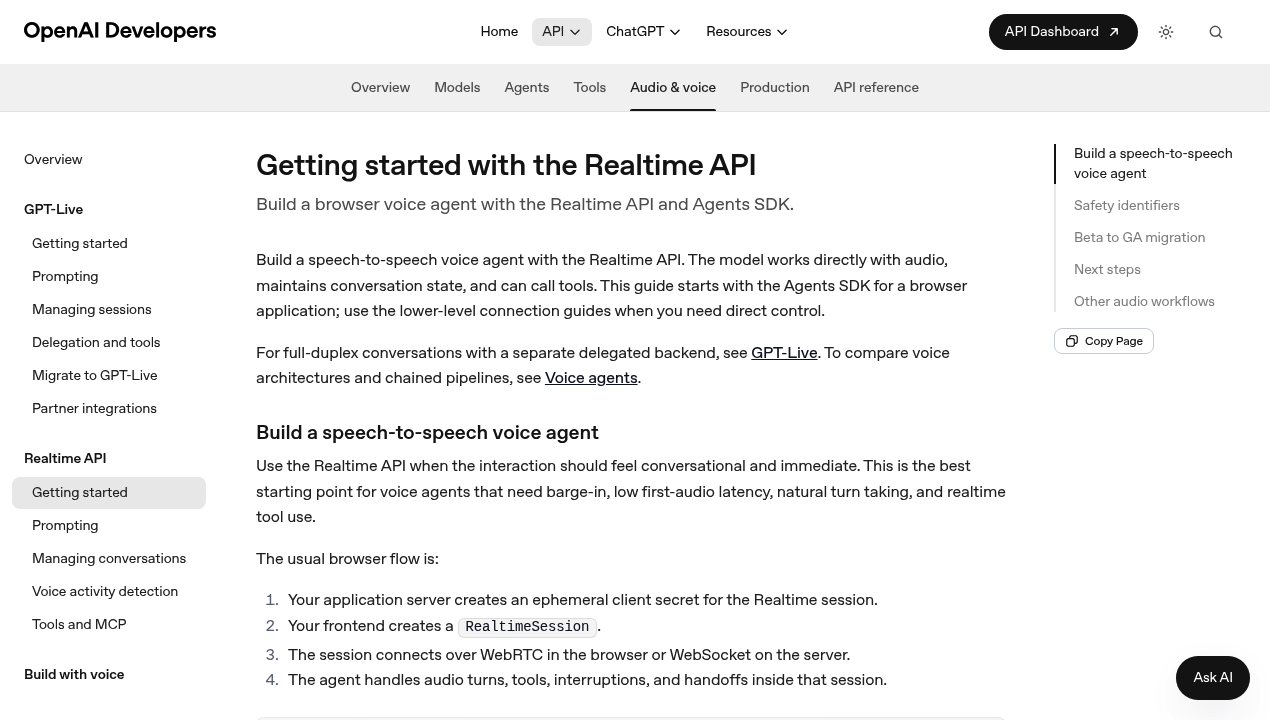
The OpenAI Realtime API is a developer interface for building voice agents that listen and speak in real time. Documentation walks through creating a browser voice agent with the Agents SDK, then covers prompting, managing conversations, voice activity detection, tools and MCP connections. Developers can connect over WebRTC, WebSockets or telephony and SIP, and related guides describe live transcription, live translation and text-to-speech. Custom voices, server-side controls and audio processing are part of the same section of the docs.
The audience is software engineers, solutions architects and product teams who want spoken interaction inside an application rather than a text box. A startup can prototype a voice front end for its product, while an enterprise team can follow the production guidance on latency, accuracy and cost optimization before launch. Contact center developers will look at the SIP and telephony options, and accessibility teams may explore live transcription. Working with it requires comfort with APIs and SDKs, so it is not a no-code option for general consumers or business users.
Typical scenarios include a support assistant that answers phone calls, an in-browser tutor that speaks with learners, a voice interface for a mobile app, and a live interpreter that translates speech between two languages. Developers connect tool calls so the agent can look up an order, schedule an appointment or query internal data in the middle of a conversation. The production section offers a deployment checklist, performance and quality tips, and ways to reduce cost and improve throughput as traffic grows.