
OpenAI for Healthcare logo

OpenAI for Healthcare

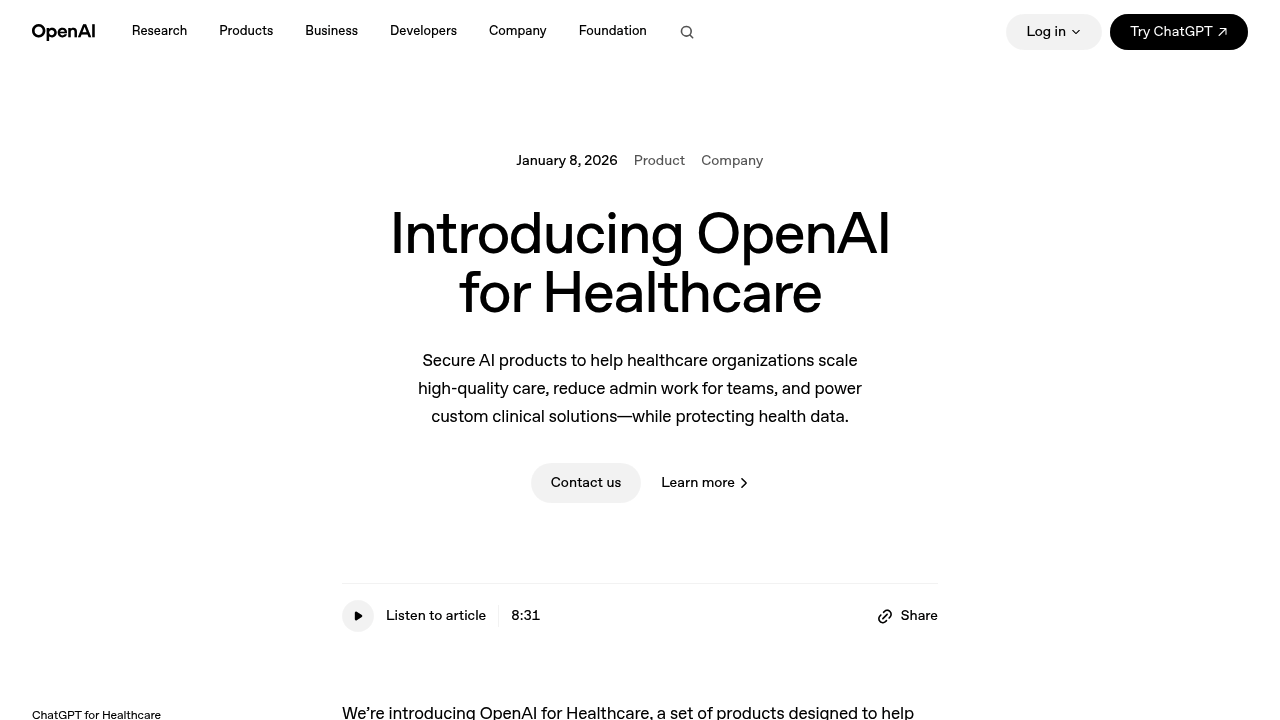
OpenAI for Healthcare is a set of secure AI products for healthcare organizations, introduced on January 8, 2026.

It bundles an enterprise workspace for clinicians, administrators and researchers with the OpenAI API, so hospitals can reduce administrative work, support clinical workflows and power custom clinical solutions while…

OpenAI for Healthcare screenshot

OpenAI for Healthcare is a set of secure AI products for healthcare organizations, introduced on January 8, 2026. It bundles an enterprise workspace for clinicians, administrators and researchers with the OpenAI API, so hospitals can reduce administrative work, support clinical workflows and power custom clinical solutions while protecting health data and supporting HIPAA compliance. The workspace includes models built for healthcare and evaluated through physician-led testing, and answers that cite sources such as peer-reviewed studies, public health guidance and clinical guidelines with titles, journals and dates.

Hospitals and health systems are the primary customers, and early partners include AdventHealth, Baylor Scott & White Health, Boston Children's Hospital, Cedars-Sinai, HCA Healthcare, Memorial Sloan Kettering and UCSF. Clinicians use it for evidence-based reasoning, administrators for paperwork, and researchers for literature. Health technology companies such as Abridge, Ambience and EliseAI build on the API in HIPAA-compliant configurations. IT and compliance leaders get role-based access, SAML SSO and SCIM user management, audit logs and options for data residency and customer-managed encryption keys.

Everyday uses include drafting discharge summaries, patient instructions and clinical letters from shared templates, and supporting prior authorization requests. Integrations with enterprise tools such as Microsoft SharePoint let responses reflect an institution's own approved policies and care pathways, so teams follow consistent procedures. A clinician preparing for a complex case can ask a question and receive an answer with transparent citations to check quickly. Developers can embed the API in ambient documentation, patient engagement or operations software, with a Business Associate Agreement available to support compliance.


OpenAI for Healthcare alternatives

See all →

Frequently asked

6 questions
What does OpenAI for Healthcare provide?
An enterprise workspace for healthcare teams and API access for building clinical applications are provided. Features include evidence retrieval with citations, reusable workflow templates and governance controls.
Who is OpenAI for Healthcare meant for?
Hospitals, health systems and healthcare software companies are the intended customers. Clinicians, administrators and researchers can all work in the same secure workspace.
What tasks can teams automate with it?
Shared templates cover drafting discharge summaries, patient instructions, clinical letters and prior authorization support. Teams spend less time rewriting and searching for documents.
How are answers backed up?
Answers draw on millions of peer-reviewed studies, public health guidance and clinical guidelines. Clear citations with titles, journals and publication dates support quick source-checking.
What privacy and access controls are included?
Patient data and PHI remain under the organization's control, with options for data residency, audit logs and customer-managed encryption keys. Role-based access works with SAML SSO and SCIM, and a BAA is offered.
How can an organization get started?
Organizations can use a Contact us option from the announcement to begin. Developers can also use the API, which thousands of organizations have configured for HIPAA-compliant use.

Reviews (0)

Write review

No reviews yet. Be the first to share your experience.