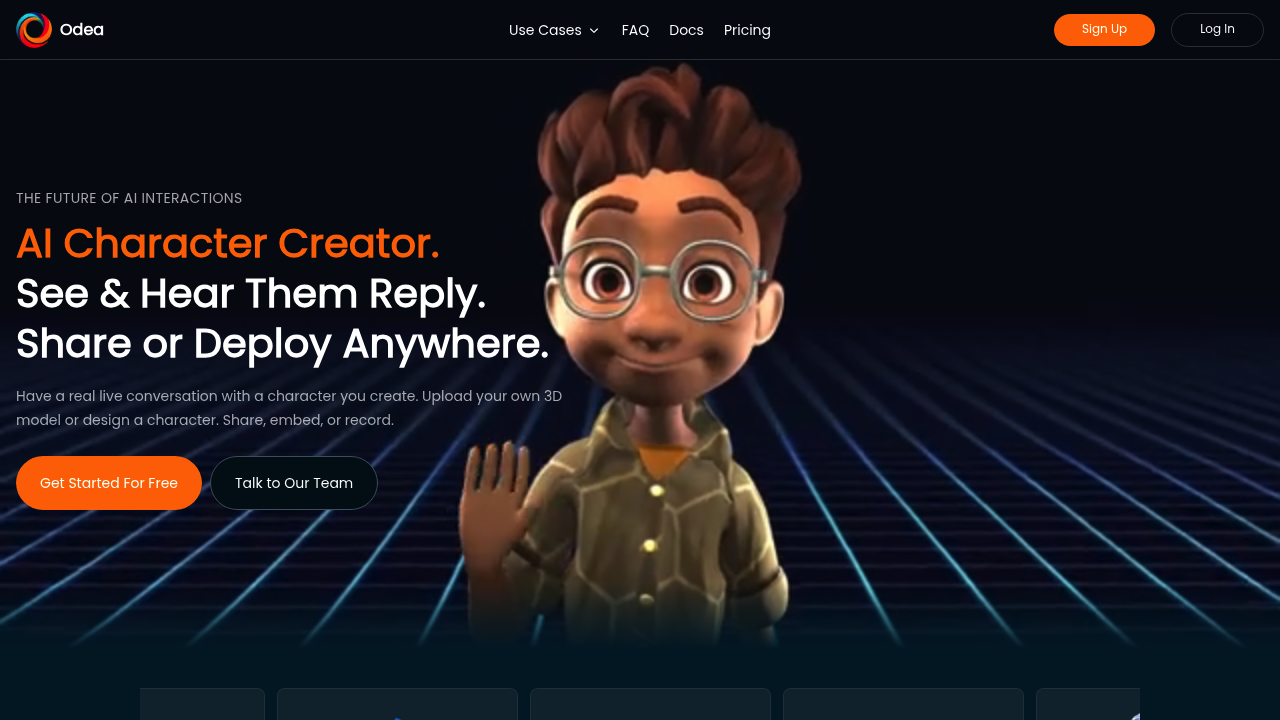
A content creator wants to offer personalized tutoring at scale but can't record hundreds of different explainer videos. They build a 3D avatar in Odea.io, configure its personality to be encouraging and patient, and give it context about their course material. Students can now have live video conversations with the avatar, asking questions and getting explanations tailored to their learning pace. The avatar embeds directly into their course website with no coding required.
Odea.io lets you either pick from a library of 3D characters or upload your own rigged 3D models. You configure personality traits, select voice options, and provide context about what the avatar should know. Once set up, the avatar can hold natural conversations through live video calls or embedded website widgets. You can record these conversations and share avatars with specific audiences.
A customer service manager at a small e-commerce company creates an avatar to handle basic product questions on their site. The avatar sits embedded in the corner of their product pages, answering sizing questions and explaining return policies during off-hours when their two-person support team isn't available. Customers click to start a video conversation instead of waiting for email responses. The manager configured the avatar with their brand's friendly tone and loaded it with their entire FAQ documentation as context.
An indie game developer creates companion characters that players can video chat with between gaming sessions. Each character has distinct personality configuration and voice. Players build relationships through these conversations, making the game world feel more alive than text-only interactions would allow.
Odea.io works well when you need conversational AI with a visual presence and have clear context to provide. It handles straightforward question-and-answer scenarios, educational tutoring, basic customer service, and entertainment applications. The no-code setup means non-technical users can deploy working avatars quickly.
Where it struggles: The avatar quality depends entirely on how well you configure personality and context. If you provide vague or incomplete information, conversations will feel shallow. Odea.io doesn't create the personality for you. It just provides the framework. You're responsible for defining how the character should behave and what it should know.
The free plan offers 10 minutes per month with unlimited avatar creation and embedding access. That's enough to test Odea.io but not to run any real application. The Starter plan at $10 monthly includes 200 minutes. Growth costs $40 monthly for 1000 minutes, with only 50 spots available at that Early Adopter rate. Enterprise pricing is custom and includes volume discounts, custom 3D animated avatars, full integration service, and dedicated support.
Content creators with established audiences who want to offer interactive experiences without hiring voice actors will benefit from this. Small businesses handling repetitive customer questions that don't require human judgment can offload those conversations. Educators building self-paced courses can provide students with always-available tutoring. Game developers and entertainment projects wanting character interaction beyond scripted dialogue have a clear application.
Skip this if you need text-based chatbots without the visual component. The 3D avatar is the entire point here. If you don't have clear use cases for video conversations or embedded visual characters, simpler chat tools will work better. Companies needing deep integrations with existing customer service platforms won't find those connections built in. And if you're not comfortable defining personality traits and providing detailed context, you will end up with underwhelming avatar interactions that don't serve your users well.