
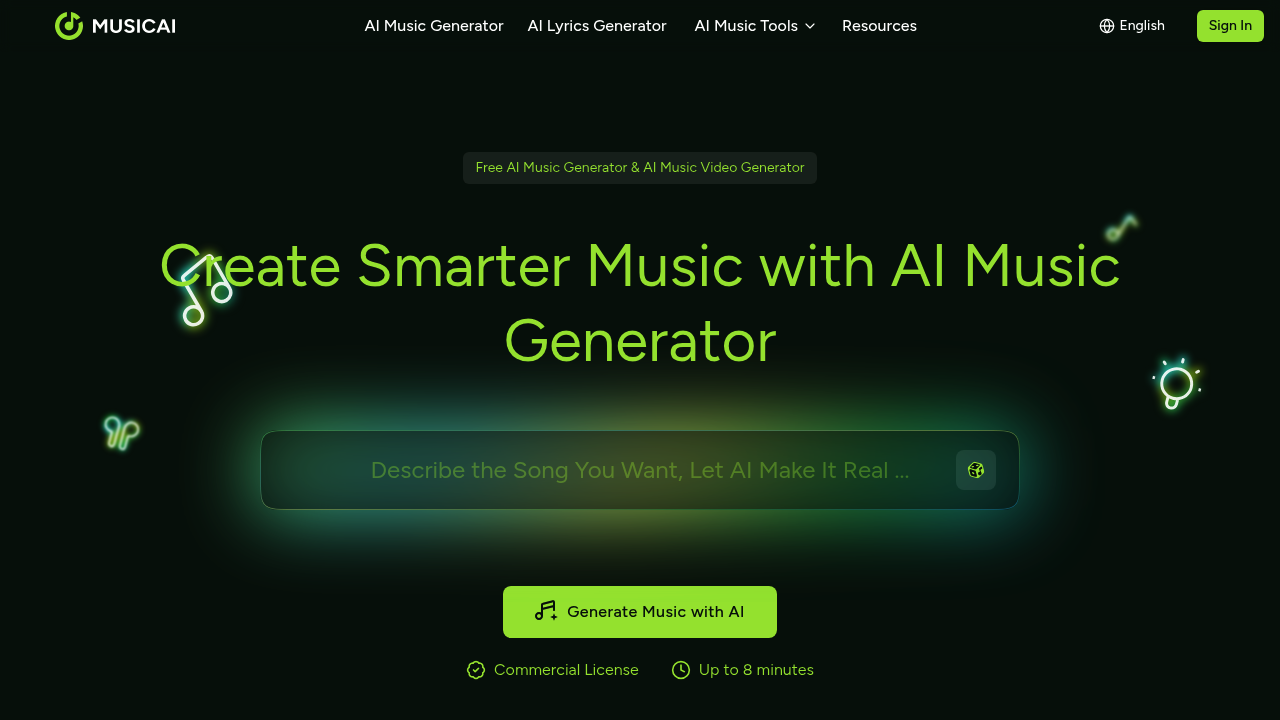
A YouTube creator needs background music for a travel vlog but can't afford licensing fees and doesn't want copyright strikes. She types a description of the mood she wants — upbeat, acoustic, summery — and MusicAI.ai generates a complete track in seconds. She downloads it, drops it into her edit, and publishes without worrying about royalties. This service creates original music from text prompts, lyrics, images, or melodies, producing tracks she can use commercially with a paid plan.
MusicAI.ai handles the full spectrum of music creation and manipulation. The AI Music Generator takes text descriptions or lyrics and turns them into complete songs. A songwriter stuck on melody can input her lyrics and get musical ideas to build from. The AI Lyrics Generator works in reverse — feed it a theme or style and it writes lyrics. The Stem Splitter breaks existing songs into individual instrument tracks, useful for a music producer who wants to isolate drums or guitar parts. The Vocal Remover strips vocals entirely, creating instrumental versions. Photo to Music Generator creates soundtracks from images, which sounds experimental but could work for a visual artist scoring a gallery installation.
MusicAI.ai offers specific genre tools like an AI Rap Generator and Lofi Converter. The Singing Voice Generator and Song Cover Generator let users create vocal performances in different styles or voices. A podcaster could generate intro music tailored to their show's theme. A game developer prototyping an indie title could create placeholder tracks without hiring a composer yet. The MIDI Editor and Audio to MIDI conversion give producers more control over generated output, translating audio into editable MIDI data.
The commercial licensing gets messy fast. Free users get two songs and one music generation monthly, personal use only. That's fine for hobbyists or testing, but a content creator who posts weekly can't survive on two songs a month. The Starter plan at $10.49 monthly includes commercial license with 200 songs and 100 music generations monthly, plus 1000 download times. The terminology's confusing — what's the difference between a song and a music generation? Hobby at $20.99 monthly bumps to 500 songs and 250 generations with unlimited downloads. Professional at $34.99 monthly offers 1200 songs and 600 generations. Yearly billing cuts 30% off.
The output quality matters but is not documented. AI-generated music often sounds generic or lacks the dynamic arrangement a human composer would create. A wedding videographer might find the tracks serviceable for montages but too flat for ceremony moments. The Music Analyzer and AI Mastering tools suggest post-processing, but free users only get basic versions. MusicAI.ai claims tracks run up to eight minutes, which works for most content but not for longer projects like documentaries.
Musicians looking for creative partnership won't find it here. This isn't a collaborator that understands musical theory or responds to feedback with nuance. It's a generator. A producer with specific arrangement ideas will hit walls when the AI doesn't interpret prompts the way they envision. The Singing Voice Model Training feature allows users create custom voice models, but that's advanced territory that most casual users won't touch.
Skip this if you need music with specific emotional beats or if you're creating high-production content where sound quality's critical. The free tier's too restrictive for anyone creating regularly. But for content creators who need safe, quick background music and can tolerate some generic output, the paid tiers solve the licensing headache cheaply.