
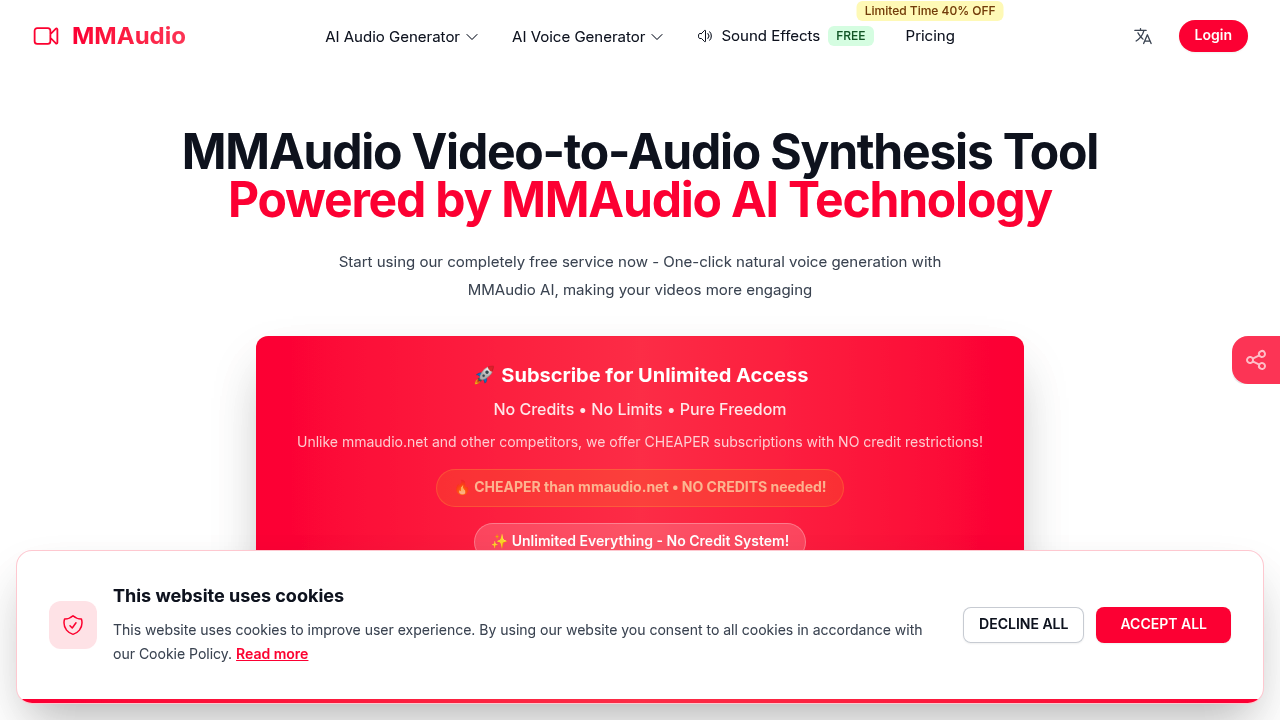
You upload a video and this thing analyzes what's happening on screen, then generates matching audio. Sound effects, ambient noise, voiceovers (all synthesized to sync with your footage). The core tech comes from the open-source MMAudio AI project, but this commercial version wraps it in a web interface with subscription plans instead of the credit systems most competitors use.
Does it actually work? Processing speed is legitimately fast. An 8-second video gets processed in 2 seconds according to their numbers. You can feed it video files directly (MP4, AVI, MOV) or paste URLs. There's also a text-to-audio mode where you type descriptions and it generates corresponding sounds. The free tier lets you test basic effects, but you're capped at 50MB file sizes and stuck with MP4 only. Voice generation maxes out at 1,000 characters on the starter plan.
Here's where it gets restricted. The free and $4.99 plans only give you "basic" effect types. Advanced effects, timeline controls, and sound conversion features are locked behind the Professional tier at $14.99 monthly. That's a pretty significant feature wall. Batch processing? Also gated to Professional and Enterprise plans. The character limits on voice generation feel tight too — 1,000 characters won't get you far if you're generating longer narration tracks.
File size caps matter more than you'd think. 50MB disappears quickly with high-quality video. Professional bumps you to 100MB and promises 2x faster priority processing, but that's still not huge if you're working with longer content. And there's zero mention of API access or integrations with editing software, so this lives entirely in its own web interface. You're uploading, processing, downloading. No Premiere plugins or After Effects extensions.
The pricing structure is straightforward at least. $4.99 monthly gets you past the free tier's limitations but keeps you on basic effects. $14.99 opens up advanced and timeline effects plus faster processing. $24.99 Enterprise exists but details are vague — just "maximum flexibility" language without concrete specs. They're running a 40% discount right now, though limited-time promotions always raise questions about sustainability. Annual billing only for paid plans.
The comparison point they make is interesting. They claim they're cheaper than mmaudio.net and don't use credit systems. That's true — you get unlimited usage within your plan's feature set rather than burning credits per generation. Whether that's better depends on your volume. Light users might prefer pay-per-use. Heavy users benefit from flat monthly costs.
Who actually needs this? Content creators pumping out social media videos without budgets for sound designers. Researchers prototyping video projects with small production teams who need placeholder audio fast. It's not replacing professional sound design, but it fills the gap when you need something functional quickly. The voice generation could work for rough demo narrations or internal presentations.
The open-source foundation means the underlying AI tech isn't proprietary, which explains the competitive pricing. But it also means the differentiation is mostly in the interface and subscription model rather than breakthrough technology. It does one thing reasonably well at accessible price points. Just know you're buying convenience and speed, not Hollywood-grade audio production.