
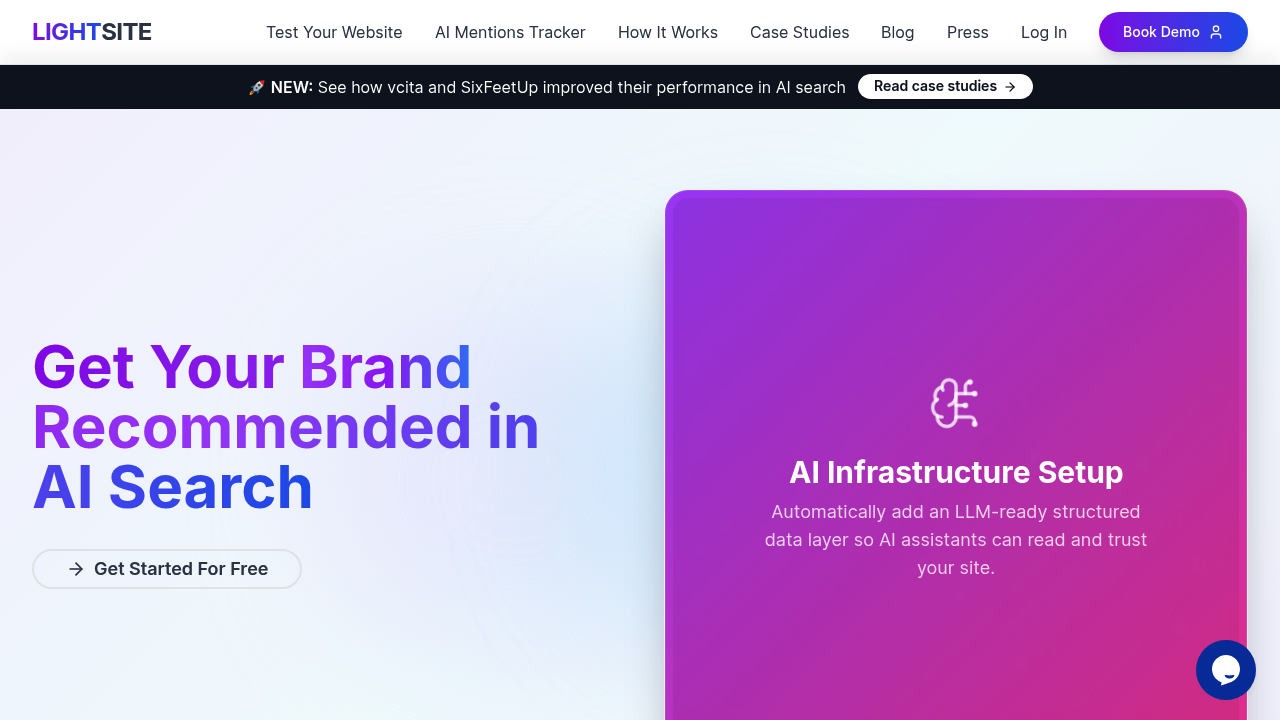
Businesses now face a visibility problem beyond traditional search engines. When users ask AI assistants for recommendations, those systems pull from structured data layers most websites do not have. LightSite AI addresses this gap by retrofitting existing websites with infrastructure that makes content readable and recommendable to generative search platforms.
The core infrastructure feature automatically adds structured data layers optimized for large language models. This happens without developer involvement and completes in roughly 10 minutes according to the company's claims. The system doesn't require code changes or technical implementation, which removes the typical barrier marketing teams face when trying to optimize for new channels.
Crawler analytics tracks which AI bots visit specific pages, giving visibility into what content these systems actually see. Search presence monitoring reveals whether AI platforms recommend your business when users ask relevant questions. This creates a feedback loop where teams can identify which prompts trigger their content and which don't. Prompt-level control lets businesses influence when their information surfaces in AI-generated responses.
Competitor intelligence shows why other companies get cited in AI responses. LightSite AI performs semantic analysis to identify positioning gaps, revealing where competitors outrank you in generative search results. AI position intelligence compares your semantic footprint against rivals. Sentiment control monitoring tracks how AI systems describe your brand, letting teams spot and address negative or inaccurate characterizations.
The content optimization features provide real-time suggestions for filling gaps that prevent AI citations. Teams can create answers formatted for AI reuse, preparing content that language models can easily extract and present. The unified workflow combines traditional SEO with what LightSite AI calls GEO, or generative engine optimization.
Performance data from named clients shows measurable results. NextGen Technology saw AI impressions increase 13%. Wolt gained 9% organic traffic growth. Naturally Namibia recorded 11% organic traffic improvement over two months. Vcita achieved a 13% boost in AI impressions. Business Bricks experienced 7% organic traffic growth.
LightSite AI targets marketing teams, SEO managers, CMOs, and digital marketing specialists who recognize that search behavior now extends beyond traditional engines. Companies wanting visibility where users actually ask questions rather than browse links face a distinctly different optimization challenge. LightSite AI positions itself as the bridge between existing website content and the structured data requirements of AI recommendation systems. The 10-minute setup claim matters because it suggests marketing teams can implement this without entering development queue backlogs.