
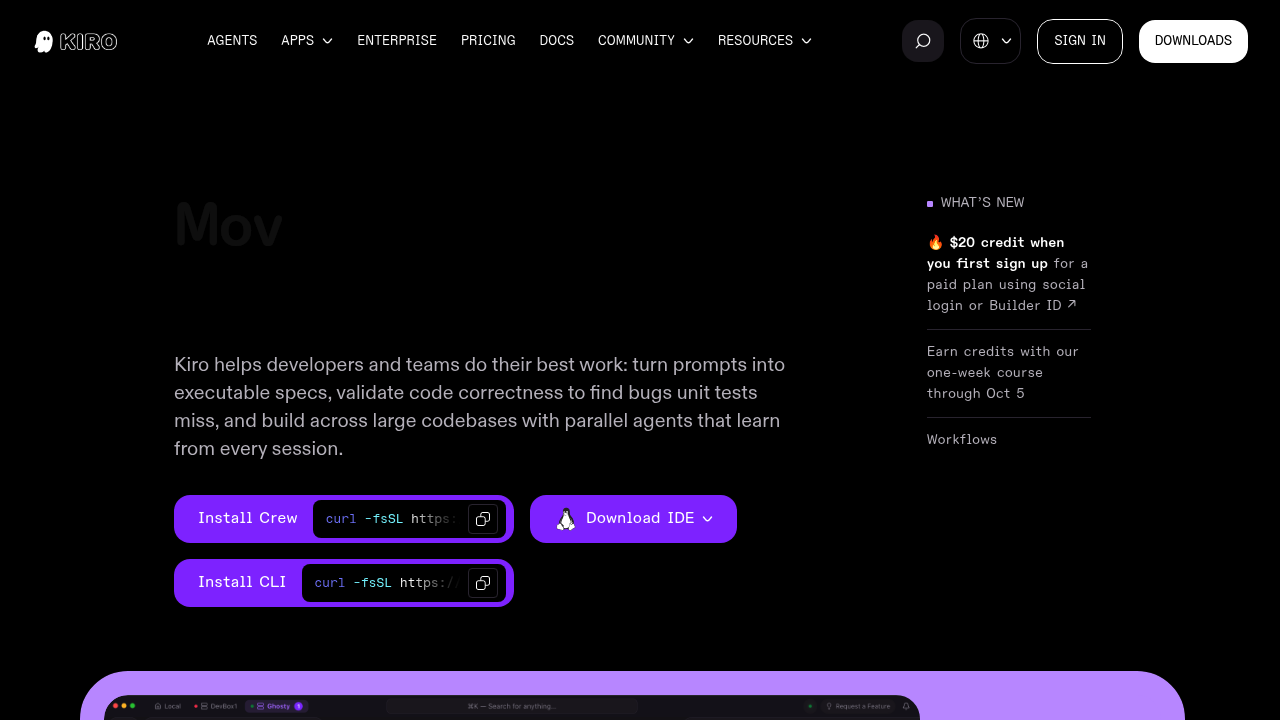
Kiro is an agentic engineering environment for developers and teams. It starts from a prompt and produces requirements, architectural designs and sequenced tasks, then implements them with parallel agents running locally or in the cloud. Property-based tests and automated reasoning checks look for contradictions and edge cases that ordinary unit tests miss. Kiro ships as an IDE, a CLI and a web version, and it supports MCP, AGENTS.md and Agent Client Protocol. A free tier includes 50 credits, and paid plans run $20, $40, $100 and $200 per month.
Professional software developers who want structure around AI-assisted coding are the primary audience, especially those who care whether code matches a written specification. Engineering teams of up to 500 users can subscribe on per-user plans, and larger organizations can ask for centralized billing, SSO, usage analytics and enterprise security controls. Platform and DevOps engineers benefit from the headless CLI in CI/CD pipelines, and developers coming from other editors can import settings from their existing IDE. Newcomers can follow guides and a game-building tutorial to learn the workflow.
A developer describes a feature, reviews the generated requirements and design, and lets parallel agents implement the tasks while property-based tests verify rules that must hold across all inputs, such as rate limiting on an export endpoint. Teams run the CLI in CI to review pull requests and fix bugs without opening an editor. Engineers pull context from tools like Figma or Terraform into a session, switch between model families or leave selection to Auto, and work across large codebases with agents that learn from each session. Add-on credits cover busy months at $0.04 per credit.