
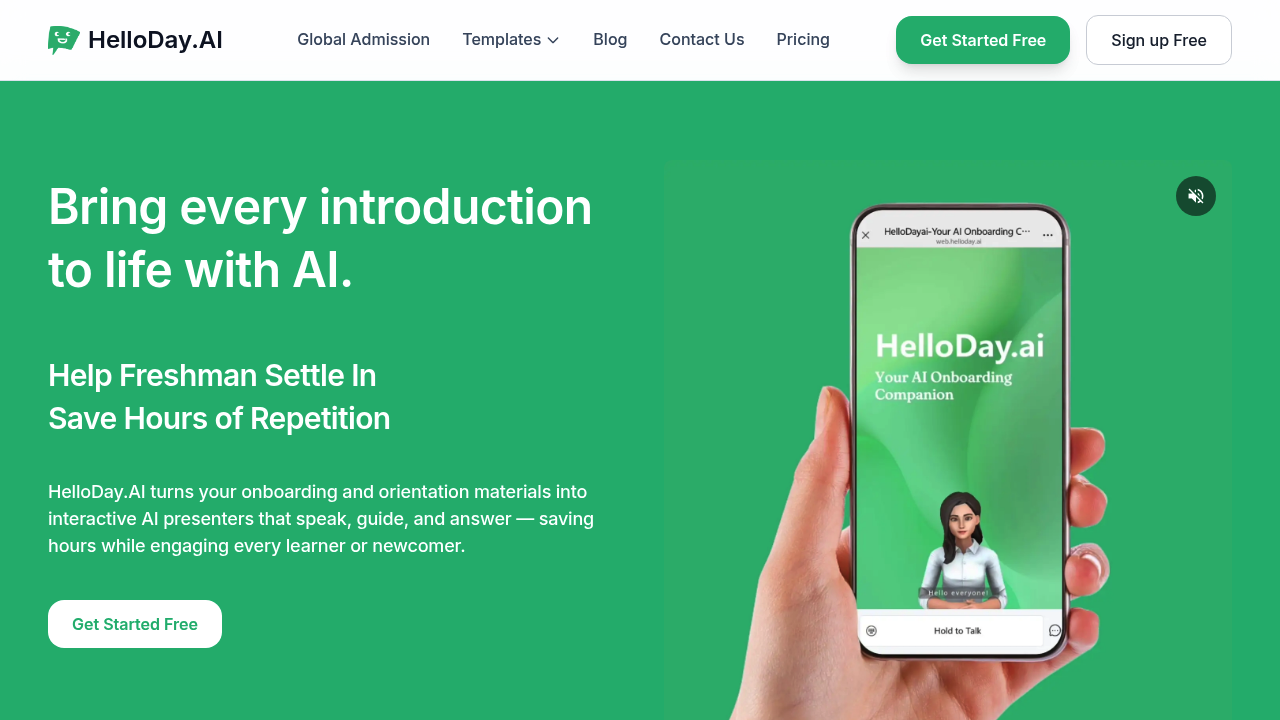
Drop a 50-page orientation PDF into HelloDay.ai and it becomes a talking AI assistant. Students or employees can ask questions, get instant answers in their language, and work through materials at their own pace. HelloDay.ai handles everything from virtual campus tours to policy explanations without human intervention.
The conversion process takes existing documents and transforms them into interactive experiences. Someone joining your company can ask the AI about vacation policies or benefits enrollment rather than hunting through slide decks. Universities use it for course registration guidance and answering the same freshman questions hundreds of times. It supports over 20 languages, which matters when you're onboarding international students or global teams.
Does the automation actually deliver? The tracking features show who completed what and where people got stuck. You can export completion reports and edit the knowledge base when policies change. The AI answers pull from your uploaded content, so responses stay consistent with your actual materials. It's available 24/7, which beats waiting for someone in HR to respond to an email.
The limitations show up in member caps. Really small. The Micro plan at $9.90 monthly handles 10 people with only 3 AI interactives. Launch jumps to 30 members and 10 interactives for $29 monthly. You don't get unlimited interactives until the Grow plan at $99 monthly for 100 members. Scale runs $499 monthly for 500 members. Enterprise pricing is custom with no member limits.
That roughly dollar-per-person pricing looks reasonable if you're replacing expensive onboarding methods. HelloDay.ai claims to cut traditional costs by 99% compared to hiring translators at $500+ daily or paying $300-500 hourly for HR training sessions. Factory safety training at $400 per session adds up fast. But you need consistent onboarding volume for the math to work. A company hiring three people per year won't see those savings.
What's missing matters for some organizations. No integrations listed means you're probably copying data manually between systems. Can't tell if there's API access for connecting to existing HR platforms or student information systems. No mobile app mentioned, though the interactive assistants likely work in browsers. HelloDay.ai focuses narrowly on document-to-AI conversion rather than broader onboarding workflows like task assignments or signature collection.
The personalized onboarding paths feature suggests some customization based on role or department, but details are thin. How much branching logic can you build? Can you gate certain content until prerequisites are complete? The engagement tracking is useful but doesn't clarify what metrics you actually see.
Universities dealing with repetitive orientation questions across hundreds of incoming students will find this highly useful. HR teams at companies with multilingual workforces can skip the translator expenses. Startups scaling quickly might appreciate automated onboarding that doesn't require constant human involvement. But smaller organizations without regular onboarding needs or those requiring deep integration with existing systems should think twice. HelloDay.ai does one thing well—turns static documents into interactive AI guides. Just make sure that's the specific problem you need solved.