FireHydrant logo
AI Developer Tools FREEMIUM from $25/mo

FireHydrant

FireHydrant is an incident management system that brings alerting, on-call scheduling, runbooks, status pages and retrospectives into one place.

When something breaks in production, it pages the right engineer, opens a dedicated channel in Slack or Microsoft Teams, and tracks every step through resolution. AI features write incident summaries, draft status page…

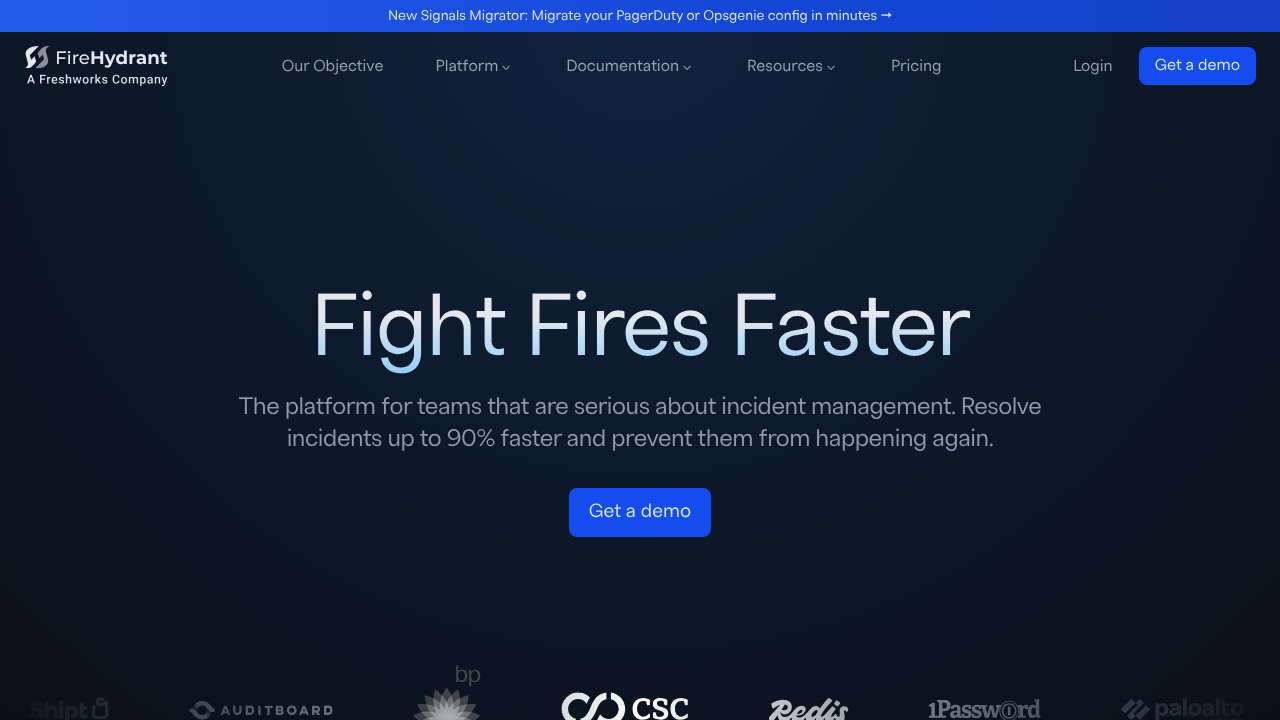
FireHydrant screenshot

FireHydrant is an incident management system that brings alerting, on-call scheduling, runbooks, status pages and retrospectives into one place. When something breaks in production, it pages the right engineer, opens a dedicated channel in Slack or Microsoft Teams, and tracks every step through resolution. AI features write incident summaries, draft status page updates, transcribe Zoom and Google Meet calls, and assemble retrospectives from the incident data. A Signals Migrator imports existing PagerDuty or Opsgenie configurations in minutes.

Site reliability engineers, DevOps teams and platform groups are the core audience. Engineering managers use the analytics to track mean time to mitigate and other MTTx figures across incidents, while on-call responders rely on the service catalog to see who owns a failing service and what depends on it. Security and compliance staff get SOC 2 compliance, SSO, RBAC, audit logs and SCIM. Teams that already script their infrastructure can work against 350+ API endpoints, Terraform support and SDKs.

Typical scenarios start with an alert firing at night: the on-call engineer is paged, an automated runbook assigns roles and pulls context into a channel, and stakeholders receive status page updates without anyone typing them by hand. After the fix, the AI-enhanced retrospective captures the timeline and assigns follow-up tasks so the same failure is less likely to return. Backblaze reports cutting its Mean Time to Mitigate by 91%. Companies moving off PagerDuty or Opsgenie can import their schedules and escalation policies, then run incident response, paging and postmortems from a single product.

FireHydrant alternatives

See all →

Frequently asked

6 questions
How does FireHydrant handle an incident from alert to retrospective?
An alert pages the on-call engineer, and the incident is run inside Slack or Microsoft Teams with automated runbooks guiding the steps. AI produces summaries and status page updates along the way. Afterward it assembles a retrospective and assigns follow-up action items.
Who are the typical users of FireHydrant?
SRE, DevOps and platform engineering teams are the main users, along with engineering managers who track response metrics. Security teams benefit from SOC 2 compliance, SSO, RBAC, audit logs and SCIM.
Can FireHydrant document a live incident call automatically?
Live video transcription works with Zoom and Google Meet, so decisions made during the call are written down automatically. Those notes feed the incident summary and the later retrospective.
Is there a way to try FireHydrant before committing?
A Start for free option and a demo booking are both offered. Plan pricing is handled through the vendor directly.
What gaps should teams weigh before choosing FireHydrant?
The product is aimed at engineering teams running software in production, so it is not a general helpdesk or business ticketing system. Chat-based response also assumes the team works in Slack or Microsoft Teams.
How can an existing PagerDuty or Opsgenie setup move over?
PagerDuty or Opsgenie configuration imports in minutes through the Signals Migrator. For custom workflows there are 350+ API endpoints, Terraform support and SDKs.

Reviews (0)

Write review

No reviews yet. Be the first to share your experience.