
Evo 2 logo

Evo 2

Evo 2 is a genomic foundation model from Arc Institute that handles prediction and design tasks across DNA, RNA and proteins.

It models biological sequences at single-nucleotide resolution, with near-linear scaling of compute and memory relative to context length. The model has 40 billion parameters, a context window of 1 megabase and training…

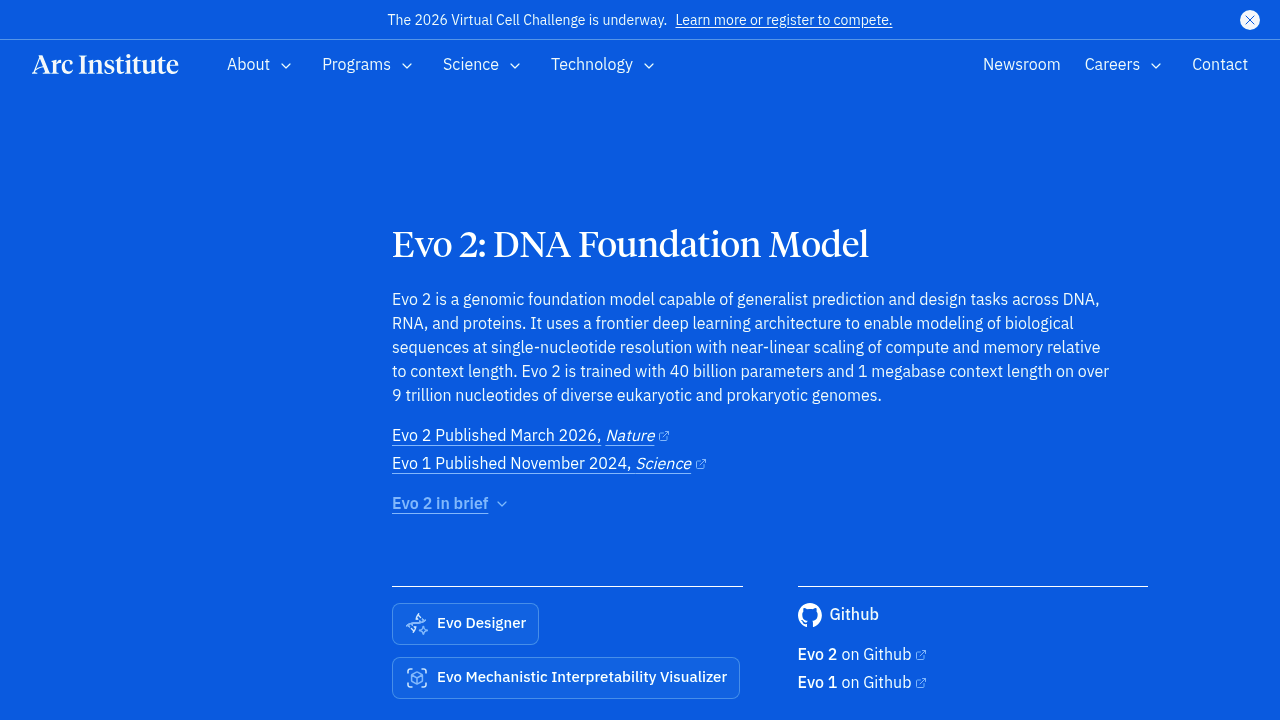
Evo 2 screenshot

Evo 2 is a genomic foundation model from Arc Institute that handles prediction and design tasks across DNA, RNA and proteins. It models biological sequences at single-nucleotide resolution, with near-linear scaling of compute and memory relative to context length. The model has 40 billion parameters, a context window of 1 megabase and training on more than 9 trillion nucleotides from eukaryotic and prokaryotic genomes. Evo 2 was published in Nature in March 2026, following Evo 1 in Science in 2024.

The audience is computational biologists, genomics and protein engineering researchers, and machine learning teams working on biological sequences. Because the model is released through GitHub and Hugging Face, users should be comfortable running models in code or fine-tuning them on their own data. Arc Institute also offers Evo Designer and a mechanistic interpretability visualizer for people who want to explore the model's behavior without building everything from scratch. It is a research resource rather than a polished consumer application.

A researcher can score the likely effect of a genetic variant by comparing sequence likelihoods across a long genomic region. A synthetic biology group can generate candidate DNA sequences and then test them in the lab. Protein engineers can pair Evo 2 with Arc's MULTI-evolve framework to speed up design-test-build cycles. Teams building virtual cell models can use it alongside Arc tools such as State and Stack. Interpretability researchers can inspect which sequence features the model has learned, using the visualizer, and compare behavior between Evo 1 and Evo 2.


Evo 2 alternatives

See all →

Frequently asked

6 questions
What tasks can Evo 2 perform?
Generalist prediction and design across DNA, RNA and proteins are supported. It works at single-nucleotide resolution over contexts up to 1 megabase.
Who is Evo 2 meant for?
Computational biologists, genomics researchers and machine learning teams working with biological sequences are the main users. It assumes comfort with running models in code.
How big is Evo 2?
Forty billion parameters make up the model parameters and a 1 megabase context length. It was trained on over 9 trillion nucleotides of eukaryotic and prokaryotic genomes.
Where can I get Evo 2?
Look on GitHub, where Arc Institute links Evo 2 and offers a Hugging Face integration. Evo 1 is available in the same places.
Is Evo 2 a ready-made app for non-programmers?
Most uses involve code because this is a research model. Evo Designer and the interpretability visualizer offer friendlier ways to explore it.
What other resources come with Evo 2?
Arc Institute provides Evo Designer, an Evo Mechanistic Interpretability Visualizer and an Evo 2 summary. Its wider AIxBio work includes virtual cell models such as State and Stack.

Reviews (0)

Write review

No reviews yet. Be the first to share your experience.