
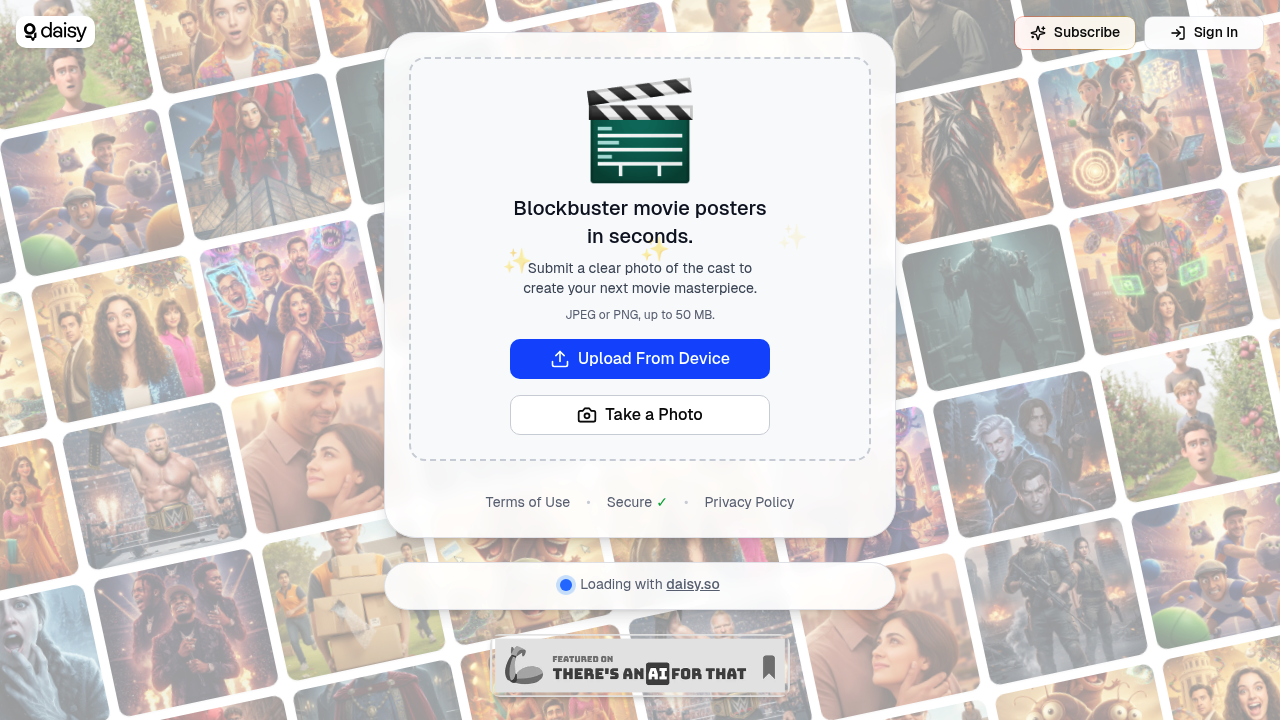
This system transforms personal photos into blockbuster movie poster artwork through an image processing pipeline that accepts user uploads and applies stylistic transformations. The system works by taking a clear photo of the intended cast and running it through visual AI models that replicate the aesthetic conventions of theatrical movie posters.
The data flow is straightforward. Users upload JPEG or PNG files directly from their device or capture a new photo through the interface. The system accepts files up to 50 MB, which provides enough resolution for detailed facial features and composition elements that the underlying models need to generate convincing poster-style outputs. Once uploaded, the processing happens server-side where the AI analyzes facial structure, lighting, and composition before applying the poster treatment.
The technical approach relies on style transfer and image generation techniques that map personal photos onto the visual language of cinema marketing materials. This includes dramatic lighting adjustments, color grading that mimics theatrical poster palettes, and compositional reframing. The models have been trained on the specific visual characteristics that define movie poster aesthetics rather than general photo editing.
Processing happens quickly. The entire transformation completes in seconds, suggesting the backend uses optimized inference rather than training custom models per request. This speed indicates pre-trained models running on GPU infrastructure with minimal preprocessing steps.
This system operates through daisy.so's platform infrastructure. It doesn't exist as a standalone service. All processing and account management happens within that ecosystem.
Output quality depends heavily on input photo clarity. The system explicitly requires clear photos of the cast, meaning blurry images, poor lighting, or obscured faces will produce suboptimal results. The AI needs distinct facial features and good composition in the source material to generate convincing poster treatments. There's no indication of manual editing tools or refinement options after generation.
File format support is limited to JPEG and PNG. No RAW formats or other image types are accepted. The 50 MB ceiling accommodates high-resolution smartphone photos and most digital camera outputs but excludes very large professional camera files.
Security is mentioned but not detailed. The system processes photos securely without specifying encryption standards or data retention policies. Users upload personal images that contain identifiable faces, so the actual security implementation matters but isn't documented in technical terms.
This system can't handle multiple generation styles or customization options based on available information. You get the blockbuster poster treatment without apparent control over specific aesthetic choices or poster genres.