
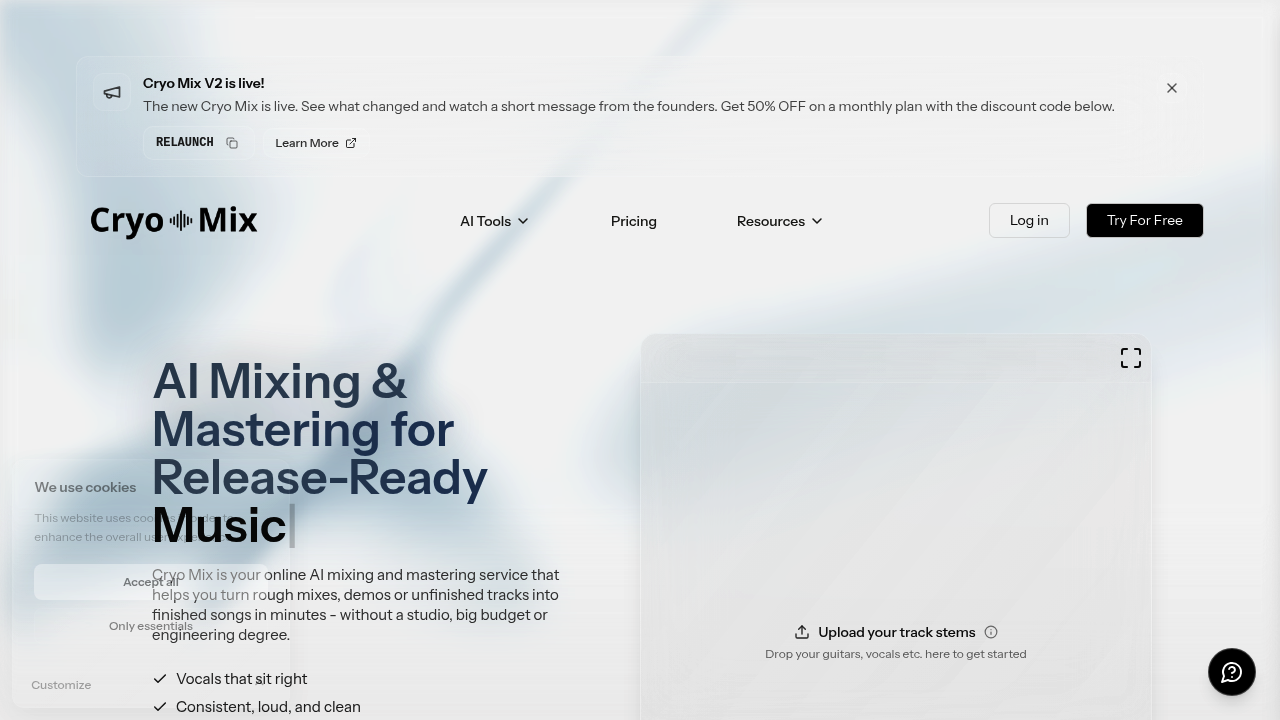
Cryo-Mix's website shows a basic landing page. Minimal information about actual capabilities. No clear details emerge about what the audio processing delivers or how it handles different file types.
Audio engineers working on tight deadlines might find themselves clicking through pages that don't explain core functionality. Cryo-Mix doesn't specify whether it handles mastering chains. EQ curves? Compression algorithms? You can't tell what separates this from other AI audio tools.
Without pricing information visible, budget planning becomes impossible.
Cryo-Mix's interface gives no hints about processing limits or file size restrictions. A podcast producer juggling multiple shows would need concrete details about batch processing capabilities and turnaround times. Can it handle 20 episodes simultaneously? Does it maintain consistent loudness standards across different content types? These workflow questions go unanswered.
Missing feature specifications make it difficult to assess whether Cryo-Mix suits professional audio work. Studio-quality results require transparency about algorithms and processing methods. Missing technical documentation leaves potential users guessing about output formats and quality preservation.
Cryo-Mix appears to target the AI audio editing space — but provides insufficient information for evaluation. The sparse website content doesn't build confidence for users managing audio projects at scale.