
#8 in AI Web Scraping Canopy API logo

Canopy API

Canopy API pulls Amazon product data through REST and GraphQL endpoints, giving developers programmatic access to information across 350 million products and 25,000 categories on Amazon

Com. The system processes requests in real time, retrieving product titles, descriptions, pricing, stock estimations, sales estimates, and customer reviews. It also handles search result queries, returning keyword…

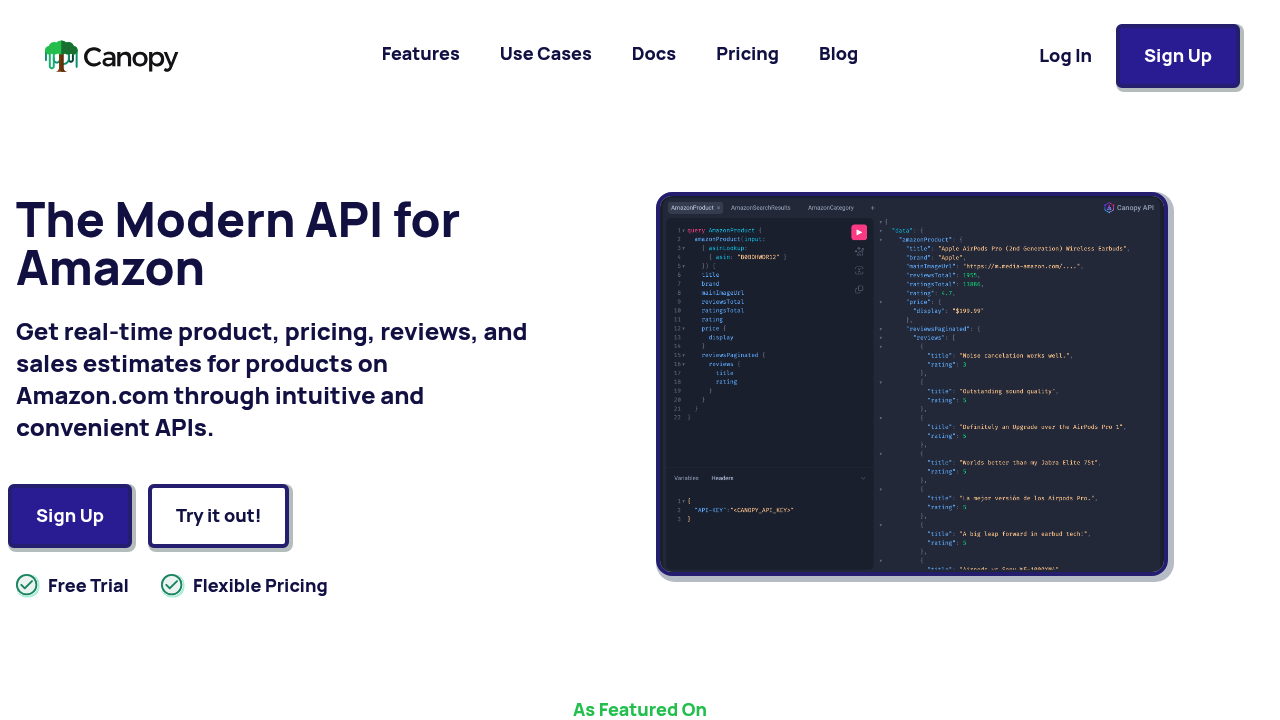
Canopy API screenshot

Canopy API pulls Amazon product data through REST and GraphQL endpoints, giving developers programmatic access to information across 350 million products and 25,000 categories on Amazon.com. The system processes requests in real time, retrieving product titles, descriptions, pricing, stock estimations, sales estimates, and customer reviews. It also handles search result queries, returning keyword rankings and product positioning data.

The technical architecture uses both REST and GraphQL interfaces, which is unusual for Amazon data services. Most competitors stick with REST alone. GraphQL lets developers request exactly the fields they need rather than receiving full product objects, reducing bandwidth and parsing overhead. The API processes queries through an AI-powered data layer that extracts and structures information from Amazon's product pages. This isn't scraping in the traditional sense. The system interprets page structure, validates data consistency, and fills gaps where Amazon's native data might be incomplete.

Behind the scenes, there's a caching system that handles over 10,000 hits daily. When multiple users request the same product data, the API serves cached responses instead of making redundant calls to Amazon. This speeds up response times and keeps costs down, though it means some data might be minutes or hours old rather than instantaneous. The cache invalidation logic isn't specified in the technical documentation, so developers can't control freshness intervals directly.

Output quality depends on what Amazon makes publicly available. Sales estimates are modeled predictions rather than exact figures since Amazon doesn't expose actual unit sales. Stock estimations work similarly, inferring availability from listing behavior rather than accessing inventory databases. Review data comes through cleanly with text, ratings, and timestamps, but the API doesn't appear to offer sentiment analysis or review summarization beyond what's already on Amazon's pages.

There aren't any listed integrations with other platforms or services. You're working with raw API responses that you'll need to pipe into your own database, analytics tools, or application logic. No webhooks for price changes or stock alerts. No pre-built connectors for Shopify, WordPress, or data warehouses.

The Hobby plan provides 100 requests monthly at no cost, permanently. That's enough for testing or very light monitoring of a small product catalog. Pay As You Go starts at zero dollars with the same 100 free requests, then charges one cent per additional request. Volume discounts apply automatically as usage scales. Premium sits at 400 dollars monthly minimum, including 100,000 requests and charging four-tenths of a cent for overages. Premium also adds phone support versus email-only for lower tiers. There's a Custom Enterprise option for higher volume needs with dedicated support and custom integrations, though specific pricing isn't published.

The biggest limitation is geographic scope. Amazon.com only. No UK, Germany, Japan, or other Amazon marketplaces. If you're building tools for international sellers or doing competitive analysis across regions, you'll need a different solution or multiple API subscriptions. The free tier's 100-request cap is tight. Monitoring even 10 products daily would burn through that in three days if you're checking prices and reviews. Rate limits aren't specified in the available documentation, so high-frequency polling strategies might hit throttling without warning. The GraphQL interface is a technical advantage, but it requires familiarity with query syntax that REST developers might not have.


Canopy API alternatives

See all →

Frequently asked

7 questions
Does Canopy API have a free tier?
The Hobby plan provides 100 API requests per month at no cost, permanently. There's no trial period because the free tier doesn't expire. Once you exceed 100 requests, you'd need to upgrade to Pay As You Go, which charges one cent per request after the same 100-request monthly allowance. The free tier includes email support but won't cut you off if you stay within the limit.
How does Canopy API get Amazon product data?
The system processes Amazon product pages through an AI-powered data layer that extracts and structures information rather than traditional scraping. It interprets page layouts, validates consistency across data points, and fills in gaps where Amazon's native data might be incomplete. Responses get served through both REST and GraphQL endpoints, with a caching system that handles over 10,000 daily hits to speed up repeated requests for the same products. Sales and stock figures are modeled estimates since Amazon doesn't expose actual inventory or unit sales numbers.
Can Canopy API access Amazon marketplaces outside the US?
Data's limited to Amazon.com only. The API doesn't support UK, Germany, Japan, or any other regional Amazon marketplaces. If you're monitoring international product listings or building tools for sellers across multiple countries, you'd need a different service or multiple API subscriptions. This geographic restriction is one of the main technical limitations.
What's the difference between REST and GraphQL in Canopy API?
REST endpoints return complete product objects with all available fields, while GraphQL lets you specify exactly which data points you need in each request. GraphQL reduces bandwidth since you're not pulling unnecessary fields like full descriptions when you only want pricing updates. Most Amazon data APIs only offer REST, so the GraphQL option is technically unusual in this space. Developers unfamiliar with GraphQL query syntax can stick with REST without losing core functionality.
How much does Canopy API cost for high-volume use?
Premium starts at 400 dollars monthly and includes 100,000 requests, with additional requests costing four-tenths of a cent each. Pay As You Go charges one cent per request after the first 100 free monthly requests, with automatic volume discounts that aren't specifically detailed. For very high volumes, there's a Custom Enterprise tier with unpublished pricing. The Premium plan also upgrades support from email to phone.
What can you build with Canopy API?
Developers use it for price monitoring tools that track competitor pricing across thousands of products, review aggregation systems that analyze customer sentiment, and sales estimation dashboards for market research. The API works for side projects monitoring a handful of products or enterprise applications handling hundreds of thousands of requests monthly. Search result data lets you track keyword rankings and product positioning over time. There aren't pre-built integrations, so you'll pipe the raw API responses into your own database or analytics stack.
How current is the data from Canopy API?
The system pulls real-time data from Amazon, but a caching layer serves repeated requests for the same products to improve speed and reduce costs. This means some responses might be minutes or hours old rather than instantaneous, depending on whether the data's already cached. Cache invalidation timing isn't exposed in the API documentation, so developers can't control or verify data freshness intervals. Sales estimates and stock levels are modeled predictions rather than live figures since Amazon doesn't publish that information directly.

Traffic

Estimated monthly website visits · last 7 months

9.9K visits/mo
Monthly visits
9.9K
↑ 2.3% MoM
Global rank
#2,032,083
US #837,742
Category rank
#8
AI Web Scraping
9.9K 8.1K 6.2K 4.4K 2.5K Jan 2026: 4.1K visits Jan 2026 Feb 2026: 2.5K visits Feb 2026 Mar 2026: 6.9K visits Mar 2026 Apr 2026: 8K visits Apr 2026 May 2026: 9.7K visits May 2026 Jun 2026: 9.7K visits Jun 2026 Jul 2026: 9.9K visits Jul 2026

Reviews (0)

Write review

No reviews yet. Be the first to share your experience.