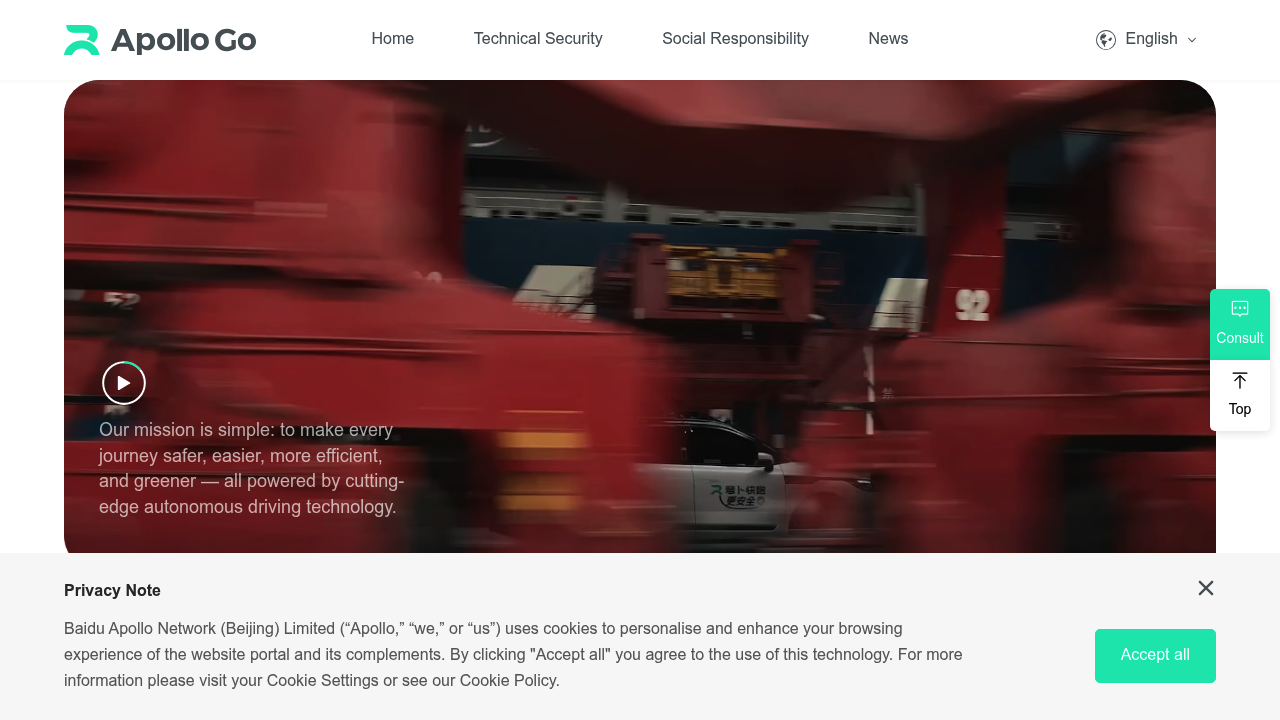
Apollo Go is Baidu's autonomous ride-hailing service, where riders request a driverless vehicle, confirm a drop-off point, wait for the car to arrive and pay at the end of the trip. The service says Apollo Go has traveled over 330 million kilometers without a single major accident. Cabins offer spacious seating, personalized features and AI-powered voice assistance, and the mission is to make journeys safer, easier, more efficient and greener. The English and Chinese interface reflects a product aimed at both domestic and international audiences.
Riders who want a ride without a human driver are the primary audience, along with people for whom conventional driving is a barrier. The company stresses inclusive mobility, with the goal of giving everyone the freedom to travel independently. City authorities, fleet operators and commercial partners are another audience, and a pre-sales consultation form lets organizations contact the team. Examples include transport regulators and ride-hailing companies seeking autonomous capacity.
Recent announcements show where the service is heading. Baidu signed a memorandum with Dubai's RTA to deploy 1,000 autonomous vehicles, partnered with Autogo on a large robotaxi fleet in Abu Dhabi, and teamed up with Lyft to deploy autonomous rides across Europe. A strategic partnership with battery maker CATL aims to speed up autonomous driving and AI innovation. In everyday use, a rider can order a car through the app, watch it arrive, and travel to a chosen destination, with payment and review handled at the end of the journey.