
Amazon SageMaker logo

Amazon SageMaker

Amazon SageMaker is AWS's service for data, analytics and AI in one place.

SageMaker AI trains, customizes and deploys machine learning models and foundation models on managed infrastructure, with HyperPod, JumpStart and MLOps tools. SageMaker Unified Studio adds notebooks with a built-in AI…

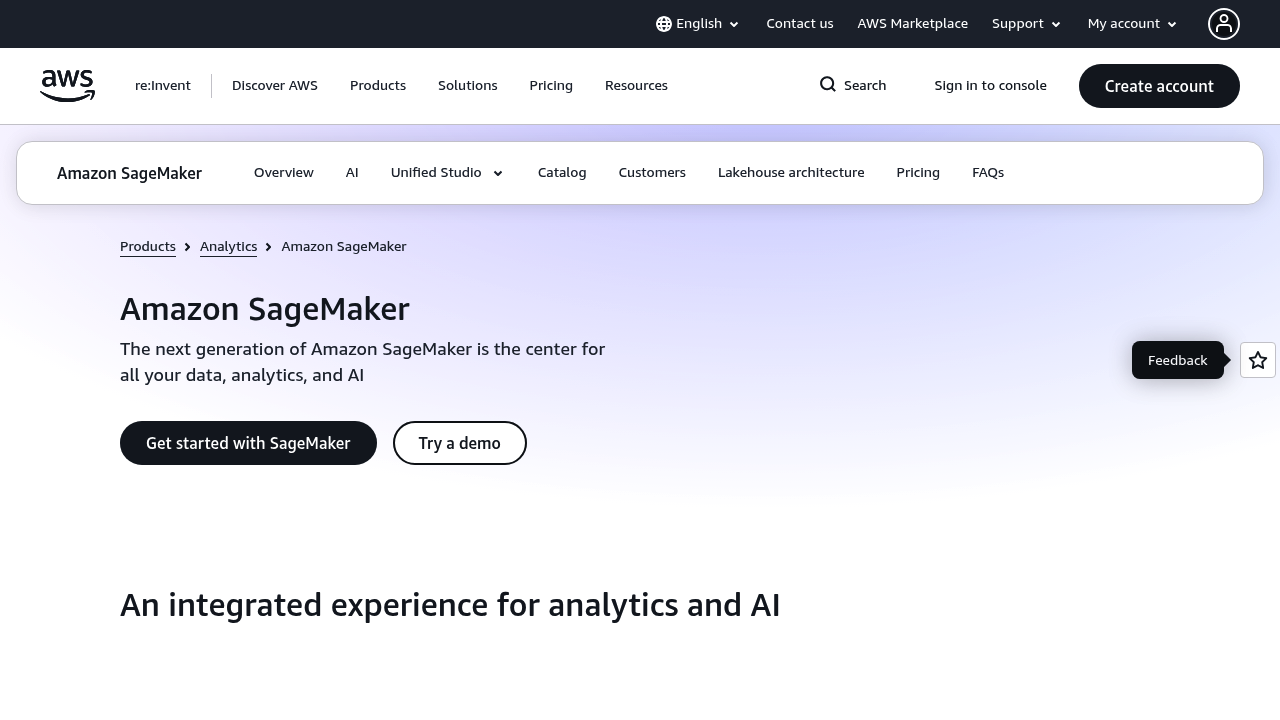
Amazon SageMaker screenshot

Amazon SageMaker is AWS's service for data, analytics and AI in one place. SageMaker AI trains, customizes and deploys machine learning models and foundation models on managed infrastructure, with HyperPod, JumpStart and MLOps tools. SageMaker Unified Studio adds notebooks with a built-in AI agent, a SQL editor and data processing, while a lakehouse on Apache Iceberg unifies data in Amazon S3 and Amazon Redshift. SageMaker Catalog, built on Amazon DataZone, handles governance and access. Billing follows each AWS service you use, and a Unified Studio free tier covers core setup and management requests.

It is built for data scientists, machine learning engineers, data engineers, analysts and platform teams at organizations that already run on AWS. A data team can build models and pipelines in one environment, while governance staff define fine-grained permissions that apply across analytics and AI tools. Enterprises with strict security needs use the catalog for classification and access policies, and generative AI developers can build applications on their own data. Customers include Toyota, Charter Communications, Lennar, Carrier and NatWest Group. Teams without AWS experience face a steeper start because costs and setup span several services.

Typical workloads include training and deploying a prediction model at scale, building a generative AI application tailored to company data, running SQL analytics across lake and warehouse data, and preparing data with processing jobs. Near real-time zero-ETL integrations bring operational databases and applications into the lakehouse, and federated queries read third-party sources in place. An analyst can ask Amazon Q Developer to find data, generate SQL or build pipeline jobs in natural language. Teams share data, models and applications as governed assets through projects and domains, which suits organizations moving from experiments to production.


Amazon SageMaker alternatives

See all →

Frequently asked

6 questions
What can Amazon SageMaker be used for?
It covers building, training and deploying machine learning and foundation models, plus data processing, SQL analytics and generative AI application development. SageMaker Unified Studio brings these tools into a single environment.
Who typically uses Amazon SageMaker?
Data scientists, ML engineers, data engineers and analysts at organizations on AWS. Toyota, Charter Communications, Lennar, Carrier and NatWest Group are listed as customers.
How does Amazon SageMaker help with data from several sources?
A lakehouse architecture unifies data across Amazon S3 data lakes and Amazon Redshift warehouses, accessible to Apache Iceberg-compatible engines. Zero-ETL integrations and federated queries reach operational and third-party data.
How is Amazon SageMaker priced?
AWS charges the pricing of each service you use, so cost depends on usage. A Unified Studio Free Tier covers core requests such as domain setup, project management, user management and policy grants.
What is a drawback of Amazon SageMaker?
Costs are spread across the individual AWS services used, which makes budgeting harder than a flat subscription. It also requires an AWS account and some familiarity with AWS tooling such as IAM Identity Center.
How does a team begin with Amazon SageMaker?
Create an IAM Identity Center based domain through the quick setup or manual option, then open SageMaker Unified Studio. A demo is available, and the manual route gives full visibility into costs.

Reviews (0)

Write review

No reviews yet. Be the first to share your experience.