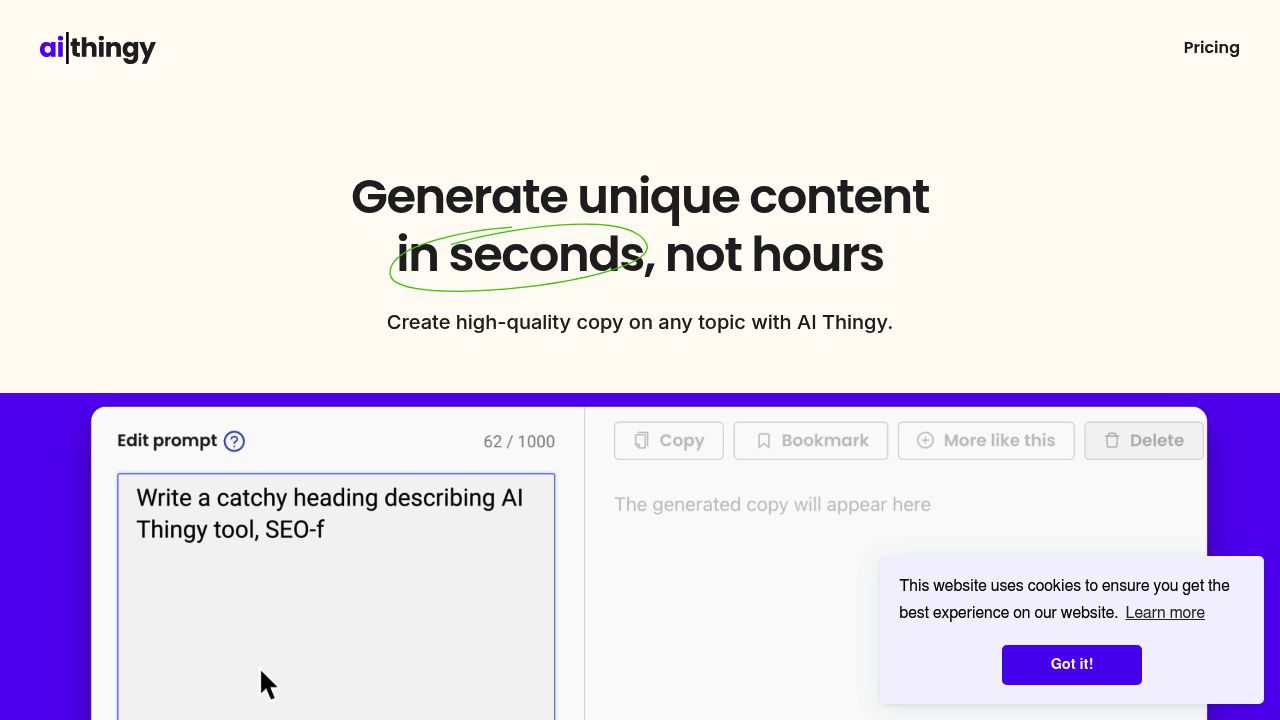
Originally built by New Zealand's Sliday Agency for internal use, AI Thingy generates marketing copy across dozens of formats in seconds. This system handles everything from ad copy and blog posts to product descriptions and email campaigns, using smart templates that adapt to different tones of voice while automatically incorporating SEO keywords. It produces content that the company claims is four times faster than manual writing while maintaining uniqueness. New users receive 100 free credits to test the system, with paid options starting at $1 for 10 credits in the Casual plan, $7 for 100 credits in the Curious plan, or $50 for 1,000 credits in the Serious plan—a pay-as-you-go model that replaces traditional subscriptions. AI Thingy also generates images to complement written content and maintains an output history with search functionality.
Copywriters juggling multiple client projects benefit from the template variety and tone controls, while marketing managers coordinating campaigns across channels can standardize messaging without bottlenecking creative teams. Content creators producing high volumes of social media posts, blog articles, and promotional materials find the speed gains particularly valuable. Scientists and academics needing to communicate research findings in accessible language use AI Thingy to translate technical concepts into public-facing copy. Students working on marketing assignments or building portfolios can experiment with professional-grade output at minimal cost through the credit system. Small business owners without dedicated marketing staff rely on it to maintain consistent web presence and advertising efforts.
E-commerce teams deploy AI Thingy for scaling product description creation across large catalogs, ensuring SEO optimization without manual keyword research for each item. Agencies managing multiple brand voices use the tone controls to maintain client-specific messaging across campaigns. The Slack integration allows marketing teams to generate quick copy during brainstorming sessions or urgent requests without switching tools. Designers working in Figma access the plugin to draft interface copy and microcopy directly within their workflow. Social media managers schedule content creation sessions using various format templates, then track past outputs through the searchable history when repurposing seasonal campaigns. The Chrome extension enables content teams to generate copy while researching competitors or reviewing analytics dashboards, keeping ideation and execution in the same browser environment.