
A TikTok creator posts three times daily, churning through ASMR video ideas faster than she can film them. Soap cutting, slime mixing, kinetic sand — her audience expects fresh content, but filming real materials means buying supplies, setting up lighting, and hoping the footage turns out viral-worthy. She switches to AI-ASMR.co and picks a template for soap carving. Eight seconds later, she's got a 1080P vertical video with synchronized cutting sounds, ready to post. No soap. No knife. No cleanup.
This service runs on templates instead of prompts. A YouTube Shorts producer doesn't type "satisfying soap cutting with ASMR sounds" and hope the AI understands. He scrolls through pre-built templates that mirror what's already trending on social feeds. Each template handles the visual generation through Veo 3.1 and pairs it with Qwen3 TTS for voice work. The output always matches — visuals sync with audio because the system controls both layers. He adjusts material variables like texture or color, then exports in either 9:16 for vertical platforms or 16:9 for horizontal.
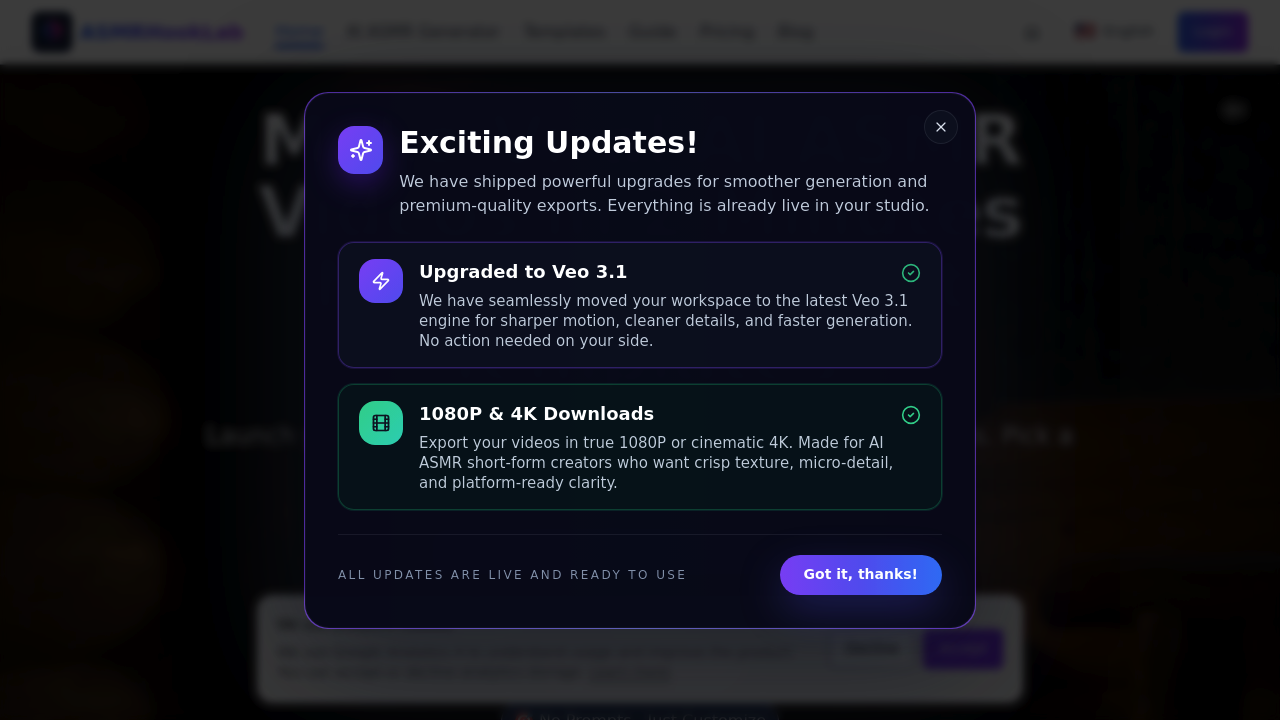
Videos generate in two quality modes. Fast Quality costs 30 credits and produces posting-ready content quickly. High Quality burns 150 credits but delivers 4K resolution. An Instagram Reels account manager on the Starter plan gets 900 monthly credits, enough for 30 fast videos or six high-quality ones. She mixes both depending on the content — fast mode for daily posts, high quality for sponsored content that needs polish. Every export comes without watermarks and includes commercial use rights.
The template library updates based on what's actually performing across platforms. A creator doesn't guess at trends. If slime videos spike this week, templates appear for that format. If kinetic sand videos trend next month, those templates get added. This removes the guesswork that tanks most AI video tools. Prompt engineering doesn't matter here. The analysis happens behind the scenes.
But the credit system creates math problems. A Creator plan member gets 2,400 credits monthly. If she needs all high-quality output, that's 16 videos. If a brand deal requires 20 videos in 4K, she's stuck upgrading to Pro or rationing quality. The 8-second loop length also boxes content into specific formats. Long-form ASMR channels that run 10 or 20-minute videos can't use this. It's built for short-form bursts.
This tool works for volume creators who post daily or multiple times daily across TikTok, YouTube Shorts, and Instagram Reels. A social media manager handling five ASMR accounts finds value because templates speed up production without requiring physical materials. The $7.92 monthly Starter plan fits hobbyists testing ASMR content. The $39.17 Pro tier makes sense for agencies or creators monetizing multiple channels who need 200 fast videos monthly.
It doesn't fit creators who want full creative control over every frame. Template-based generation means accepting pre-designed formats. A filmmaker wanting specific camera angles or custom animations won't find those levers here. Anyone making longer ASMR content hits the 8-second wall immediately. And creators who post sporadically — once weekly or less — pay for monthly credits they won't use. The credit system penalizes inconsistent posting schedules.
Over 2,000 people actively use it, with 5,000 videos generated and a 4.9 out of 5 rating. Those numbers suggest it solves a real production bottleneck for ASMR creators who need volume more than artistry.