ADSoar logo
AI Ad Generator PAID from $39/mo

ADSoar

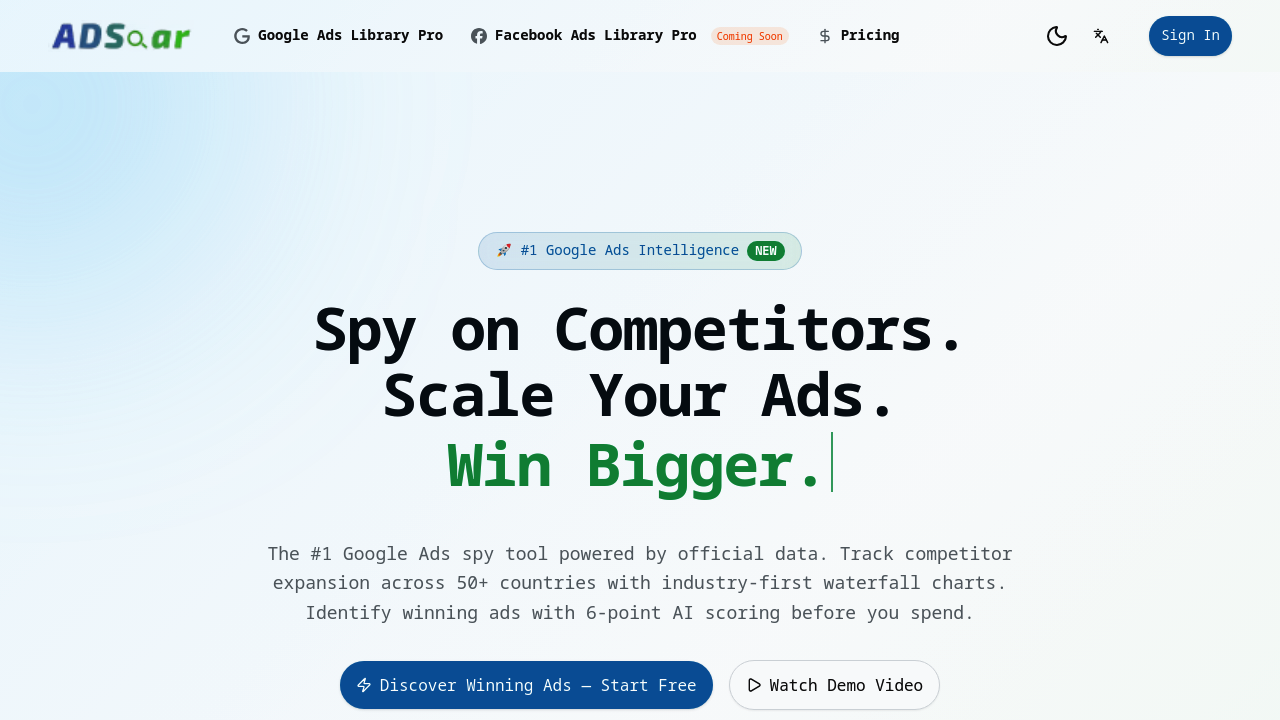
ADSoar pulls competitive intelligence from Google Ads campaigns across 50 countries using official data rather than estimates or scraped content

The system tracks what competitors are running, where they're spending, and how their campaigns evolve over time. This gives advertisers concrete data about market activity instead of guessing what works. The core…

ADSoar screenshot

ADSoar pulls competitive intelligence from Google Ads campaigns across 50 countries using official data rather than estimates or scraped content. The system tracks what competitors are running, where they're spending, and how their campaigns evolve over time. This gives advertisers concrete data about market activity instead of guessing what works.

The core technical approach centers on a 6-point AI scoring system that evaluates ads based on multiple performance indicators. When you search for competitor campaigns, the system assigns each ad a score that reflects its likelihood of being a winner. This scoring runs across six distinct dimensions, though the exact weighting methodology isn't disclosed. The output ranks ads so you can focus on what's actually performing rather than sifting through every variant a competitor tests.

Data visualization happens through several specialized views. Waterfall charts map how competitors expand geographically, showing the sequence of country rollouts. This matters because successful advertisers typically test in one market before scaling elsewhere, and the waterfall view makes that expansion pattern visible. Interactive heatmaps overlay spending concentration across regions. Campaign history timelines show when specific ads launched and how long they ran.

The keyword extraction pulls the top 20 terms from competitor headlines automatically. Instead of manually reading hundreds of ad copies, you get a ranked list of what language competitors emphasize. This feeds into copy strategy without the manual labor.

Search filtering operates on multiple dimensions like country, date range, ad format, and campaign type. Basic plans get standard filters while Pro and Business tiers enable advanced filtering options. The system uses a credit model where viewing ad details goes for one credit and loading additional pages of results also consumes credits. Basic allocates 3,000 credits monthly, Pro gives 15,000, and Business provides 45,000.

Historical data depth varies by tier. Basic subscribers see 30 days back, Pro extends to 90 days, and Business gets unlimited historical access. This creates a technical constraint where lower tiers can't analyze seasonal patterns or long-term strategy shifts. The data export functionality outputs to JSON or XLSX formats on Pro and Business plans, letting you pipe competitive intelligence into your own analysis tools.

ADSoar claims 247% average ROAS improvement, though this figure lacks context about sample size or measurement methodology. Coverage spans 50 countries, but the system doesn't clarify update frequency or data latency for each market.

Two features remain unreleased. TikTok Ads Pro and AI Ad Strategy Analysis both show as coming soon, which means current capabilities don't extend to TikTok competitive intelligence or automated strategic recommendations. Email support response times differ by plan: 48 hours for Pro, 24 hours for Business. Only Business subscribers get a dedicated account manager.

The comparison positioning targets official ad libraries that show one country at a time and require manual pagination. It also positions against full-featured SEO platforms that bundle ad intelligence with many other features at higher price points.

Pricing starts at $39 monthly for Basic, $89 for Pro, and $189 for Business. Annual billing cuts 30% off these rates while all plans include a 7-day money-back guarantee. The credit system limits how much data you can access within each billing period, which could become restrictive for agencies managing multiple client accounts or advertisers monitoring many competitors simultaneously.

ADSoar alternatives

See all →

Frequently asked

7 questions
Does ADSoar have a free trial or free plan?
ADSoar doesn't offer a free trial or freemium tier. Paid plans start at $39 monthly for the Basic tier with 3,000 credits, though all subscriptions include a 7-day money-back guarantee. This means you'll need to commit to a paid plan upfront but can request a refund within the first week if the tool doesn't meet your needs. Annual billing reduces costs by 30% across all tiers.
How does ADSoar's AI scoring system identify winning ads?
ADSoar uses a 6-point AI scoring system that evaluates ads across multiple performance dimensions to predict which creative executions are likely winners. The system analyzes competitor campaigns and assigns each ad a composite score based on these six factors, though the exact weighting methodology and specific metrics aren't publicly documented. This scoring runs automatically when you search competitor campaigns, ranking results so high-scoring ads surface first. The limitation is you're trusting a proprietary algorithm without visibility into how it weighs different signals or whether its training data matches your specific market.
What's the difference between ADSoar and Facebook Ad Library?
ADSoar aggregates data from official ad platforms like Google Ads, Meta Ads, and Instagram into a unified interface with competitive intelligence features that native ad libraries don't provide. Official libraries show one country at a time and require manual pagination through results, while ADSoar displays up to 40 ads per page across 50 countries simultaneously. The system adds keyword extraction that pulls the top 20 terms from competitor headlines, AI scoring to identify high-performing ads, and waterfall charts that visualize geographic expansion patterns. Native ad libraries give you raw transparency data but no analytical layer on top.
How many competitor ads can I analyze with ADSoar credits?
The credit system charges 1 credit per ad detail view and 1 credit each time you load more results beyond the initial 40 ads displayed. Basic plans allocate 3,000 credits monthly, Pro gives 15,000, and Business provides 45,000. This means a Basic subscriber could view details on roughly 3,000 individual ads per month, though the actual number decreases if you frequently paginate through search results. Agencies monitoring multiple competitors or running extensive competitive research will likely need Pro or Business tiers to avoid hitting credit limits mid-month.
Can ADSoar track TikTok ads from competitors?
TikTok Ads Pro functionality shows as coming soon but isn't currently available in any plan tier. Right now the platform pulls data from Google Ads, Facebook Ads, and Instagram using official platform sources. The roadmap indicates TikTok competitive intelligence will launch as a Business plan feature, though there's no public timeline for when it'll ship. If TikTok ad tracking is critical for your competitive research, you'll need to wait for that feature release or use alternative tools.
What historical ad data can I access on different ADSoar plans?
Historical data depth varies significantly by subscription tier, creating a technical constraint for analyzing long-term trends. Basic plans limit you to 30 days of historical campaign data, Pro extends to 90 days, and Business provides unlimited historical access. This means Basic subscribers can't identify seasonal patterns or track how competitors adjusted strategy over quarters. The system uses official platform data rather than estimates, but lower tiers simply can't query beyond their historical window regardless of whether older data exists in ADSoar's database.
How do ADSoar's waterfall charts show competitor expansion strategy?
Waterfall charts visualize the geographic sequence of competitor campaign rollouts across ADSoar's 50-country coverage area. The visualization maps which markets a competitor entered first and the order they expanded into additional countries, revealing their testing and scaling pattern. This matters because successful advertisers typically validate creative and targeting in one market before replicating to others, and the waterfall view makes that expansion chronology explicit. The feature works alongside interactive heatmaps that show spending concentration, giving you both the timeline and intensity of competitor geographic strategy.

Traffic

Estimated monthly website visits · last 0 months

Not enough historical data for a chart yet.

Reviews (0)

Write review

No reviews yet. Be the first to share your experience.