
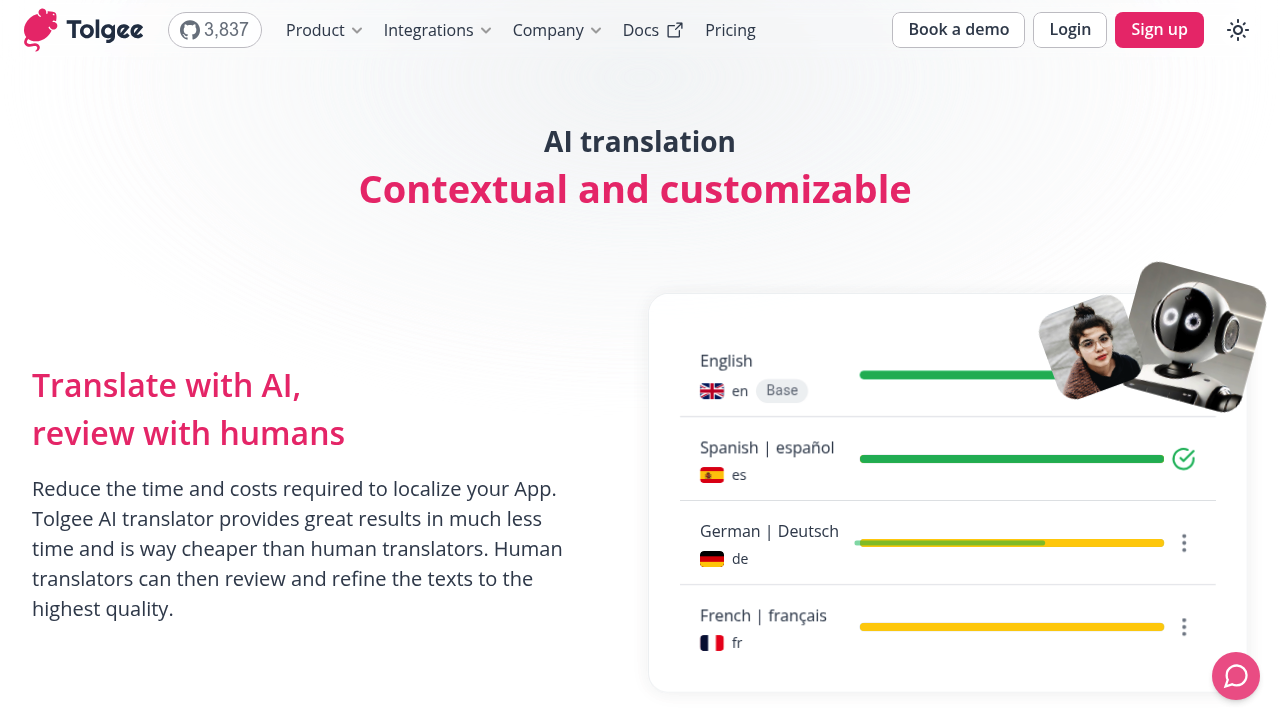
Developer localization tools usually promise AI magic but leave you fixing broken translations. Tolgee takes a different approach by treating AI as one part of a translation workflow, not the whole solution.
It pulls context directly from your app during development. When you integrate Tolgee into your codebase, it automatically collects information about where text appears, what's around it, and how it's used. Screenshots can feed into translations too. This contextual data trains the AI to understand what "submit" means in a button versus a form label.
You can customize the AI prompts that generate translations. The system uses variables for key data, screenshots, and context snippets. Project descriptions and language-specific notes further tune how the AI interprets your content. This matters because generic translation tools don't know if your app is a banking platform or a game.
The AI Playground proves particularly useful. Test prompts on actual translation data before running them across your entire project. Compare results from different models side-by-side. This prevents the common mistake of applying a bad prompt to thousands of strings and discovering the problem too late.
Tolgee supports multiple LLM providers and self-hosted models. Smart load balancing spreads requests across providers to dodge rate limits. If one provider hits capacity, translations continue through another. That's practical for teams with high translation volumes.
What doesn't work: It assumes you're already technical. Non-developers won't find this accessible. The context collection requires integration work upfront. If your app isn't structured to provide clean context, the AI advantage shrinks. The facts show 3,837 as some metric, but without clarity on what that number represents, it's hard to judge adoption or scale.
The human review workflow matters more than the marketing suggests. AI translations still need checking. Tolgee positions itself as cheaper than human translators and better than pure machine translation, but you're still reviewing output. The time saved depends on translation quality, which varies by language pair and content type.
Missing from the facts: any actual performance metrics. No accuracy percentages, no time savings data, no comparison numbers against other options. The claim about superior results lacks backing. Integration with GitHub, Slack, and Discord suggests developer-friendly tooling, but the depth of these connections isn't specified.
For development teams already managing localization in code, the contextual approach makes sense. For marketing teams wanting quick translations without technical setup, this isn't right. The value scales with how much context you can feed it.