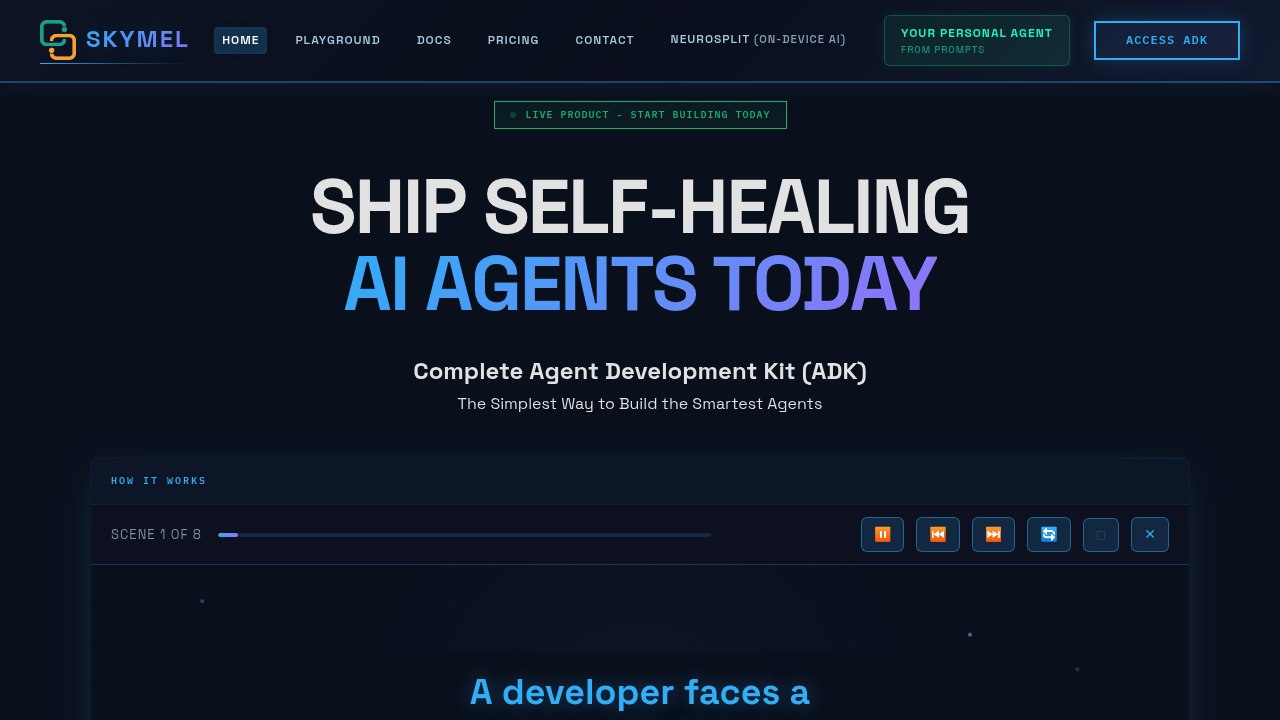
Skymel ADK takes a different approach to building AI agents by combining multiple specialized models instead of relying on a single large language model. This system uses what it calls a multi-component brain architecture. Each component handles specific reasoning tasks. LLMs process natural language. Machine learning models ground predictions in data. Causal models enforce logical consistency. External memory provides context across executions.
The core technical mechanism is the ECGraph execution engine. When you describe a task in natural language, the system generates a dynamic workflow represented as a directed acyclic graph. Each node in the DAG represents a specific operation. The engine routes different parts of the workflow to whichever model type makes sense for that step. This happens at runtime rather than using pre-built templates.
The workflow generation adapts per task. Two similar requests might produce different execution plans based on context and available resources. The system monitors token usage during execution and can adjust strategies mid-workflow to prevent cost overruns. When errors occur, the system attempts automatic recovery without requiring manual intervention.
The architecture specifically targets three common agent failures. Hallucinations get reduced because causal models check whether LLM outputs follow logical rules. Infinite loops get caught by the DAG structure since cycles can't exist in acyclic graphs. Goal drift gets prevented by having the causal layer verify that each step still aligns with the original objective.
Learning happens continuously. After each execution, the ML models update based on what worked and what didn't. Skymel ADK claims standard LLM-only agents show zero percent improvement after failures because they lack this learning mechanism. They're just predicting statistical patterns without understanding cause and effect.
The low-code approach means you don't write orchestration logic. You describe what you want. The system figures out how to route data between models. Developers can integrate database APIs and external services. Skymel ADK connects with major language model providers through their APIs.
Resource monitoring tracks execution in real time. You can see which models are being invoked and how many tokens each operation consumes. This visibility helps identify bottlenecks or expensive operations before they become problems.
The technical trade-off is complexity. Running multiple model types requires more infrastructure than a single LLM call. The dynamic workflow generation adds computational overhead compared to static pipelines. The causal reasoning layer needs formal logic rules defined for your domain, which takes upfront work. Skymel ADK assumes you're building agents that need this level of control rather than simple chatbot interfaces.