
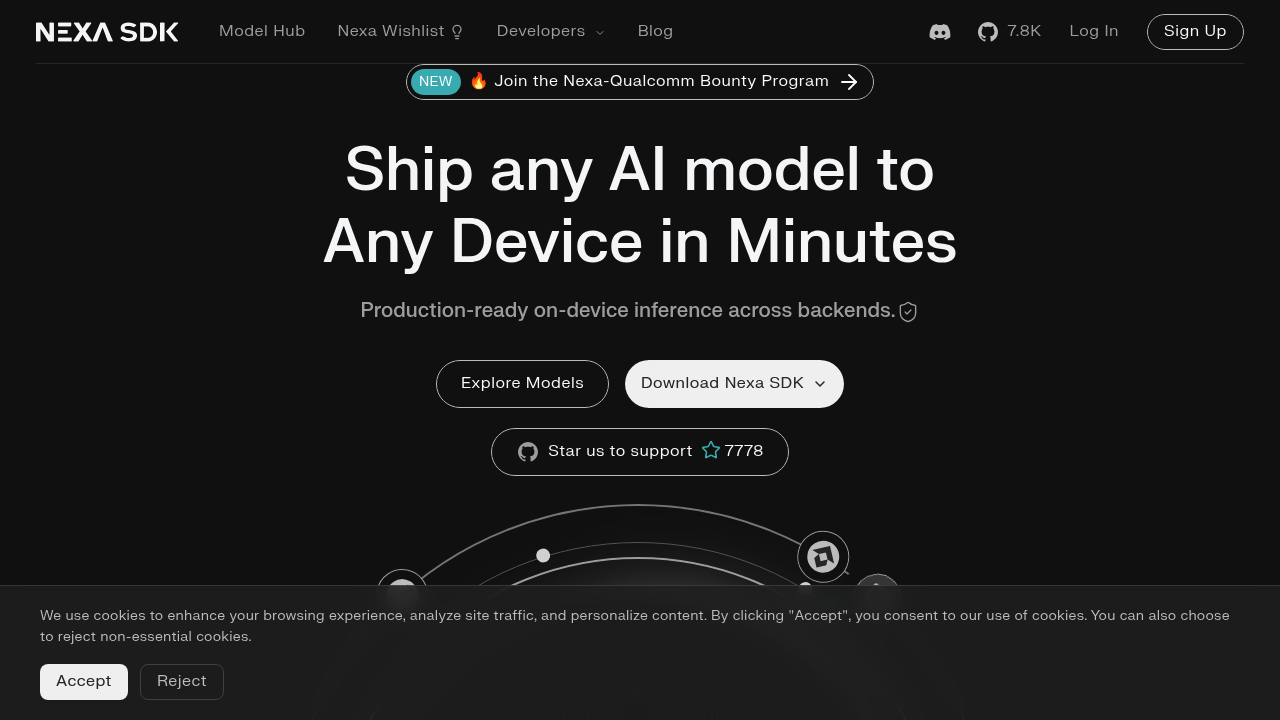
The SDK handles on-device AI inference by routing model execution through three distinct hardware backends. When you initialize a model, it automatically detects available computational resources and assigns workloads to NPU, GPU, or CPU based on hardware capabilities and model requirements. This abstraction layer means the same code runs across different platforms without modification.
Setup takes under 60 seconds. One command in terminal loads and executes models.
The system supports GGUF and MLX model formats, which are quantized representations that reduce memory footprint while maintaining inference quality. Models run entirely on-device with no server calls. This architecture keeps data local and eliminates network latency but requires sufficient device memory and processing power for larger models.
The SDK includes specialized pipelines for different task types. Real-time object detection processes video frames through convolutional layers optimized for edge devices. The multilingual translation system handles neural machine translation across language pairs without cloud dependencies. Visual search embeds images into vector space for similarity matching. OCR extracts text from documents and natural scenes using recognition models tuned for mobile hardware.
Speech recognition converts audio to text on-device through automatic speech recognition models. Text reranking scores document relevance without external APIs. Vision-language-action models combine visual input with language understanding for robotics applications. Embedding models generate vector representations for semantic search.
Platform support spans CLI tools, Python libraries, Android applications, and Linux systems. The Android implementation's particularly relevant since it enables mobile deployment without backend infrastructure.
The technical constraint is hardware dependency with performance scales directly with device capabilities. NPU acceleration delivers the best efficiency but isn't available on all devices. CPU fallback works universally but runs slower. Model size directly impacts memory requirements and inference speed. Larger models won't run on resource-constrained devices regardless of optimization.