
Mirai logo

Mirai

Developers building AI applications for Apple devices face a persistent challenge: running sophisticated models locally without sacrificing speed or draining device resources

Mirai tackles this with an inference engine built specifically for Apple Silicon, converting and optimizing models from Hugging Face with a single line of code. The system taps directly into the Neural Engine available…

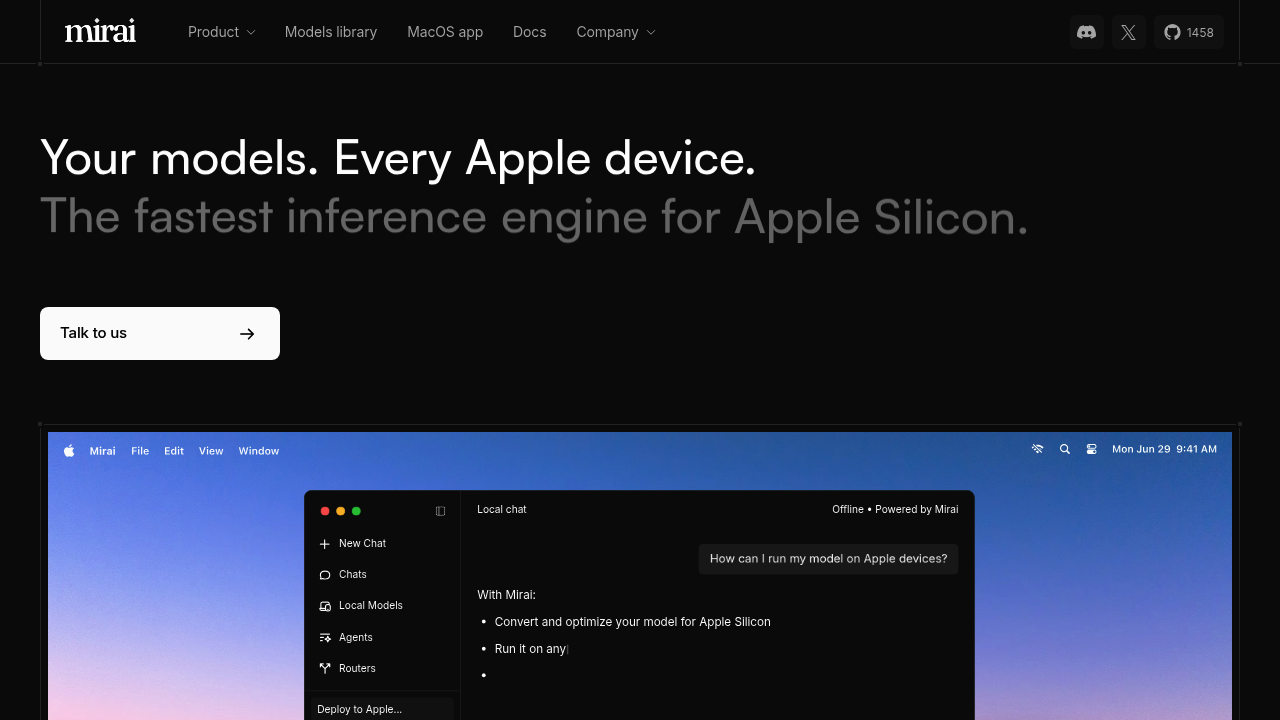
Mirai screenshot

Developers building AI applications for Apple devices face a persistent challenge: running sophisticated models locally without sacrificing speed or draining device resources. Mirai tackles this with an inference engine built specifically for Apple Silicon, converting and optimizing models from Hugging Face with a single line of code. The system taps directly into the Neural Engine available across Mac, iPhone, and iPad hardware, utilizing unified memory bandwidth that reaches 273 GB/s on M4 chips.

Performance numbers tell the story. Qwen3-0.6B hits 147 tokens per second on M4 Max hardware. The engine squeezes this speed from Apple's 38 TOPS Neural Engine on M4 devices, making it faster than competing on-device runtimes according to the company's benchmarks. Model quantization maintains quality while shrinking size, and cross-device compatibility means the same optimized model runs on phones, tablets, and computers without reconfiguration.

The offline-first architecture matters for specific scenarios. Translation works without internet connection. Classification and intent detection happen on-device. Real-time text generation processes locally. Summarization and extraction don't ping servers. This setup delivers two benefits developers care about: user privacy through local processing and cost reduction by avoiding cloud API calls for every inference request.

Mirai does not force an all-or-nothing approach. The routing system lets applications split work between device and cloud infrastructure, choosing local processing for speed-sensitive tasks and cloud for heavier workloads. This flexibility addresses the reality that some models remain too large for mobile devices while others run comfortably on modern Apple hardware.

The current version (0.1.18) handles text generation, summarization, extraction, classification, intent detection, and translation. Speech capabilities appear on the roadmap. Speech-to-text, text-to-speech, speech-to-speech, and voice commands are marked as coming soon. Benchmarking tools ship with the engine, letting developers measure actual performance on their target hardware before committing to deployment.

The target user works in development shops building native Apple applications where inference latency matters or where privacy requirements prohibit sending user data to external servers. Companies reducing cloud API runs by shifting inference to user devices also fit the profile. The Hugging Face integration simplifies the path from open-source models to production deployment on Apple hardware.

Real-time performance depends on model size and device capabilities. Smaller models fly on recent hardware. Larger models still benefit from optimization but will not match cloud GPU speeds. The system assumes Apple Silicon, so Intel Mac support doesn't exist.

Mirai alternatives

See all →

Frequently asked

6 questions
Is Mirai free to use for developers?
Mirai operates on a freemium model, though the specific details of what's included in free versus paid tiers aren't publicly documented in current materials. Developers can access the inference engine and model conversion tools, but the exact limitations on free usage remain unclear from available information. The system provides API access and mobile app capabilities, suggesting commercial deployment options exist beyond basic development use. Companies should contact the team directly to understand pricing for production deployments at scale.
How fast does Mirai run AI models compared to other on-device solutions?
Mirai claims to run models faster than any other on-device runtime for Apple Silicon, with concrete benchmarks showing Qwen3-0.6B reaching 147 tokens per second on M4 Max hardware. The engine achieves this by tapping directly into Apple's Neural Engine, which delivers 38 TOPS on M4 chips, combined with unified memory bandwidth of 273 GB/s. Performance scales with device capability, so recent M-series Macs outpace older hardware and mobile devices. The actual speed you'll see depends heavily on model size and which Apple device you're targeting, but the architecture extracts more from Apple Silicon than competing runtimes according to the company's testing.
Can Mirai run AI models completely offline on iPhone and iPad?
Mirai runs entirely offline once models are converted and deployed to devices, working across iPhone, iPad, and Mac without internet connectivity. Translation, classification, intent detection, summarization, and text generation all process locally without server calls. The system's routing capability lets developers choose which inference requests stay on-device and which go to cloud infrastructure, useful when balancing performance needs against device limitations. This offline-first approach addresses privacy requirements for applications handling sensitive user data and eliminates cloud API costs for every inference request.
What AI models work with Mirai?
Mirai converts models from Hugging Face with one-line commands, handling the optimization and quantization automatically for Apple Silicon deployment. The system currently supports text generation, summarization, extraction, classification, intent detection, and translation tasks. Speech capabilities including speech-to-text, text-to-speech, speech-to-speech, and voice commands appear on the roadmap as coming soon features. Model compatibility depends on whether the architecture can be optimized for Apple's Neural Engine, and size constraints matter since mobile devices have less memory than Mac hardware.
Does Mirai require Apple Silicon or can it run on Intel Macs?
Mirai is built specifically for Apple Silicon and requires M-series chips to function, with no Intel Mac support mentioned in any documentation. The entire architecture depends on features unique to Apple Silicon like the Neural Engine and unified memory bandwidth that Intel Macs lack. Performance claims reference M4 and M4 Max chips specifically, showing the system targets recent Apple hardware. Developers working with older Intel-based Macs would need to test on actual Apple Silicon devices or use cloud infrastructure routing for inference tasks.
What are the limitations of running large language models on-device with Mirai?
Device memory constrains which models can run locally through Mirai, since even quantized versions of large language models require substantial RAM that mobile devices may not have. Performance for bigger models won't match cloud GPU speeds regardless of optimization, though Apple Silicon punches above its weight compared to other mobile processors. The routing system exists specifically to address this limitation, letting applications offload heavier inference to cloud infrastructure while keeping lighter tasks on-device. Speech capabilities remain in development, so applications needing voice features can't rely on Mirai's on-device processing yet.

Traffic

Estimated monthly website visits · last 8 months

26K visits/mo
Monthly visits
26K
↓ 37.4% MoM
Global rank
#1,099,157
US #730,128
Category rank
#47
AI Developer Tools
41.5K 33.7K 26K 18.2K 10.5K Dec 2025: 10.5K visits Dec 2025 Jan 2026: 16K visits Jan 2026 Feb 2026: 13.9K visits Feb 2026 Mar 2026: 24K visits Mar 2026 Apr 2026: 30.5K visits Apr 2026 May 2026: 33.1K visits May 2026 Jun 2026: 41.5K visits Jun 2026 Jul 2026: 26K visits Jul 2026

Reviews (0)

Write review

No reviews yet. Be the first to share your experience.