
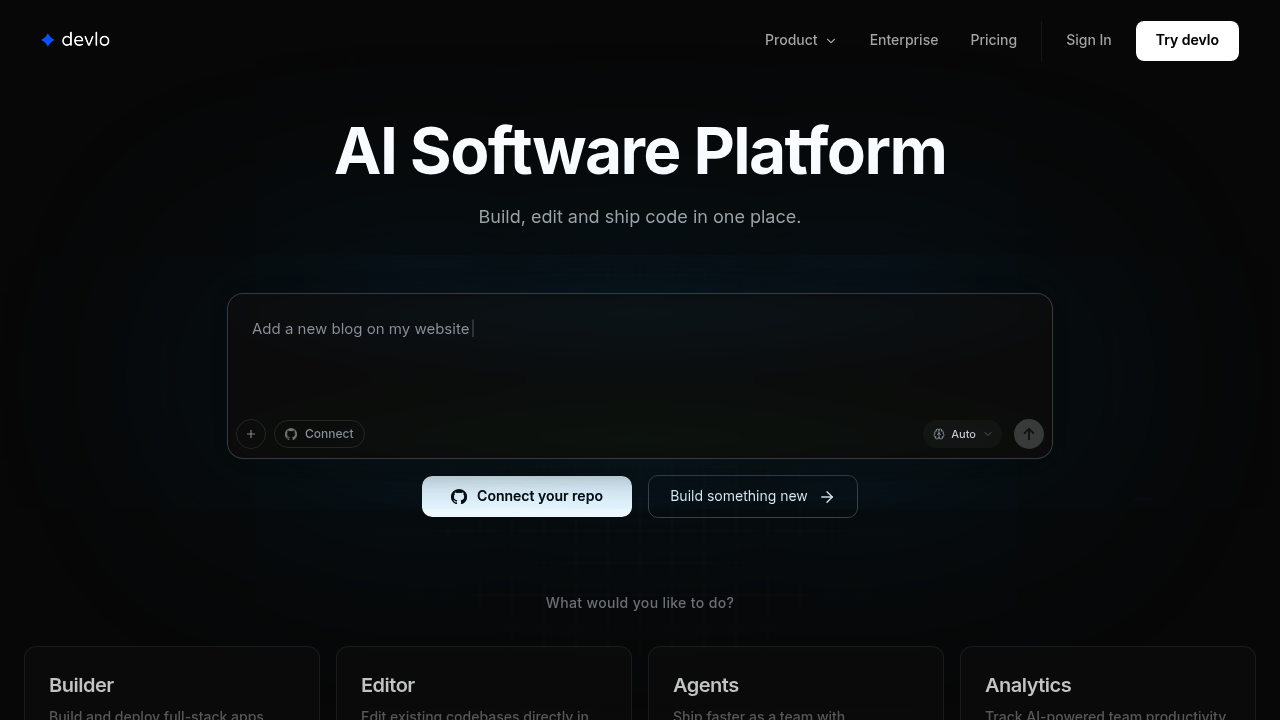
Engineering teams get a browser-based system that handles code from multiple angles. Devlo brings AI agents, a no-code builder, and codebase chat into one interface. The pitch: write, edit, and ship code without leaving your browser.
The autonomous agents handle specific jobs. A Reviewer agent checks pull requests. A Coder agent writes features. Custom agents trigger on issues, tickets, PRs, comments, or schedules. There's a Triage Bot, Security Guard, Debug Agent, and Code Reviewer. Each one works independently based on what you set up.
The no-code builder creates full-stack apps from scratch while production-ready templates speed things up. For existing codebases, the browser editor lets you make changes and generate pull requests directly. Live edits apply to frontend apps immediately. The codebase chat answers questions and builds features through conversation.
Integration with Github and Jira converts issues and tickets straight to pull requests. Task delegation happens inside PRs. Devlo claims to cut ticket resolution time in half and slash review time by over 60%. It records performance metrics and adjusts over time, ranking as a SWE-Bench leader.
Team productivity analytics track how agents perform. The AI Model Picker switches between different models depending on the task. QA testing and Instant Deploy handle the final steps before production. Auth0 handles authentication.
What's missing matters. No mobile app. No browser extension. The facts don't show a free tier, so testing before committing isn't guaranteed. Devlo targets teams already using Github and Jira, which narrows the audience. If your workflow runs on different tools, you're stuck.
The SOC-2 Type-2 compliance and zero data retention policy address security concerns. But the initial adjustment looks steep. You're managing multiple agent types, setting custom triggers, and coordinating between no-code building and direct code editing. Small teams might find that overhead heavy.
The interface consolidates a lot of functions. That's either convenient or cluttered depending on your tolerance for feature density. Some developers want separate tools for separate jobs. Devlo bundles everything together.
The autonomous agents work best when you define clear triggers and boundaries. Vague setups produce vague results. The codebase chat needs specific questions to generate useful code. The quality depends heavily on how well you frame requests.
For teams drowning in pull request backlogs and Jira tickets, the time-saving claims check out on paper. Real performance depends on codebase complexity and how much setup you invest upfront. Devlo learns, but that means early results won't match later ones.