
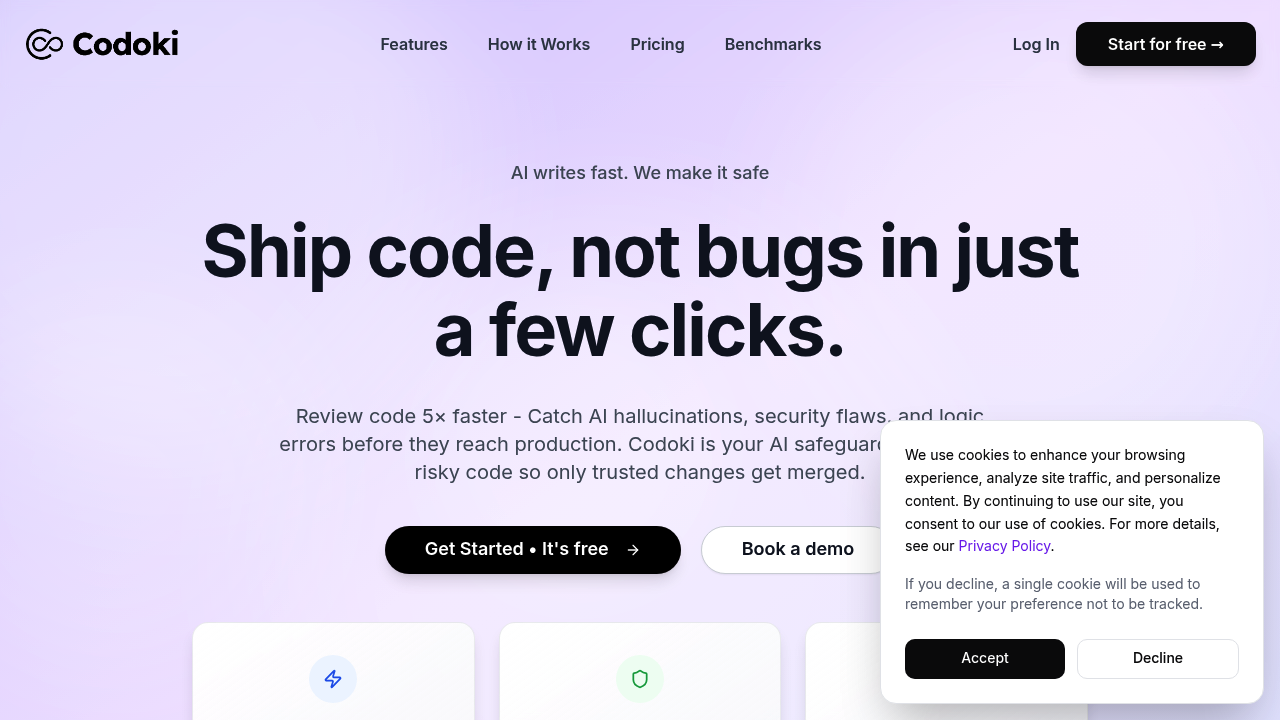
Code review automation that catches what human reviewers miss. Pull requests get analyzed through a four-step process combining static analysis with runtime validation inside an ephemeral sandbox environment. Codoki claims a 92% issue detection rate while cutting review noise by 70% and speeding up the overall review process by five times.
Every pull request receives a single structured comment instead of scattered feedback. That comment includes a summary of changes, critical risks that must get fixed before merging, a suggested patch when applicable, and a clear merge recommendation. The analysis runs completely automated, from initial scan through final verdict.
The sandbox component sets Codoki apart from static-only tools. Code doesn't just get scanned for patterns. It actually runs in a secure isolated environment that mirrors the production tech stack. This catches runtime errors, logic flaws, and behavioral issues that static analysis alone would miss. The sandbox spins up, validates the code, then destroys everything immediately. User code never persists and never trains the underlying models. All data transmission happens over end-to-end SSL encryption.
Static analysis covers language-specific checks for bugs, security vulnerabilities, and what Codoki calls AI hallucinations. These checks adapt to different programming languages rather than applying generic rules. Dynamic analysis then validates behavior during actual execution. Findings only surface when confidence thresholds get met, which explains the reduced noise claim. Style nitpicks and duplicate warnings stay filtered out.
Team memory builds over time. The system learns patterns from past reviews and enforces style guides automatically. Custom rules can get defined per repository or specific file paths. This means different standards for frontend versus backend code or stricter security checks for payment processing modules. Test intelligence analyzes existing test coverage and flags gaps. When critical code paths lack adequate tests, Codoki proposes concrete test cases rather than vague suggestions.
Beyond the core review engine, Codoki generates automatic PR descriptions and offers a dedicated review portal. The unified inbox consolidates pull requests across repositories. Analytics track review patterns, common issues, and team performance metrics. Integrations connect to Jira for issue tracking, Linear for project management, and Slack for notifications.
The Starter plan gives teams 10 AI-powered reviews monthly at no cost, plus automatic descriptions, the review portal, unified inbox, and analytics access. Solo costs $7.99 monthly and raises the limit to 150 reviews with priority queue access, custom rules, and full integration support for private and public repositories. Pro runs $12.50 monthly when billed annually or $14.99 month-to-month, removing review caps entirely and adding unlimited custom rules. Enterprise pricing gets customized and includes priority support, onboarding assistance, higher usage limits, flexible contracts, and early feature access. A 14-day money back guarantee covers paid plans.
Review limits constrain the lower tiers directly. Ten reviews monthly works for small projects or occasional validation. One hundred fifty reviews suits individual developers or small teams. Larger organizations hitting those ceilings need Pro tier or higher.
Software developers working solo benefit from catching issues before human review. Development teams gain consistency across reviewers and faster merge cycles. Organizations reduce the burden on senior developers who'd otherwise spend hours reviewing junior code. Freelancers can validate work before client delivery. Anyone shipping code through pull requests fits the use case, though teams with high PR volume get the most value from unlimited plans.