
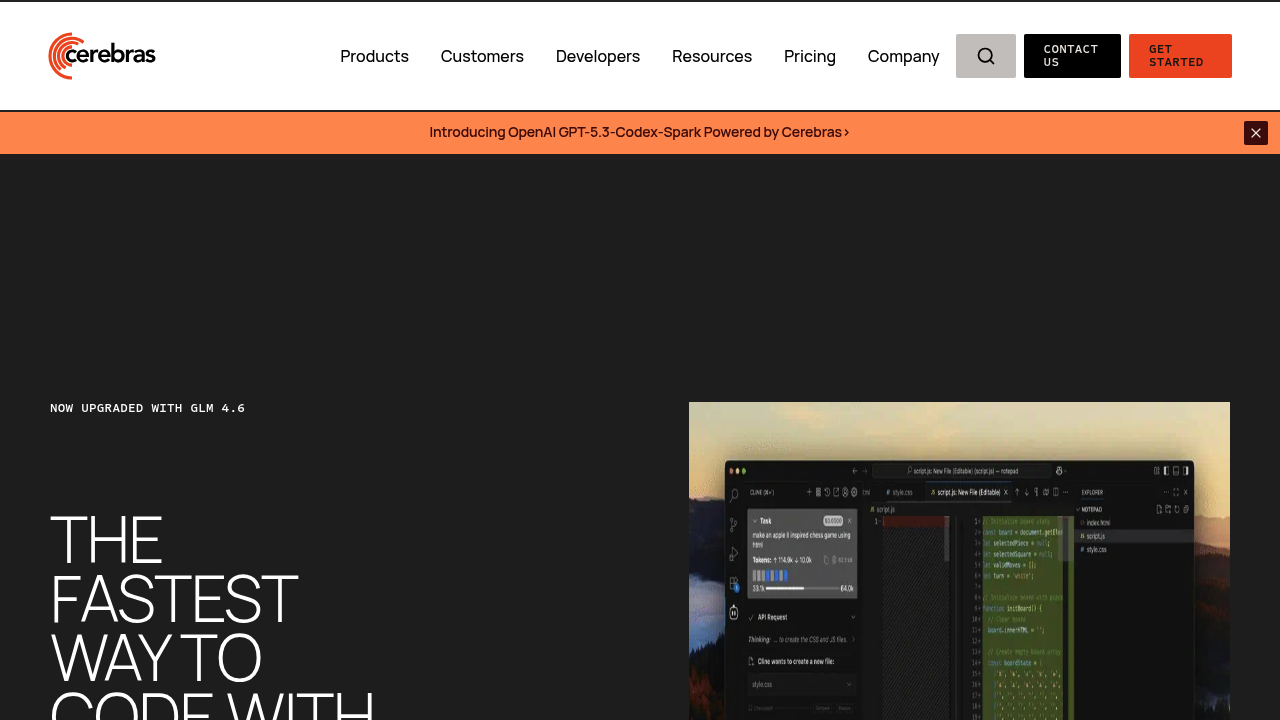
CerebrasCoder runs GLM 4.6, an open coding model, at speeds exceeding 1,000 tokens per second. This service is built on Cerebras inference infrastructure, which pushes throughput high enough that code generation feels nearly instantaneous during active development sessions. GLM 4.6 ranks first on the Berkeley Function Calling Leaderboard for function calling accuracy, which matters when the model needs to invoke functions, parse APIs, or interact with external systems during code generation.
The technical pipeline works through standard API calls. You connect any editor that accepts API keys and route requests through CerebrasCoder's endpoints. The model handles high-context completions, meaning it can process large codebases or lengthy context windows without degrading performance. This matters for refactoring tasks or when working across multiple files where the model needs to understand relationships between components.
Function calling capabilities let the model execute functions during generation. If you're building agentic workflows where code needs to call external APIs, query databases, or trigger other services, the model can handle those operations within the generation process itself. The Berkeley leaderboard ranking suggests it's reliable at parsing function signatures and generating correct invocations.
Web development performance sits on par with Sonnet 4.5 according to the provided benchmarks. That means for frontend work, backend APIs, or full-stack projects, output quality should match what you'd expect from top-tier commercial models. The model's open, which has implications for transparency and potential self-hosting down the line, though CerebrasCoder handles the infrastructure.
Integration works through Cline, RooCode, OpenCode, and Crush. Any editor accepting API keys can connect. You're not locked into proprietary software. The workflow's straightforward: configure your editor with the API key, point it at CerebrasCoder's endpoints, and the editor handles the rest. This means you can use your existing setup without switching environments.
The free plan offers limited tokens and requests. It's functional for testing Cerebras inference speeds or building small demos, but token restrictions mean you'll hit limits quickly during active coding. The Pro plan, listed at fifty dollars monthly, provides up to 24 million tokens daily. That translates to roughly three to four hours of continuous coding before hitting the cap. The plan's marked as coming soon, so availability isn't immediate. The Max plan runs two hundred dollars monthly with 120 million tokens daily, targeting full-time developers running heavy workflows, IDE integrations, or multi-agent systems.
Token limits are real constraints. Pro's 24 million daily cap means if you're coding intensively for extended periods, you'll exhaust your allocation. The free tier's restrictions make it impractical for anything beyond experimentation. These aren't soft limits. Once you hit them, generation stops until the next cycle.
The model's strength is speed. Thousand-plus tokens per second means responses appear almost as fast as you type. For iterative development where you're generating, reviewing, and regenerating frequently, latency nearly disappears. Function calling performance matters for agentic use cases where reliability in function invocation prevents cascading errors. The context window size covers working across large codebases without artificial chunking.
Limitations center on token budgets and plan availability. Pro's not launched yet. Free's too restricted for serious work. Max costs more than many competing services. Speed's impressive, but if you exhaust your daily tokens mid-session, you're stuck. This service doesn't offer team features or collaborative capabilities based on available information.