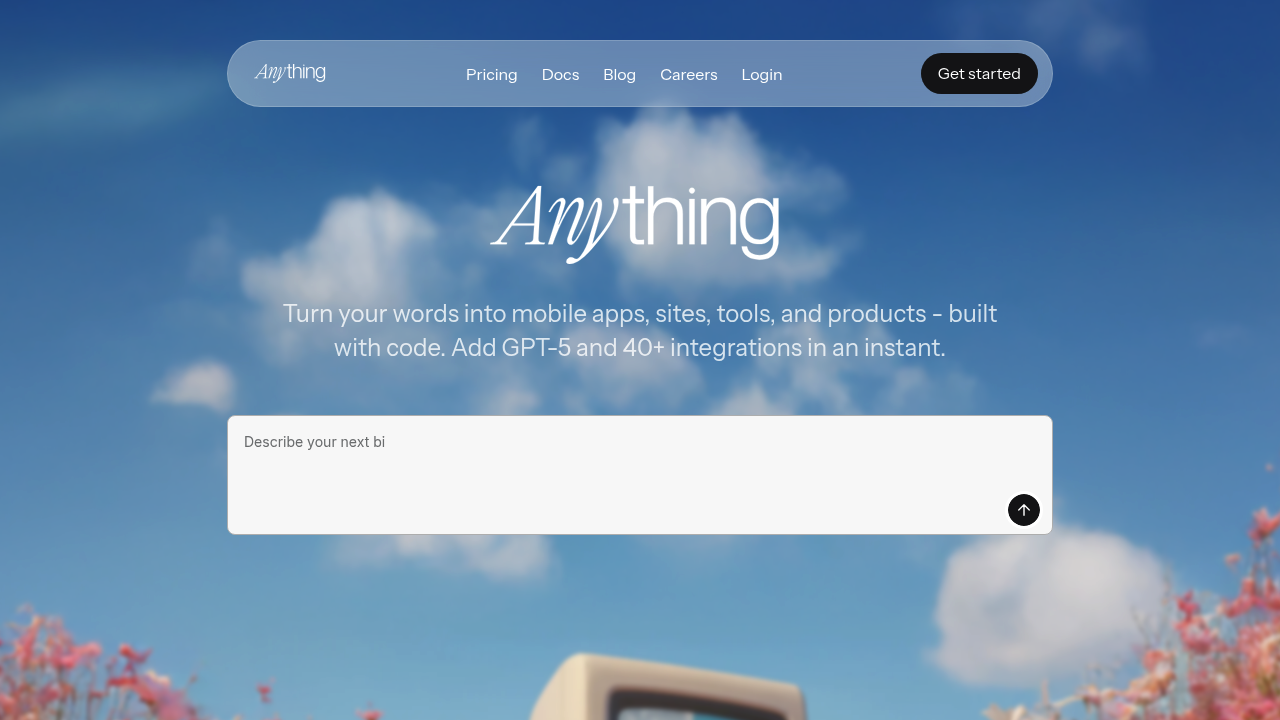
Anything takes a natural language description and converts it into production-ready code for mobile apps, websites, and web applications. You describe what you want to build in plain English, and the system generates the actual source code, database schema, authentication flows, and deployment configuration. It's not a template builder or drag-and-drop interface. The output is real code.
The technical architecture works across iOS, Android, and web platforms from a single description. When you request an app, the system uses a combination of frontier and custom AI models to reason through the implementation. It plans the data structure, API endpoints, user interface components, and business logic before generating code. The web search capability pulls in documentation for hundreds of APIs and libraries, so the generated code can integrate external services without you manually configuring them.
For projects that grow beyond 100,000 lines of code, the system automatically refactors the codebase. This addresses a common problem with AI-generated code where large projects become unwieldy. The refactoring maintains functionality while restructuring the code for better performance and maintainability. Automatic error detection runs continuously, identifying bugs and fixing them without manual intervention.
Each app gets a built-in Postgres database with over 1GB of storage. No configuration needed while the database includes both development and production environments. File storage handles images, video, audio, and PDFs without requiring separate cloud storage services. For payments, Stripe integration works with both subscription billing and one-time transactions. The authentication system includes email and password login plus social auth through Google, Facebook, and X.
Deployment happens with one click for the App Store. Web apps can use a custom domain or get a free hosted domain. The cross-platform architecture means the same backend serves both mobile and web clients, reducing the amount of code to maintain.
This service includes over 40 integrations spanning payment processors, email services, automation tools, and mapping services. Image generation creates app assets directly within the builder. Real-time exploration lets you interact with the app as it's being built, seeing updates immediately without recompiling.
Over 500,000 builders use this system. Many are non-technical founders testing product ideas without hiring developers. The system handles apps built on hundreds of different APIs and libraries, all accessible through natural language requests.
The free tier provides the 1GB database per app and free domain hosting for web applications. This makes it possible to launch a functional product without upfront costs.
The technical limitation is inherent to AI-generated code. While the system refactors large projects automatically, there's still a ceiling on complexity. Apps with highly specialized algorithms or unusual architecture patterns might require manual code adjustments. The automatic error fixing works well for common bugs but won't catch every edge case in complex business logic.
The data pipeline from description to deployed app involves multiple AI models working in sequence. First, a planning phase breaks down your request into technical requirements. Then code generation creates the implementation. Error detection scans the output. Finally, deployment automation handles the infrastructure setup. Each step feeds into the next without manual handoffs.