
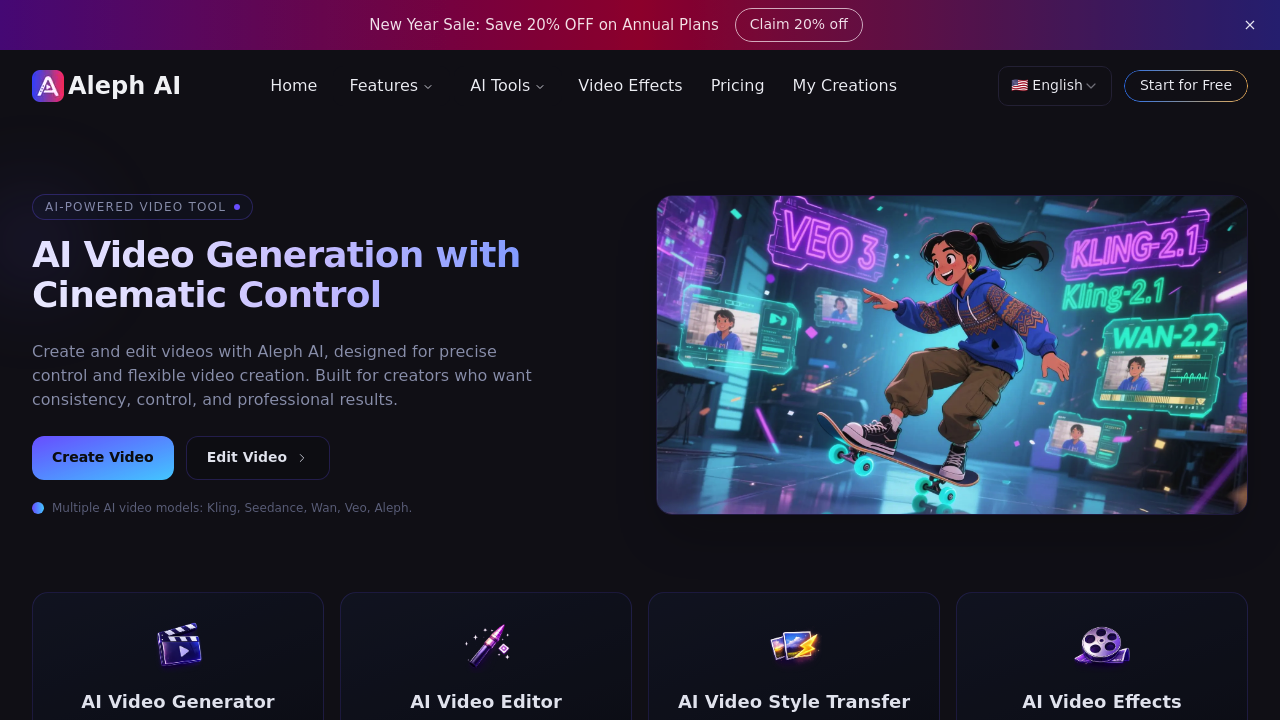
AlephAI.app generates and edits videos through text prompts, uploaded images, or pre-built templates. This service routes requests through five different AI video models: Kling, Seedance, Wan, Veo, and its own Aleph model. Users describe what they want in natural language, and the system interprets these commands to produce video output rather than requiring traditional timeline editing or keyframe manipulation.
The text-to-video pipeline accepts prompts up to 2000 characters that describe scenes, actions, camera movements, and visual styles. Image-to-video conversion takes static JPG, PNG, or WEBP files under 10MB and animates them based on text instructions. Each generation consumes 8 credits from the user's account balance, with the system supporting multiple concurrent jobs. Paid plans allow 4 running jobs simultaneously.
Output configurations include three aspect ratios (1:1, 9:16, 16:9, 3:4, 4:3) and three resolution tiers (480P, 720P, 1080P). Duration settings range from 4 to 12 seconds per generation, and all videos export as MP4 files. The system doesn't apply watermarks on paid tiers, and commercial-use permissions come standard with subscription plans.
The video editor operates differently from conventional editing software. Instead of dragging clips or adjusting parameters on sliders, users type commands to modify existing footage. This includes changing camera angles, adding or removing objects from scenes, transforming environments, and applying style transfers. The AI interprets these instructions and re-renders the affected portions while maintaining consistency with unchanged elements.
Style transfer functionality applies artistic looks or cinematic aesthetics to existing video content. The effects library includes preset enhancements that can be combined with custom text prompts for more specific results. AlephAI handles object manipulation by identifying elements in the frame and modifying them based on natural language descriptions.
Camera control works through text instructions rather than manual repositioning. Users can request new perspectives, angles, or movements, and the system generates these views from the existing scene data. This differs from traditional 3D rendering where camera paths must be manually defined.
The credit system operates on a consumption model. The Hobby plan gives you 300 credits monthly (approximately 30 videos at 8 credits per generation), Basic offers 800 credits (80 videos), Pro includes 2400 credits (240 videos), and Max provides 5000 credits (500 videos). Credits expire based on the plan's history retention period, which ranges from 30 days on Hobby to 360 days on Max. Unused credits roll over within these windows.
Free trial access includes all Standard plan features without requiring payment information upfront. Paid plans start at $7.92 monthly when billed annually, representing a 20% discount over monthly billing. Higher tiers include priority queue access, which reduces generation wait times during peak usage periods.
Technical constraints include the 10MB image upload limit and 2000-character prompt restriction. Image inputs must use specific formats, and the system won't accept other file types. Credits don't persist indefinitely, they expire according to each plan's history retention schedule. Generation time varies based on queue position and selected model, with paid plans receiving priority processing.
AlephAI doesn't offer API access for programmatic video generation. No integrations with external platforms or services are available. The multi-model approach means users can switch between different AI backends depending on which produces better results for specific prompts, though the system doesn't expose detailed technical specifications for how each model differs in its processing methodology.